
Article
Methylene blue in analytical testing and environmental research
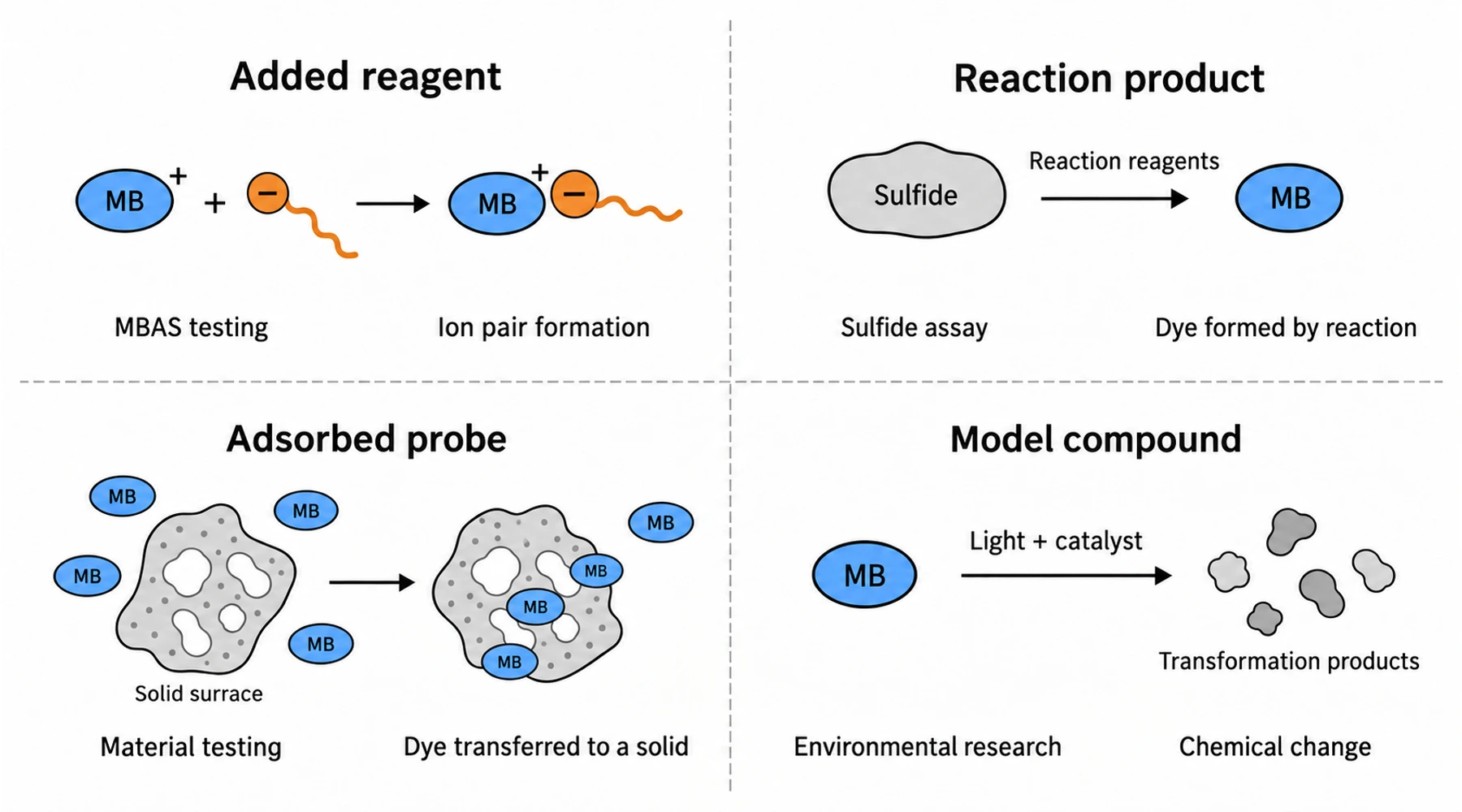
Methylene blue appears in many laboratory methods, but it does a different job in each. In one water test, the laboratory adds the dye to detect surfactants. In another, the reaction produces the dye from sulfide. In an adsorption experiment, the laboratory measures how much added dye leaves the solution.
These methods can all end with a blue liquid and a spectrophotometer reading. Their results are not interchangeable. Before selecting a method, identify the sample, the property being measured, and the role of methylene blue in generating the signal.
Find the method that answers your question
The following index separates the principal analytical and environmental applications. “Measured property” describes the result the experiment can support, provided its controls and calibration are valid.
| Question and method | Sample | Role of methylene blue | Measured property and interpretation limit |
|---|---|---|---|
| MBAS surfactant testing | Water or wastewater | Added reagent forming extractable ion pairs | Methylene blue active substances; does not identify every surfactant individually. |
| Sulfide colorimetry | Water or waste samples covered by the method | Dye formed during the analytical reaction | Method-defined sulfide concentration; sample oxidation and volatilization can cause loss. |
| Activated-carbon adsorption tests | Dye solution contacted with a known solid mass | Adsorbate measured before and after contact | Dye uptake under specified conditions; does not establish universal filtration performance. |
| Clay and aggregate testing | Defined soil, aggregate, or filler fraction | Probe adsorbed by the specimen | Method-specific methylene blue value; sample fractions affect comparisons. |
| Photocatalytic degradation experiments | Dye solution and catalyst under defined illumination | Model compound undergoing removal or transformation | Color loss or chemical change, depending on measurements; color loss alone does not establish mineralization. |
| Polymer and membrane experiments | Membrane, film, or composite exposed to dye solution | Transport or sorption probe | Dye passage, retention, or uptake in the tested arrangement; retention can include adsorption. |
| Electrochemical sensors | Electrolyte or a validated sample matrix | Redox reporter | Electrical response related to a target through the sensor's recognition and calibration system. |
| Package dye-ingress testing | Filled or suitably simulated closed packages | Detectable tracer outside the package | Detectable ingress under the test conditions; not a direct sterility measurement. |
| Tashiro mixed-indicator titration | Solution undergoing a specified acid-base titration | Component of a mixed indicator | Formulation-specific endpoint color; not methylene blue's redox transition alone. |
A reagent and a reaction product require different calibrations
In MBAS testing, methylene blue reacts with anionic surface-active substances to form species that are extracted into chloroform. The EPA Method 425.1 summary in NEMI describes measuring the color of that extract. The analytical result concerns substances that respond to this procedure, rather than a complete inventory of detergents in the water.
The sulfide method reverses the dye's role. In EPA Method 376.2, sulfide reacts with dimethyl-p-phenylenediamine in the presence of ferric chloride to generate methylene blue. The method covers specified water and waste matrices and excludes acid-insoluble sulfides. It also warns that aeration can remove sulfide or introduce oxygen that changes it into an unmeasurable form.
This distinction affects calibration. Standards must represent the analyte and pass through the relevant chemistry. A bottle of blue solution is not automatically an appropriate substitute for a sulfide standard or a surfactant standard. Sample handling also belongs to the measurement: a precise instrument cannot recover analyte lost before analysis.
Material tests measure behavior under chosen conditions
An adsorption experiment commonly starts with a known dye concentration and a known amount of solid. After contact, the laboratory separates the solid and measures residual dye in the liquid. The concentration difference, solution volume, and solid mass provide an apparent uptake per unit mass, subject to a valid mass balance.
A comparative study of methylene blue adsorption on several carbons found that removal depended on initial concentration, particle size, contact time, adsorbent amount, and pH. Those dependencies explain why a large removal percentage is insufficient for ranking materials. One experiment may simply have used much more carbon. Use the guide to comparing adsorbent capacity and kinetics to check whether studies tested comparable conditions.
Aggregate testing uses adsorption for a different purpose. ASTM C1777-20, listed as active by ASTM, reports dye uptake per gram of fine aggregate or mineral filler. The value reflects the quantity and characteristics of clay minerals in the specimen.
The standard explicitly warns that results from C1777, AASHTO T 330, and EN 933-9 can differ substantially even when their units match. Among the reasons are different tested particle-size fractions. A numerical limit taken from one method cannot simply be transferred to another.
Environmental research needs more than a fading blue color
Methylene blue is useful as a model compound because its optical signal is convenient to follow. However, several processes can reduce that signal. Dye can move onto a solid surface, change into another chemical form, or undergo more extensive breakdown.
An early study of the photocatalytic degradation pathway investigated methylene blue in titanium-dioxide suspensions under ultraviolet light. The researchers assessed intermediate products and mineralization alongside color removal. That broader measurement set matters: disappearance of visible color and conversion of organic carbon into inorganic products are different endpoints.
For example, if a catalyst suspension becomes pale, first ask whether dye has collected on the catalyst. A dark-contact control helps investigate adsorption; illumination without catalyst helps investigate changes driven by light alone. Evidence for mineralization requires an appropriate carbon measurement and accounting for the phases sampled. These are experimental-design questions, not conclusions available from a photograph.
Performance in a prepared dye solution also does not establish performance in an industrial effluent containing salts, suspended particles, and competing compounds. The guide to environmental fate and wastewater evidence separates model experiments from environmental exposure questions. Textile and paper dyeing applications provide the related industrial context.
Other applications depend on the complete test system
In an electrochemical aptamer sensor, a recognition molecule binds a target, while an attached methylene blue reporter helps convert that interaction into an electrical signal. A 2026 study of sensor behavior in plasma demonstrated how proteins and other sample components can alter performance relative to buffer. The practical issue is matrix validation: calibration in a simple solution does not guarantee reliable measurements in a complex specimen.
For packaging, dye ingress asks whether a detectable tracer enters through a breach during a defined challenge. FDA guidance on container-closure integrity testing includes properly validated dye-penetration methods among possible integrity tests. It also distinguishes their use in stability programs from sterility testing before product release. A negative dye result means no ingress was detected by that test, not that every possible contamination route has been excluded.
For titration, ITW Reagents' Tashiro indicator specification identifies a methyl-red and methylene-blue mixture for ammonia titrations. Its documented color transition belongs to that formulation. Substituting methylene blue alone changes the indicator system.
Define the result before preparing the dye
Write down the sample matrix, target property, units, applicable method, and decision the result will support. Then select the reagent formulation, calibration, controls, and handling conditions that preserve that measurement.
For optical work, use the guide to building a methylene blue calibration curve to check blanks, concentration range, and linearity. A useful report states what changed, how it was measured, and which interpretation the experiment supports. The name of the dye cannot supply those details.