
Article
The methylene blue test for clay, aggregates, and soils
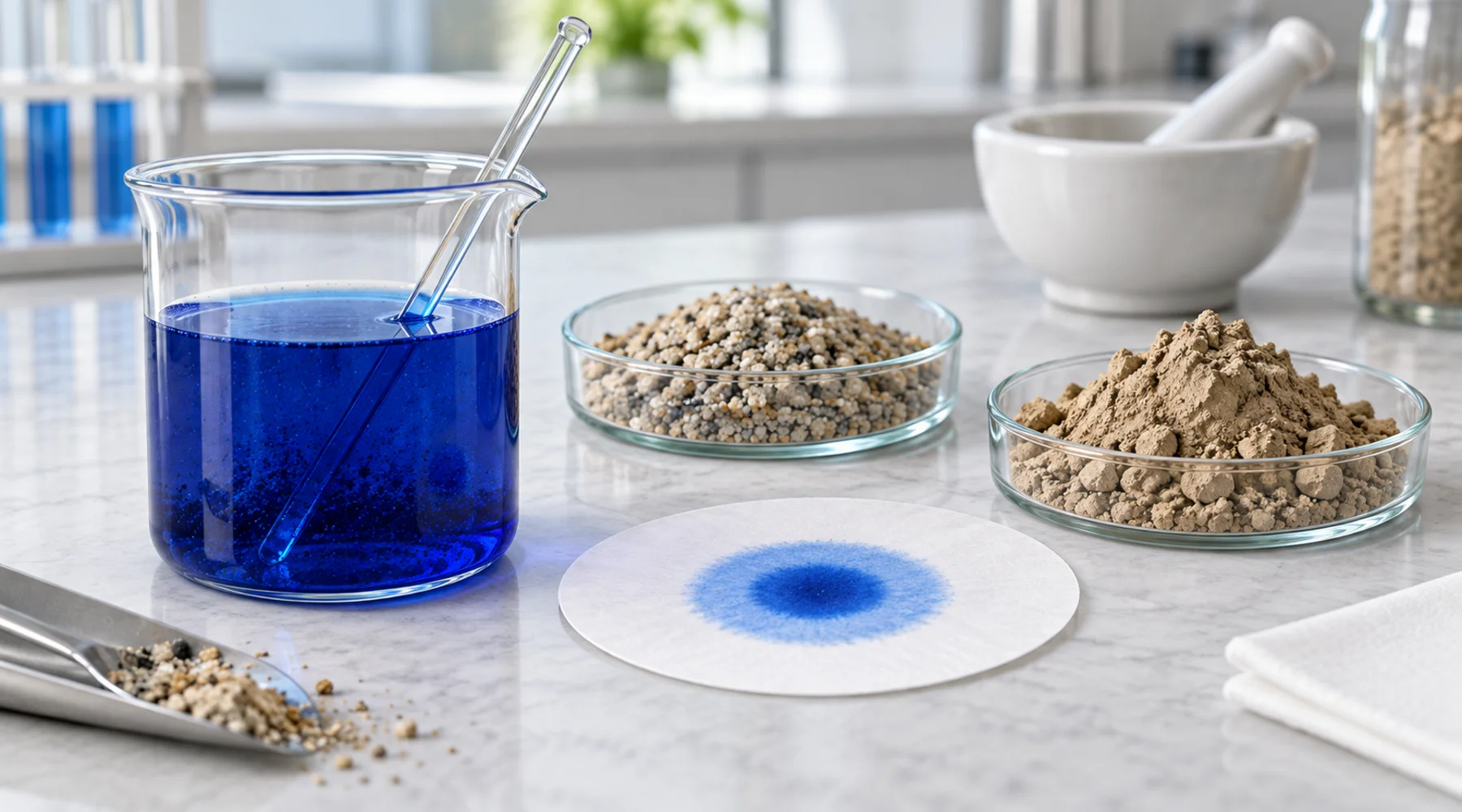
A concrete producer rejects a sand delivery because its methylene blue value exceeds the specification. The supplier protests: their own laboratory measured a lower number on the same sand. Both laboratories used methylene blue. Both reported grams per kilogram. Only one of them tested the fraction named in the specification, and the two numbers were never comparable.
This failure has a conceptual shape. "The methylene blue test" sounds like one instrument with one scale. In practice it is a family of procedures that share a dye but define different measurands: different materials, different size fractions, different endpoints, and different reporting bases. Treating the shared dye name as a shared result is the error. The sections below separate the family members so a reader can match the method to the material and read each number on its own terms.
What the dye actually probes
Methylene blue is a cationic dye. Clay minerals with high surface activity adsorb it strongly, while quartz and other inert fines take up far less. Adding dye in small steps to a stirred suspension therefore titrates the active surface: free dye appears in solution only after the active sites are occupied. That is why the methylene blue clay test responds to the quantity and character of active clay minerals rather than to total fines content alone.
Two consequences follow. First, the result depends on which particles are in the test portion. A method that tests the 0/2 mm fraction and a method that tests only the finest dust will return different numbers on the same bulk sample, because the clay is concentrated differently. Second, the reported unit only has meaning together with that fraction. Grams of dye per kilogram of what, exactly, is part of the result. A companion guide to methylene blue adsorption measurements covers the underlying uptake behavior in more detail.
Aggregate testing: EN 933-9 defines two values, not one
The European reference is EN 933-9, Tests for geometrical properties of aggregates, Part 9: Assessment of fines, Methylene blue test. The current edition is EN 933-9:2022, which replaced the 2009 edition with its 2013 amendment, and its scope is summarized in the CEN and CENELEC standards portal. The standard defines two distinct values. MB is determined on the 0/2 mm fraction. MB_F, described in a normative annex, is determined on the 0/0.125 mm fraction. Calling a 0/2 mm result "MB_F" is a category error, not a rounding choice.
The procedure suspends the test portion in about 500 mL of water and adds dye from a 10 g/L solution while agitating. After each addition, the operator places a drop of suspension on specified filter paper. The endpoint is the classic spot test: free dye shows as a light-blue halo about 1 mm wide around the central spot, persisting for five minutes. The result is reported in grams of methylene blue per kilogram of the dry tested fraction. So MB carries units of g/kg of 0/2 mm material, and MB_F carries g/kg of 0/0.125 mm material. The same sand can pass as MB and fail as MB_F, which is precisely why the specification must name the value it means.
The American aggregate methods use different principles
In the United States, two methods cover similar ground with different apparatus. ASTM C1777-20, listed as active by ASTM, determines the methylene blue value of material passing the 4.75 mm (No. 4) sieve with a colorimeter reading at 610 nm rather than the filter-paper spot test. AASHTO T 330, available through the AASHTO store, keeps the visual spot-test endpoint and tests the fraction passing 75 µm. Both report dye uptake per unit mass, dimensionally equivalent to grams per kilogram, but ASTM explicitly warns that results from C1777, AASHTO T 330, and EN 933-9 can differ substantially. The tested portions are defined differently, the clay is concentrated to different degrees, and the colorimetric reading is not the same operation as judging a halo on paper.
For a sand buyer, the practical reading of the methylene blue test for aggregate is therefore conditional: the number screens for harmful active clay in the specified fraction under the specified procedure. A laboratory that tests a different fraction, or reads the endpoint with a different principle, performs a different test even when the dye bottle is identical.
Soil testing: the French VBS belongs to earthworks, not concrete
Soils have their own member of the family. The valeur de bleu de sol, abbreviated VBS, measures methylene blue uptake by a soil for classification in earthworks and road construction. The historical procedure is the French standard NF P94-068, listed in the AFNOR catalogue. That 1998 standard has been withdrawn and superseded by NF EN 17542-3:2022, so a procedure that cites NF P94-068 without checking the current edition is working from a superseded document.
The VBS spot test resembles the aggregate spot test: successive dye additions to a soil and water suspension, with drops on filter paper until the persistent peripheral halo appears. But the measurand differs. The laboratory tests the 0/5 mm portion, and VBS is conventionally expressed in grams of blue per 100 g of dry soil, referred to the 0/50 mm material. Do not convert a VBS into an EN 933-9 MB value by multiplying or dividing by ten. The factor of ten converts the units; it does not convert the fraction, the preparation, or the normalization. A soil VBS and an aggregate MB answer different engineering questions, and each limit belongs to its own method.
Bentonite and drilling mud: activity and capacity, not cleanliness
A third branch of the family has nothing to do with accepting or rejecting aggregate. In drilling fluids, the methylene blue test for drilling mud measures how much reactive clay the mud already contains, both commercial bentonite and reactive drilled solids, and estimates total cation-exchange capacity. The current procedure sits in API RP 13B-1, Testing of water-based drilling fluids, whose sixth edition is dated January 2026; the API standards catalogue is the authoritative source for the edition in force. The mud sample is acidified and treated with hydrogen peroxide to remove interfering organics, then titrated with dye to a filter-paper halo endpoint. The result, methylene blue capacity, is reported per volume of drilling fluid and can be converted to a bentonite equivalent under stated assumptions about bentonite exchange capacity.
Dry bentonite itself is characterized differently again. API RP 13I covers laboratory testing including a methylene blue procedure on dispersed bentonite that reports an exchange-capacity estimate in milliequivalents per 100 g. ASTM C837, Standard Test Method for Methylene Blue Index of Clay, whose current revision is C837-09(2024) and remains active, measures dye adsorption by the clay itself and describes the index as related to cation-exchange capacity and other clay properties. These are clay-activity measurements. Applying an aggregate cleanliness limit to a bentonite index, or a bentonite capacity to a drilling mud, repeats the original error with new materials.
Method comparison
The following table is the reference asset for this article. Before comparing two numbers, confirm that the rows match.
| Method (current edition at time of writing) | Material and tested fraction | Endpoint | Result units and reporting basis |
|---|---|---|---|
| EN 933-9:2022, MB | Aggregates, 0/2 mm fraction | Spot test, halo persisting 5 min | g/kg of dry 0/2 mm material |
| EN 933-9:2022, MB_F (annex) | Aggregates, 0/0.125 mm fraction | Spot test, halo persisting 5 min | g/kg of dry 0/0.125 mm material |
| ASTM C1777-20 | Fine aggregate or mineral filler passing 4.75 mm (No. 4) | Colorimeter at 610 nm | mg/g of tested portion, numerically equal to g/kg |
| AASHTO T 330 | Fine aggregate fraction passing 75 µm | Spot test | Mass of dye per mass of tested portion |
| NF EN 17542-3:2022, VBS (superseding NF P94-068:1998) | Soils, 0/5 mm portion tested, reported on 0/50 mm | Spot test | g of blue per 100 g of dry soil |
| API RP 13B-1 (6th ed., 2026), MBC | Water-based drilling fluid as sampled | Spot test on treated mud | Per volume of fluid, convertible to bentonite equivalent |
| API RP 13I / ASTM C837-09(2024) | Bentonite or clay itself | Spot test / adsorption index | meq/100 g (CEC estimate) / methylene blue index of clay |
Check the edition of every standard before publishing a procedure from this table. Standards are revised, and the table records the editions verified during research, not a permanent bibliography. Related materials-testing applications of the dye, including membrane and polymer experiments, are covered in the companion guide to materials testing with methylene blue.
Why a limit from one method never transfers to another
Return to the rejected sand. Suppose the specification limit was written for EN 933-9 MB on 0/2 mm, while the supplier's laboratory reported MB_F on 0/0.125 mm, or a colorimetric value under ASTM C1777. The finer fraction concentrates the clay, so its number runs higher by construction; the colorimeter reads a different physical signal than the halo. Either mismatch alone can flip pass into fail. The dispute is not about who performed the titration better. It is about two different measurands sharing a dye name.
The rule is therefore strict. A specification limit is valid only for the method, fraction, and reporting basis that produced it. Establishing a limit under a replacement method requires an empirical correlation built on representative materials tested by both methods, not a unit conversion. And because the methylene blue test for active clay responds to clay character as well as quantity, even a good correlation on one geological source may not travel to another.
A short checklist before testing
Write down the material, the standard with its edition year, the tested fraction, the endpoint rule, and the reporting basis before preparing any solution. Confirm that the cited edition is current with the issuing body. Then prepare the dye concentration, calibration, and controls that belong to that method. A report that states all five items lets any reader reproduce the measurement and stops the dye name from doing the work that the method description should do.