
Article
Methyl red and methylene blue: how Tashiro indicator works
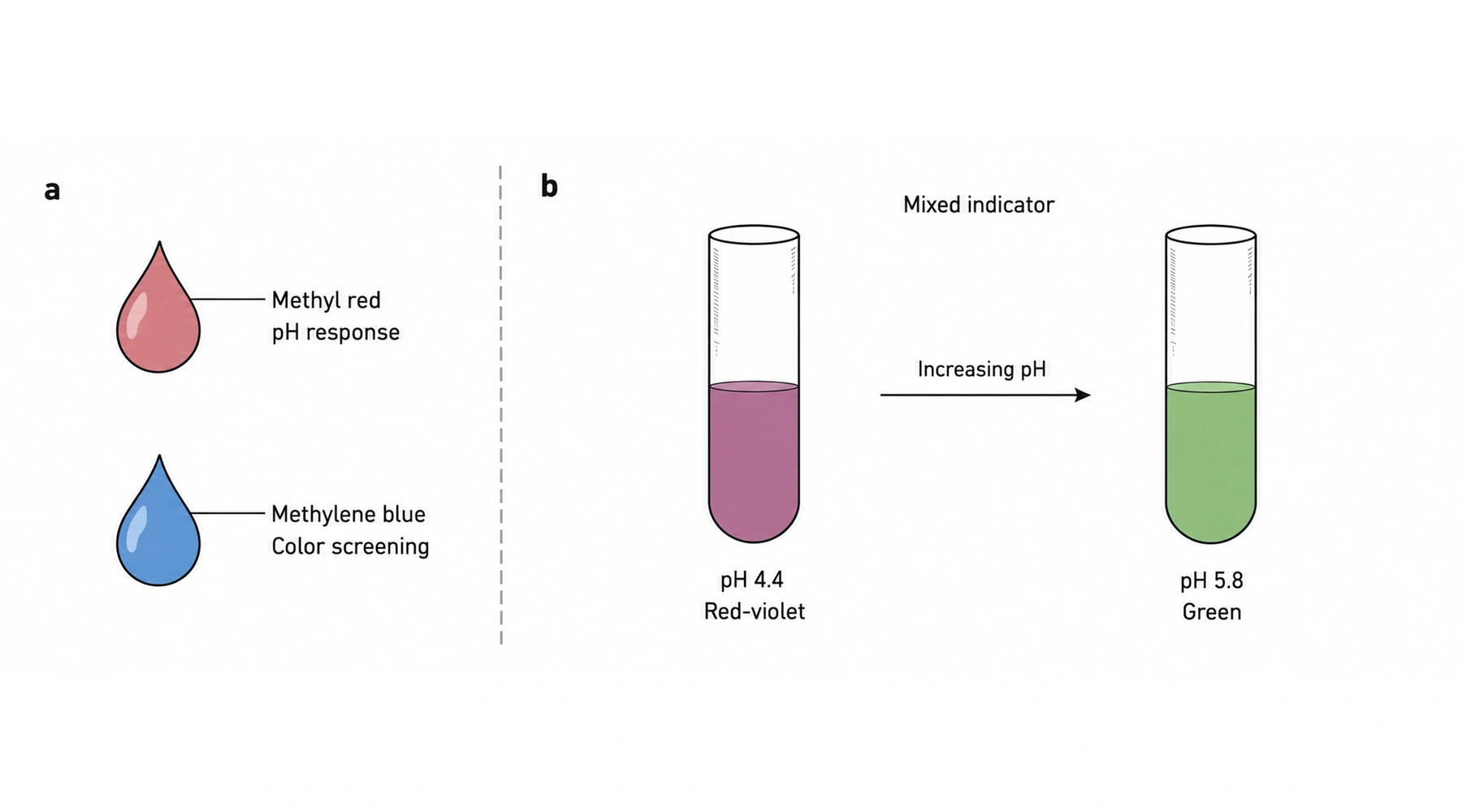
Tashiro mixed indicator combines methyl red and methylene blue to make an acid-base titration easier to read. Methyl red supplies the pH-dependent response; methylene blue changes the resulting color contrast. A green-to-violet transition in this mixture should not be interpreted as the blue dye undergoing its familiar reduction to a colorless form.
The formulation matters. A bottle name identifies an indicator family, but the laboratory still needs a composition, a documented transition, and a method that defines when to stop adding titrant.
What each dye contributes
Methyl red is an acid-base indicator. Its protonated and deprotonated forms have different visible absorption, so their changing proportions produce a color change as pH changes. For example, Sigma-Aldrich specifies a pink-to-yellow transition over pH 4.2–6.2 for its methyl red reagent.
Adding a blue component alters what the eye sees: the reddish side appears more violet, while the yellowish side combined with blue appears green. This is often described as screening the indicator. The useful distinction is between the component that responds to acidity and the component that modifies its visual presentation. Mixing the dyes does not turn methylene blue into a universal pH meter.
Compare the three situations before interpreting a color:
| Indicator system | What produces the signal? | What the observer can infer |
|---|---|---|
| Methyl red alone | Changes in acid-base form | The solution has moved through that indicator's pH transition |
| Methyl red plus methylene blue | A pH response viewed through the combined colors | The mixed indicator has reached a formulation-specific appearance |
| Methylene blue in a reducing system | Reduction of the blue dye, with possible reoxidation | Redox chemistry is occurring; this does not identify a titration endpoint |
The last row describes a different experiment. In Oxford's blue-bottle demonstration, alkaline glucose reduces methylene blue to a colorless form, and introduced oxygen restores the blue color. Those conditions explain a redox cycle, not Tashiro's intended acid-base readout. The broader distinction is covered in methylene blue's redox chemistry.
A documented formulation and its color direction
The ITW Reagents technical sheet for product 282430, edition 5 dated October 2018, specifies 100 mg methyl red and 50 mg methylene blue, with 10.4 mL water and absolute ethanol sufficient to make 100 mL. It identifies the product for ammonia titrations and documents red-violet at pH 4.4 and green at pH 5.8.
This gives the following formulation-specific diagram:
pH 4.4, red-violet → increasing pH → pH 5.8, green
pH 5.8, green → decreasing pH → pH 4.4, red-violet
The arrow describes direction through the indicator interval. It does not prescribe either end of the interval as the stopping point for every analysis. The sheet does not assign an exact gray endpoint, so a universal gray-point pH cannot be taken from this specification.
Notice also that green at pH 5.8 is still acidic in ordinary aqueous conditions. Calling the colors simply “acid” and “alkaline” can obscure this: the green side is the higher-pH side of the transition, not proof that the sample is above pH 7.
What an ammonia titration actually measures
An indicator signals when to read the burette. The amount of analyte comes from the measured titrant consumption, its standardized concentration, and the reaction stoichiometry. A more intense green does not, by itself, quantify more ammonia.
As a concrete method example, the historical EPA Method 350.2 reproduced by NEMI distills ammonia into boric acid and determines it by titration with standardized sulfuric acid. Its mixed indicator uses two volumes of 0.2% methyl red stock with one volume of 0.2% methylene blue stock, both in 95% ethanol. The method instructs the analyst to match the endpoint against a blank containing corresponding volumes of water and boric acid.
This recipe and the commercial formulation above have the same dye mass ratio, but different concentrations and solvent compositions. A matching ratio is therefore insufficient evidence that two bottles are interchangeable. The procedure also concerns ammonia-nitrogen and explicitly excludes total Kjeldahl nitrogen from its scope. A shared indicator does not make two nitrogen determinations the same assay.
Use that document to understand a specified analytical workflow, rather than to assume its historical edition governs a current reporting requirement. The laboratory's adopted method must identify the applicable edition and its quality controls.
Endpoint and equivalence point are different
IUPAC defines titration and its endpoint in terms of recognizing completion of a reaction; the equivalence point corresponds to the exact chemical equivalence. The visible signal is useful when it falls sufficiently close to that point for the method's purpose.
Suppose two analysts titrate identical samples. One stops when the solution matches the specified blank. The other continues until the most saturated violet is visible. The second analyst has selected a different endpoint and may consume excess titrant. Agreement about the name of the final color does not guarantee agreement about the measured amount.
This is why a training reference should specify the comparator, viewing conditions, and persistence criterion required by the method. A screen image can explain the direction of change, but the laboratory comparator establishes the operational judgment.
A practical check before replacing or troubleshooting an indicator
Use this worksheet when the color looks wrong or a substitute bottle is proposed:
| Check | Record | Why it affects interpretation |
|---|---|---|
| Reagent identity | Both dye names and product code | A similarly named mixed indicator may contain different chemicals |
| Formulation | Dye concentrations, ratio, and solvent | A ratio alone leaves important differences unresolved |
| Procedure | Method, edition, indicator addition, and titration direction | The bottle specification does not define the whole analysis |
| Endpoint reference | Required blank or comparator and stopping rule | “Violet” can cover several visually distinct appearances |
| Unexpected behavior | Whether the change follows titrant addition, standing, or aeration | A time-dependent bleaching cycle calls for investigation beyond pH |
Treat a failed blank or an unexplained color change as a reason to investigate the reagent and method before reporting results. Adding more dye until the sample looks familiar changes the observation conditions and can hide the original problem.
For selecting the right role for the dye in a different assay, start with methylene blue in analytical testing. For Tashiro titrations, keep the dye formulation, visual endpoint, and analytical calculation documented together.