
Article
MBAS testing: measuring anionic surfactants with methylene blue
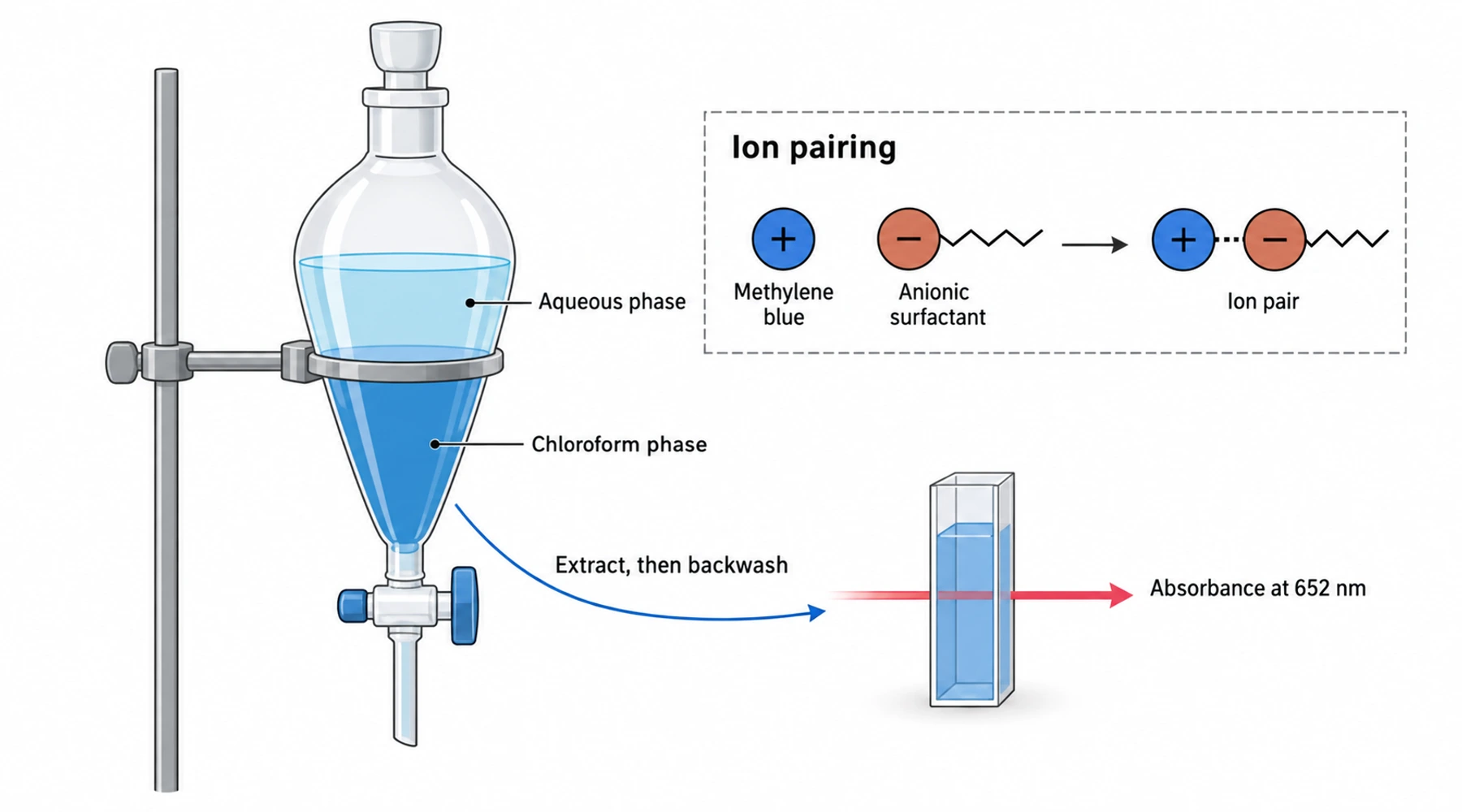
An MBAS test measures substances that interact with methylene blue under a defined extraction procedure. Laboratories use it to estimate anionic surfactants in water. It produces a group measurement, not an identification of every detergent molecule in the sample.
That distinction matters when a report says “anionic surfactants as MBAS.” A result can support a treatment-process comparison without establishing which surfactant is present. It can also change because the sample matrix changed, even when the target surfactant concentration did not.
What the blue signal measures
MBAS means methylene blue active substances. Methylene blue is a positively charged dye. Suitable negatively charged substances associate with it to form ion pairs that can enter an organic solvent. The laboratory measures the blue color in that solvent rather than simply reading the color of the original water.
The historical EPA Method 425.1 description explains this extraction principle and explicitly says the assay cannot distinguish related surfactant types and isomers. Its scope includes drinking water, surface water, and domestic and industrial wastes, but excludes saline waters. Those scope statements belong to that method; they should not be transferred automatically to every commercial surfactant test.
The result depends on the calibration material. If the laboratory calibrates against linear alkylbenzene sulfonate, or LAS, “mg/L as LAS” expresses the observed response on that reference scale. It does not prove that all responding material is LAS. Ask for the calibrant and reporting basis whenever comparing results from different laboratories.
Which method should a laboratory cite?
For United States Clean Water Act testing, the current 40 CFR 136.3 method table lists Standard Methods 5540 C-2021 and ASTM D2330-20 for surfactants by methylene-blue colorimetry. Verify the applicable permit and laboratory scope before commissioning compliance analysis.
EPA 425.1 remains useful historical documentation, but its old approval statement is not a substitute for checking the current table. “MBAS method” alone is an incomplete method reference: include the method number and revision on the report.
Also distinguish MBAS from other colorimetric surfactant assays. For example, Hach identifies Method 8028 as a crystal-violet method. Similar sample types or reporting units do not make two extraction chemistries interchangeable.
Assay workflow: where each decision enters
The National Environmental Methods Index summary of 5540 C describes three chloroform extractions from an acidic aqueous preparation, an aqueous backwash, and measurement at 652 nm. The following workflow explains the purpose of those operations. Reagent quantities and acceptance criteria must come from the laboratory's controlled procedure.
| Stage | What happens | What to record or check |
|---|---|---|
| 1. Define the sample | Choose the sampling point and required sample fraction. | Water type, collection time, visible solids, and any pretreatment. |
| 2. Establish the reference | Prepare the specified standards and blanks. | Calibrant identity, concentration basis, and working range. |
| 3. Extract the ion pairs | Contact the prepared sample with methylene blue and chloroform through the prescribed extraction sequence. | Correct phase recovery and any separation difficulty. |
| 4. Wash and measure | Backwash the extract and read its absorbance at the specified wavelength. | Complete washing, optical cell condition, and instrument response. |
| 5. Qualify the result | Apply calibration and dilution calculations, then assess quality controls. | Reporting limit, units, dilution factor, and matrix qualifications. |
The final number is only as interpretable as these records. A well-behaved calibration curve establishes instrument response to standards. It does not, by itself, establish that an industrial wastewater behaves like those standards.
Interferences can increase or suppress the result
The interference is chemical as well as optical. Additional substances may carry dye into the extract, while others prevent the target from doing so. EPA's method discussion identifies several responding organic groups and inorganic ions. The NEMI summary also describes competing cations and particle adsorption.
| Interference or condition | Possible effect | Interpretation check |
|---|---|---|
| Other extractable, methylene-blue-active compounds | Additional signal attributed to surfactant | Avoid assigning the entire response to a named ingredient. |
| Nitrate or chloride | Positive bias in susceptible procedures | Check matrix composition and the prescribed wash. |
| Cationic surfactants or amines | Reduced response through competing ion-pair formation | Investigate mixed formulations and poor spike recovery. |
| Suspended particles | Reduced aqueous response through adsorption | Document whether solids were present or removed. |
| Foam or container adsorption | An aliquot no longer represents the original bulk sample | Review collection, mixing, and subsampling. |
A particularly useful example comes from a USGS investigation of its earlier MBAS procedure. Quality-control samples containing nitrate but no other MBAS produced a positive response. Investigators confirmed nitrate and chloride interference and introduced a method with a solvent-washing step. They warned that an apparent correlation between MBAS and nitrate could reflect the analytical interference itself.
This is a historical, procedure-specific finding, not evidence that every present-day MBAS result is biased. Its practical lesson is to ask whether a correlation could originate inside the assay before explaining it as an environmental process.
Handle samples as part of the measurement
Surfactants concentrate at interfaces. The NEMI guidance warns that foam can deplete the underlying liquid and that adsorption to container walls can matter at low concentrations. Do not skim foam away and assume the remaining liquid is equivalent to the collected sample.
For the cited United States regulatory context, Table II of 40 CFR 136.3 specifies cooling surfactant samples to 6 °C or below and a 48-hour maximum holding time, subject to its footnotes. Arrange bottles, transport, and laboratory receipt before sampling. A correctly performed extraction cannot reconstruct material lost during collection or storage.
Read the quality controls before using the number
The quality-control provisions in 40 CFR 136.7 identify controls such as blanks, calibration checks, laboratory control samples, matrix spikes, and duplicates. Their roles differ. A blank checks contamination; a matrix spike asks whether added reference material can be recovered from that sample; a duplicate assesses repeatability.
Consider an illustrative process comparison: an inlet reports 1.0 mg/L as LAS and an outlet 0.2 mg/L as LAS. The arithmetic gives an 80% decrease in reported MBAS concentration. Before calling that 80% surfactant removal, check that the samples represent comparable process conditions, use the same reporting basis, and have acceptable controls. A concentration decrease also does not establish an 80% reduction in mass discharge if water flow changed.
A result below the reporting limit means the laboratory cannot reliably quantify MBAS below that stated level. It does not establish that the sample contains no surfactants or meets every water-quality requirement.
For method selection, start with the guide to methylene blue in analytical testing. For laboratory preparation, use the relevant chemical handling and laboratory safety guidance. Request a species-specific analytical method when the decision requires identifying a particular surfactant rather than measuring a collective dye response.