
Article
Methylene blue SDS: product matching, handling, spills, and disposal
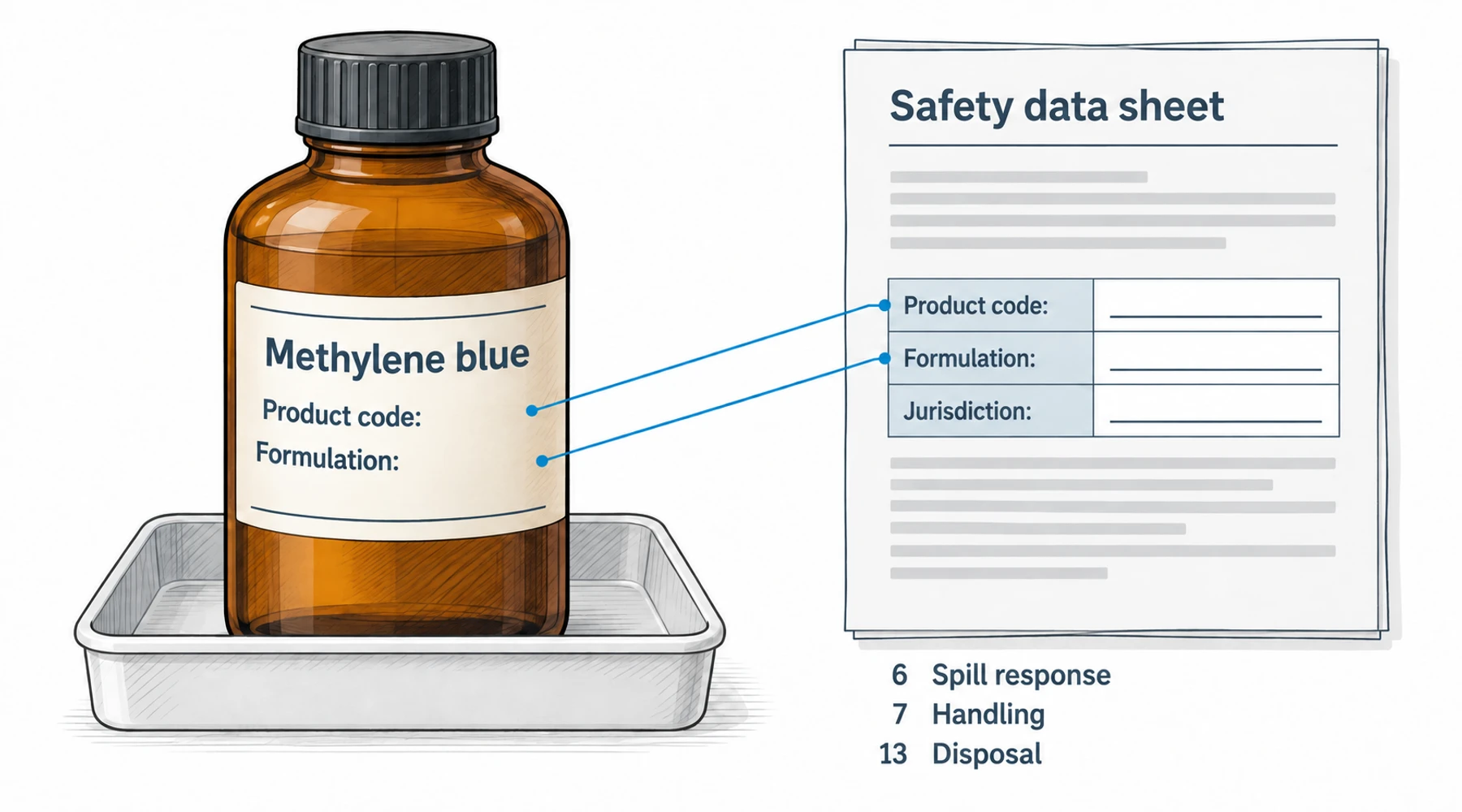
Match a methylene blue safety data sheet to the bottle before using its instructions. The supplier, product code, formulation, and jurisdiction matter. A powder SDS cannot describe the fire hazards of an alcohol-containing stain, and an aqueous reagent SDS does not establish that another supplier's solution is suitable for ingestion.
The searchable methylene blue SDS directory links directly to three supplier-hosted documents. Search by product name, code, or ingredient, then filter by formulation and jurisdiction. Records were checked on 12 September 2026. Their individual revision dates are shown separately: the date a document was checked is not the date its contents changed.
Find the sheet that belongs to your product
Start with the container label or purchasing record, not a search for the chemical name alone. Use this matching sequence:
- Supplier and product code. Match the code in SDS Section 1. Distributor ordering numbers can differ from the manufacturer's number printed inside the document.
- Physical form and composition. Check powder versus liquid, concentration basis, solvent, and other ingredients in Sections 1 and 3.
- Jurisdiction and language. Choose the document issued for your location. English-language US and Great Britain documents are not interchangeable regulatory editions.
- Revision and applicability. Check Section 16 and the supplier's current download. Ask the supplier about a mismatch or a document whose continued applicability is unclear.
The PubChem entry for methylene blue trihydrate identifies a chemical substance. It is a useful identity reference, but it cannot replace the safety document for a formulated bottle. Likewise, solubility and solution preparation concerns the composition you make, which may differ from the starting reagent.
These directory records are examples with exact product matches, not a list of interchangeable purchases:
| Supplier and product | Formulation identified in the document | Jurisdiction and revision |
|---|---|---|
| Thermo Fisher Scientific Chemicals, 42771; Fisher order code AA42771AE | Methylene Blue, 1% w/v aqueous solution; hydrate and water | United States; 28 December 2025, revision 4 |
| Fisher Scientific UK, BP117-100; Fisher order code 10307033 | Methylene blue trihydrate solid, greater than 95% | Great Britain; 13 October 2023, revision 9 |
| Remel, R40083 | Loefflers Methylene blue; ethanol, methanol, dye, and water | United States; 5 February 2015, revision 1 |
The Remel link currently serves an older revision. Its presence online does not prove that no newer sheet exists. Confirm applicability with the supplier before adopting it into a workplace system. If your bottle is absent from the directory, request its own SDS; do not select the closest-looking entry.
An SDS is not a certificate of analysis
An SDS communicates hazards and precautions. A certificate of analysis, or COA, records analytical results against specifications for an identified batch. They answer different questions: how to handle a material, and what was measured in that lot.
For a concrete example, Fisher's educational 1% solution listing explicitly states that no COA is available. Having safety information therefore does not imply that a batch analysis exists. Neither document alone establishes sterility, suitability for injection, or an appropriate patient dose.
The standardized section headings make an SDS navigable. OSHA's SDS guidance explains the structure and the older term material safety data sheet, or MSDS. For practical work, read Section 4 for exposure first aid, Section 6 for releases, Sections 7 and 8 for handling and protection, Section 10 for incompatibilities, and Section 13 for disposal. Reading only the hazard pictograms misses much of the useful information.
Handling follows the formulation
The US SDS for Thermo Fisher 42771 does not classify that aqueous product as hazardous under its stated OSHA standard. It nevertheless specifies eye, skin, and clothing protection, ventilation, closed storage, and avoiding strong oxidizers. Its environmental section says not to empty it into drains. A classification threshold is not permission to drink or discharge the solution.
The Great Britain SDS for BP117-100 classifies the solid as harmful if swallowed. It emphasizes avoiding dust formation and selecting gloves for the actual task and contact conditions. A glove material name without a suitable breakthrough time is an incomplete selection.
The Remel R40083 SDS identifies a flammable solvent-containing stain and organ-toxicity hazards. Its instructions address ignition sources and static discharge. Applying an aqueous-solution routine to that bottle would omit material hazards introduced by its solvents.
Respond to exposure before cleaning the bench
Stop work, alert people nearby, and identify the material without entering an unsafe area. If someone has difficulty breathing, collapses, or has another severe reaction, call local emergency services. For chemical eye exposure, begin rinsing immediately; the three linked SDS files specify at least 15 minutes and medical attention. Use the product label and SDS when contacting a poison service or clinician.
Cleanup depends on both the chemical and the responder's preparation. The University of Washington chemical-spill instructions reserve small-spill cleanup for trained personnel familiar with the chemical and equipped with the laboratory spill kit. A small volume is not automatically manageable when its identity is unknown or its vapors create a hazard.
For BP117-100 powder, the supplier describes collecting the solid into closed disposal containers while avoiding dust. For R40083 liquid, it specifies inert absorbent, suitable closed containers, and ignition control. The 42771 aqueous SDS contains a generic instruction to sweep and shovel despite identifying the product as liquid. Resolve that inconsistency through the supplier and your local spill procedure rather than treating it as a literal liquid-cleanup method.
Collect contaminated absorbents and cleanup residues as part of the waste stream. Do not improvise with bleach or another reagent merely to remove the blue color.
Disposal is a waste-stream decision
Section 13 is a starting point. Used stain may contain solvents, specimen material, or other reagents that were not present in the unopened product. Describe all known constituents, approximate amounts, and the process that generated the waste to the receiving service. Keep incompatible wastes separate and preserve labels.
For households in the United States, EPA's household hazardous-waste guidance directs readers to local collection options and warns against mixing leftovers or pouring hazardous waste into drains. Contact the local program with the exact formulation to establish acceptance. A workplace should use its institutional waste service, not assume household collection accepts business chemicals.
For businesses in England, the government's hazardous-waste procedure starts with classification and requires appropriate storage, authorized waste businesses, and records. The overview links separate rules for Scotland, Wales, and Northern Ireland. Outside these locations, consult your local waste authority or institutional environmental-health-and-safety team.
Do not infer disposal suitability from pale water or disappearance of color. Questions about environmental fate, aquatic toxicity, and wastewater concern more than visible staining. Until the receiving service confirms the route, retain the waste in compatible, closed, clearly identified containers under the applicable storage procedure.