
Article
Methylene blue solubility and solution preparation: a laboratory guide
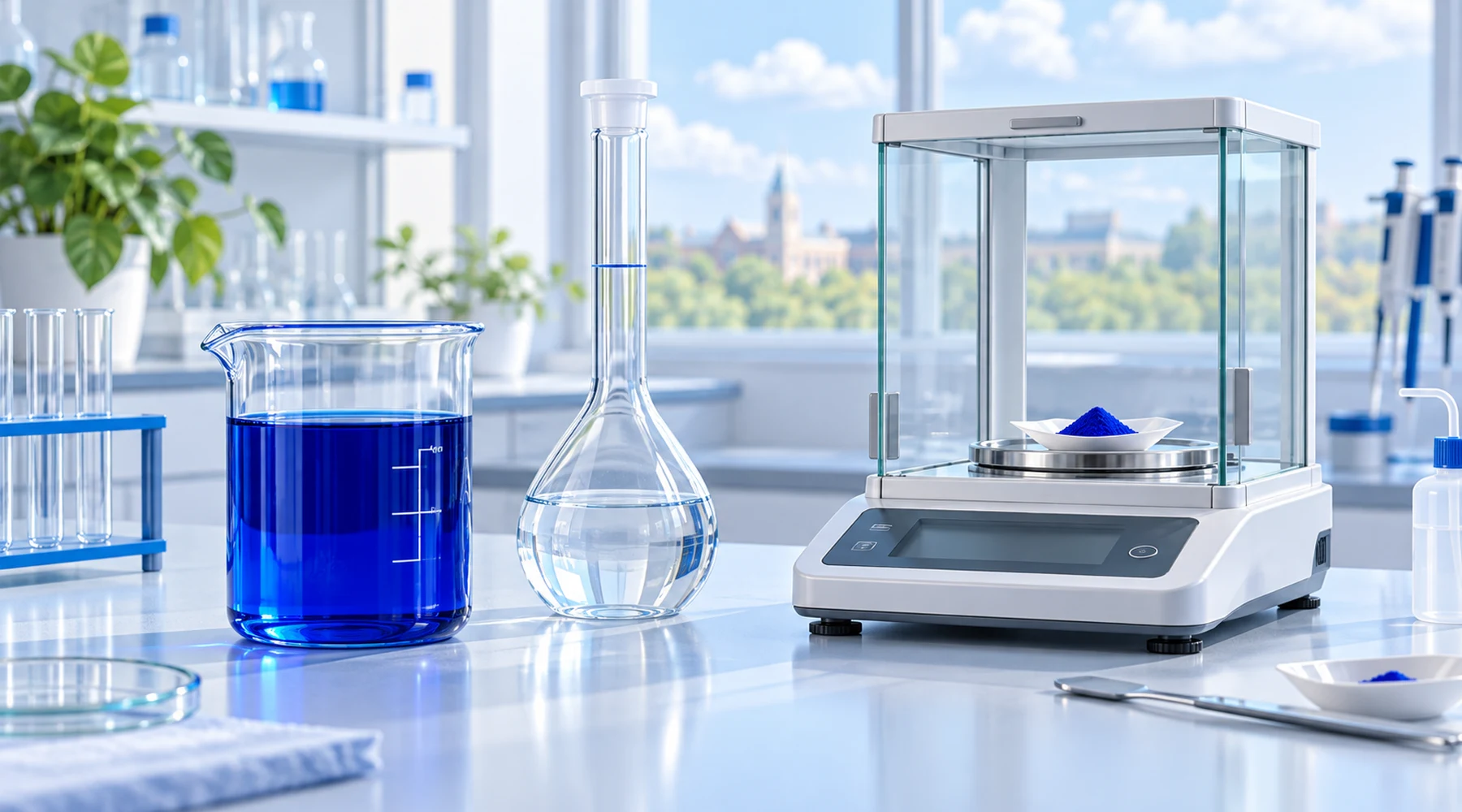
Two technicians each make a 1 percent methylene blue solution from powder. One weighs 1.00 gram and brings the flask to 100 mL. The other weighs 1.00 gram, adds it to 100 mL of water, and calls it done. A third technician weighs 1.00 gram of a different lot and gets a measurably different strength. All three bottles are labeled identically. None of them contains quite what the label says, and the differences come from three ideas that are easy to confuse: what the solvent can hold, what the weighed powder actually is, and what the percent refers to.
This guide is about laboratory formulation only: stains, indicators, analytical stocks, and working dilutions. It is not a recipe for oral or injectable medicine, and concentrations here should not be read as doses.
What solubility sets, and what it does not
Methylene blue solubility in water is high for a dye. The PubChem compound record for methylene blue reports about 43.6 grams per litre at 25 C, which is the same as 4.36 grams per 100 mL, or 4.36 percent w/v. An independent equilibration study at the same temperature measured 43.21 g/L and confirmed the older value within experimental error.
That number is a ceiling, not a target. A 1 percent stock is 10 g/L, less than a quarter of the ceiling. A 0.1 percent stock is 1 g/L, roughly one fortieth of it. If a 1 percent preparation leaves persistent solids after proper mixing at room temperature, the problem is almost never the solubility limit. It is usually incomplete wetting, cold water, lumps of powder that need more time, or a solute that was misidentified. Warm water and stirring solve most of these. If heating was used, let the flask return to its calibration temperature before bringing it to final volume.
Solubility in other solvents is lower and less consistent across sources, partly because the hydrate state of the tested material differs. Water remains the reference solvent for routine laboratory stocks. Ethanol dissolves the dye but holds substantially less than water, chloroform also dissolves it, pyridine only slightly, and diethyl ether essentially does not. Acetone and ethyl acetate sit well below water in measured series. For nonaqueous work, treat any handbook number as a starting estimate and verify it with the actual lot rather than as a formulation limit. The practical point is simple: if the goal is a defined aqueous concentration at or below 1 percent, water gives wide headroom.
The powder is not one thing
Methylene blue powder sold for laboratory use is a chloride salt that carries water in its crystal lattice, and the amount of that water varies. The anhydrous ion has a molecular weight of 319.85 g/mol. The commonly quoted trihydrate is 373.90 g/mol and the pentahydrate is 409.93 g/mol, values tabulated in the USP monograph data summarized alongside the PubChem record.
Commercial bottles are often labeled trihydrate, CAS 7220-79-3, but solid state work has found that the real material may be a pentahydrate, a partial hydrate near 2.2 waters, a dihydrate, or a monohydrate, with no distinct crystalline trihydrate phase in some analyses. The dye is also hygroscopic, so the water content of an opened bottle drifts. For qualitative staining this barely matters. For quantitative analytical work it matters a great deal, which is why the guidance on reading assay and water content on a certificate of analysis treats the lot document as authoritative over the word trihydrate on the front label.
Two correction paths follow from this, and only one should be used at a time. If the certificate gives assay and water or loss on drying, use those numbers directly. If no certificate data exist and the concentration must be expressed on an anhydrous equivalent basis, apply the theoretical hydrate factor: 373.90 divided by 319.85, or 1.169, for nominal trihydrate, and 409.93 divided by 319.85, or 1.282, for nominal pentahydrate. Do not apply both corrections at once. That double counts the water.
What percent means
Percent w/v means grams of the specified solute per 100 mL of final solution, not per 100 mL of starting water. So 1 percent w/v is 1.000 g per 100 mL final, equal to 10 mg/mL or 10 g/L. A 0.1 percent solution is 0.100 g per 100 mL final, equal to 1 mg/mL. The common confusion of 1 percent with 1 mg/mL is a factor of ten error, and it is worth checking every label for it.
The second half of the definition is the solute specification. A 1 percent solution of as weighed trihydrate powder and a 1 percent solution expressed as anhydrous equivalent are different solutions. The worked examples below state both the final volume and the basis every time, which is the habit that prevents the three technician problem above.
Worked preparations, with hydrate assumptions stated
All examples assume pure powder of the stated hydrate and water as solvent at room temperature. Scale linearly for other volumes.
Example A: 100.0 mL of 1 percent w/v, as weighed trihydrate basis. Weigh 1.000 g of methylene blue trihydrate. Add about 70 mL of purified water, stir or swirl until fully dissolved, transfer quantitatively to a 100.0 mL volumetric flask with rinses, then add water to the mark. The solute is the trihydrate itself, so no molecular weight correction applies. Result: 1.000 g per 100.0 mL final, or 10 mg/mL as weighed powder.
Example B: 100.0 mL of 1 mg/mL, anhydrous equivalent basis, from nominal trihydrate. The target is 100.0 mg of anhydrous methylene blue in 100.0 mL final. Multiply by 1.169 to correct for the three waters: 100.0 mg times 1.169 equals 116.9 mg. Weigh 116.9 mg of nominal trihydrate, dissolve in about 70 mL of water, and bring to 100.0 mL final in a volumetric flask. From nominal pentahydrate the factor is 1.282, so the same target needs 128.2 mg. Record which factor was used on the label.
Example C: methylene blue dilution from 1 percent stock to 0.1 percent. Use C1V1 equals C2V2. To make 100.0 mL of 0.1 percent from 1.0 percent stock, the required stock volume is 0.1 times 100.0 divided by 1.0, which is 10.0 mL. Pipette 10.0 mL of the 1 percent stock into a 100.0 mL flask and add water to the mark. For analysts who prefer mass units: 1 percent is 10 mg/mL, so 10.0 mL carries 100 mg, and 100 mg in 100.0 mL final is 1 mg/mL, which is 0.1 percent.
Example D: 1.000 L of 10 mg/L working solution from a 1 mg/mL stock. A 1 mg/mL stock is 1000 mg/L. The required volume is 10 times 1.000 divided by 1000, which is 0.0100 L, or 10.0 mL. Pipette 10.0 mL of stock and dilute with water to 1.000 L final. From a 1 percent stock at 10,000 mg/L, the same target needs only 1.00 mL brought to 1.000 L. Serial dilution in two steps gives better accuracy than a single microlitre transfer when the ratio exceeds about one hundred.
Each of these is a complete specification only because it contains three facts: the mass weighed with its hydrate assumption, the final volume of the solution, and the basis of the stated concentration. A notebook entry missing any one of the three cannot be reproduced exactly.
Procedure that avoids the usual errors
Dissolve the powder in less than the final volume first, then bring to volume. Adding powder directly to the full final volume of water produces a solution whose total volume exceeds the intended mark, and the concentration comes out low. Rinse the beaker into the flask so no color stays behind; the deep color makes small losses visible, which is an advantage if it prompts quantitative transfer.
Mix until no particles remain before making to volume, and inspect against light. Filter only when the method calls for it. Methylene blue adsorbs to some membrane materials, so filtration can lower the concentration of a stock that was just standardized, a point documented in membrane adsorption studies and worth remembering whenever filtration or concentration verification is part of the method. If a filtered stock must have a certified strength, verify concentration after filtration rather than before.
Store prepared solutions protected from strong light in amber or opaque bottles at room temperature, and label with solute, hydrate basis, concentration, solvent, date, and preparer. Photobleaching under sustained illumination is a known degradation path, so windowsills and lit refrigerators are poor storage even though the dye looks stable. Stability expectations and retest intervals belong with storage and stability guidance for prepared solutions, but as a working rule, analytical stocks deserve fresh preparation or reverification rather than indefinite trust.
Handle the powder and concentrated stocks with gloves, eye protection, a lab coat, and bench covering, with secondary containment for bottles. The dye stains skin, clothing, benches, and plastics quickly, and supplier safety data sheets classify the powder as harmful if swallowed and irritating to eyes and skin depending on grade. Full precautions belong with safe handling and storage practices, but staining control is itself a quality measure: stray dye on glassware and pipettes is a cross contamination source for trace analysis.
A note on grade
For staining baths and demonstrations, any clean laboratory grade prepared at the right strength performs. For quantitative or comparative work, the grade matters because the impurities differ: residual Azure B and related thiazines, heavy metals, residual solvents, and microbial load. That is why choosing a grade backed by a full certificate of analysis is part of formulation rather than an afterthought. A complete lot document reports identity, assay with its basis, water content, and the impurity panel actually tested, so the hydrate correction in the examples above uses measured values instead of the nominal trihydrate assumption. When two lots give different strengths from the same weighed mass, the certificate usually explains why.