
Article
How to read a methylene blue certificate of analysis
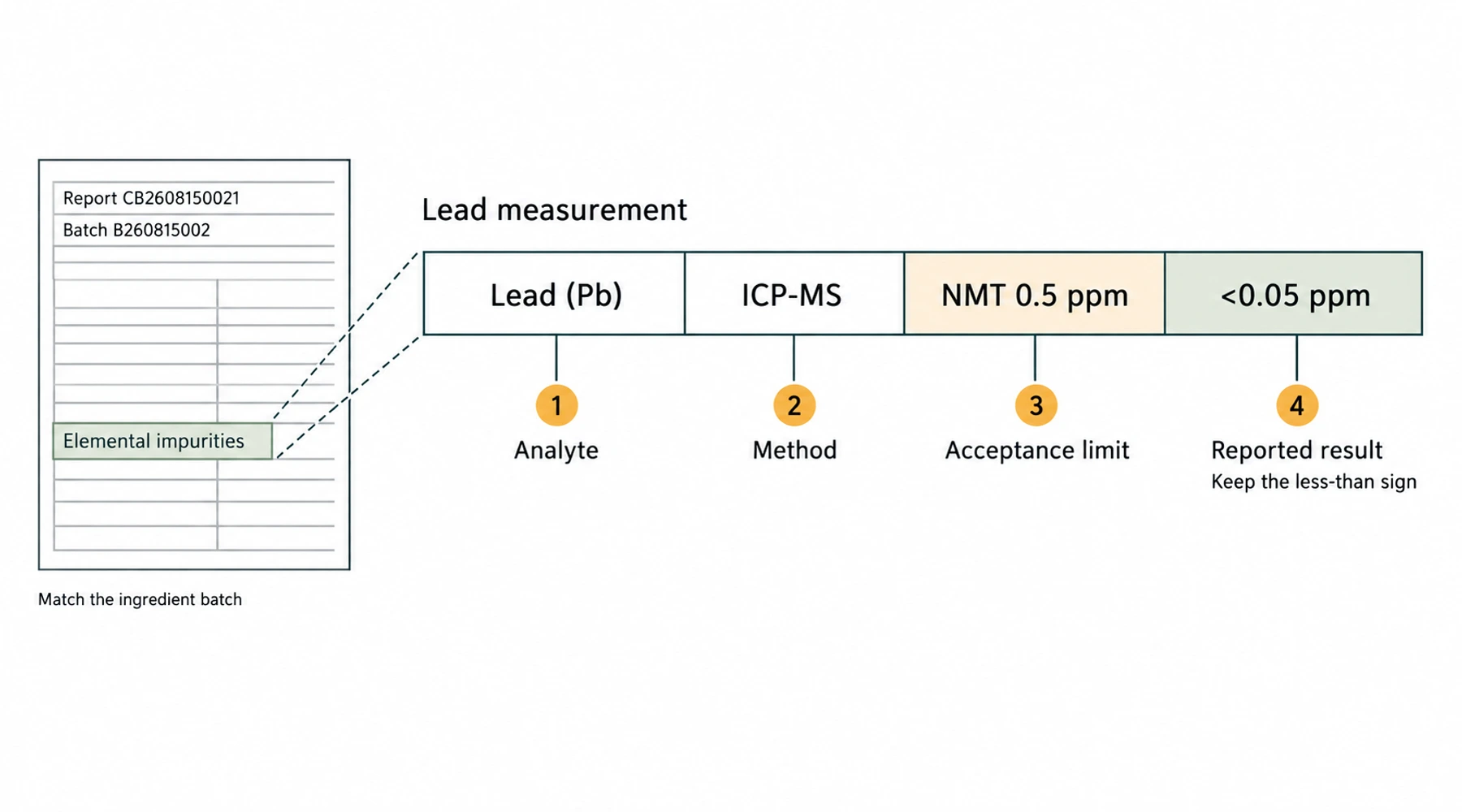
A methylene blue certificate of analysis becomes useful when you can connect its results to the material you bought. Start with the batch number, not the largest percentage. A detailed report for a different batch cannot establish the quality of yours.
Read the document in three passes: identify the sample, compare the results with their stated limits, and check what remains outside the report. Blupreme sells methylene blue; the public Blupreme example below receives the same scrutiny as any supplier's document.
First, establish what was tested
The product name should distinguish an ingredient from a prepared solution. A powder report does not state the concentration of a bottle made from that powder. Conversely, a solution concentration says little about which related dyes or metals were measured. These are separate questions in ingredient versus finished-product testing.
Find the product batch, ingredient batch and report number. They serve different purposes. The report number identifies a document; the ingredient batch identifies material; the bottle batch identifies a manufacturing or packaging group. The numbers need not be identical, but the supplier must explain their connection.
For example, Blupreme's batch records describe a bottle-to-ingredient lookup. That relationship is essential: an ingredient COA displayed on a website is not automatically the COA associated with every bottle sold there.
For pharmaceutical ingredients, FDA's ICH Q7 guidance, section 11.4, recommends batch-specific certificates with material identity, dates, acceptance limits, numerical results where applicable and authorized approval. It also addresses identifying the laboratory and original manufacturer when certificates are reissued. This is a useful documentary benchmark, not a claim that every retail chemical product has the same regulatory status.
An annotated public COA
Open Conquistador Bioscience report CB2608150021 beside this table. It is the ingredient certificate displayed on Blupreme's quality page, read here on September 12, 2026. The annotations explain the document; they are not an independent retest.
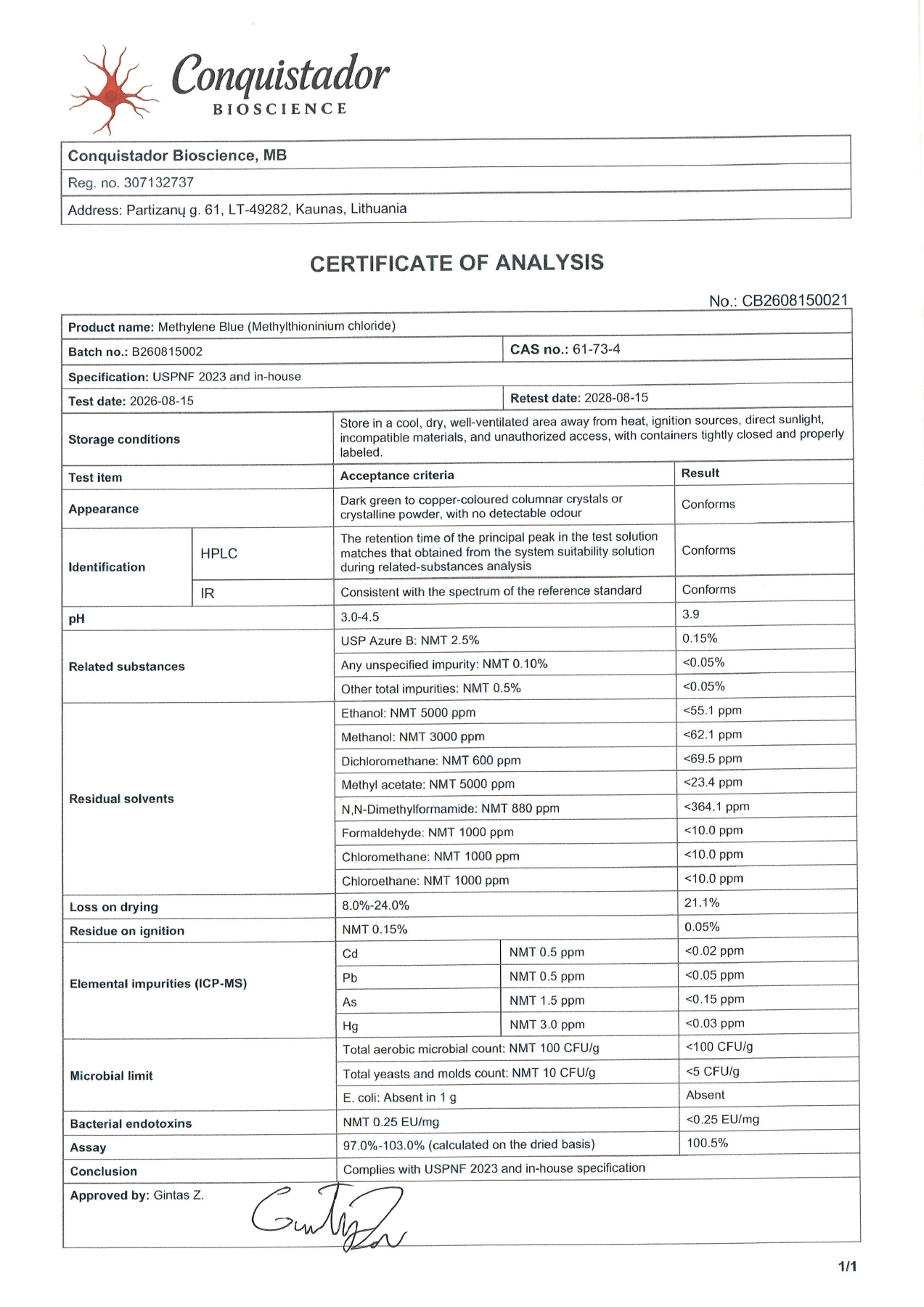
| Field in this report | What to record | How to interpret it |
|---|---|---|
| Material | Methylene blue; CAS 61-73-4 | Establishes the named substance. This is an ingredient report, not a bottle concentration measurement. |
| Document and batch | CB2608150021; B260815002 | Record both. Request the manufacturing record connecting your bottle batch to this ingredient batch. |
| Issuer | Conquistador Bioscience, MB, Kaunas, Lithuania | Identifies the organization issuing the certificate. The page does not identify a separate outside testing laboratory. |
| Dates | Tested 2026-08-15; retest 2028-08-15 | A retest date concerns reassessing material. It is not an opened-bottle shelf-life study. No separate release date is shown. |
| Specification | USPNF 2023 plus internal requirements | The conclusion concerns the stated specification. Ask which procedures and revisions support each test. |
| Identity methods | HPLC and IR; both conform | Two identity checks are reported. Neither result is a numerical purity measurement. |
| Assay | 100.5%; acceptance 97.0–103.0%, dried basis | The result falls within the report's interval. The calculation basis matters. |
| Lead | Below 0.05 ppm; maximum 0.5 ppm; ICP-MS | The reported bound is below the acceptance limit. It does not mean zero lead. |
| Related dye | Azure B: 0.15%; maximum 2.5% | A separate impurity measurement, interpreted against its own limit. |
| Approval and conclusion | Named approver and signature; stated compliance | Documents the issuer's review against its specifications. It does not establish independent sampling or clinical suitability. |
This reading separates what the page reports from what you would still need to ask. The report names some analytical techniques, but does not give a complete procedure identifier beside every test. It also does not display an accreditation number, sample receipt date or sampling history. Their absence does not prove inaccurate testing; it limits what you can verify from this page alone.
Compare each result with its own limit
Read across a row before reading down the results column. Note the analyte, units, method, acceptance criterion and reported value. NMT means “not more than”; NLT means “not less than.” A limit is the acceptance rule. It is not the measured amount.
The distinction matters for less-than results. A hypothetical report stating lead below 5 ppm would not demonstrate compliance with a 0.5 ppm maximum: the material could satisfy the reported bound and still exceed the specification. This is a logic check you can perform without knowing how the instrument works.
Similarly, “not detected” requires an associated detection or reporting threshold. EPA's explanation of method detection limits describes detection in relation to distinguishable measurement signals. It does not equate nondetection with literal absence. When a COA gives only “ND,” ask what that abbreviation and threshold mean for the sample.
Keep unlike percentages separate. A dried-basis assay, water-related mass loss and chromatographic impurity result have different definitions. Adding or subtracting them as if they were portions of one pie can produce nonsense. The explanation of assays above 100% works through those differences. A single high assay also cannot replace the wider analytical testing panel.
Check the claims surrounding the report
“Third-party tested” leaves three important questions unanswered: who tested, what sample arrived, and which tests were performed? A manufacturer may submit one ingredient sample to an outside laboratory. That does not establish that the laboratory independently purchased retail bottles or examined every finished batch.
If accreditation is claimed, ask for the laboratory's current scope, not just a logo. ILAC's description of laboratory accreditation explains the assessment framework; the relevant testing activities still need to be covered. Do not infer accreditation from a professional-looking certificate.
Also read qualifications such as results applying only to the submitted sample, subcontracted tests, or a statement issued from another laboratory's data. These tell you how far the evidence travels. A USP-grade claim requires more context than one passing contaminant result.
Request missing evidence before paying for your own tests
Independent testing can be expensive. Documentary checks are a practical first step, particularly when you do not yet know which question a new test should answer.
Send the seller your bottle batch and product details, with this request:
Please provide the complete COA associated with this batch, the record linking the bottle batch to the tested sample, and the identity of the laboratory that performed the work. Please include methods, acceptance limits, numerical results and reporting thresholds. If the report covers the ingredient, please identify which records or tests cover the finished solution.
Save the reply with the report. An unrelated batch, a generic specification or a statement that testing occurred does not close a missing traceability link. You can compare another supplier's documentation before deciding whether additional laboratory work is worthwhile.
Download the COA review checklist and complete it beside your own report. Leave unanswered fields marked “unknown.” That makes the next request specific and prevents missing evidence from becoming an assumed pass.