
Article
Methylene blue impurities: what heavy-metal, Azure B, and solvent tests measure
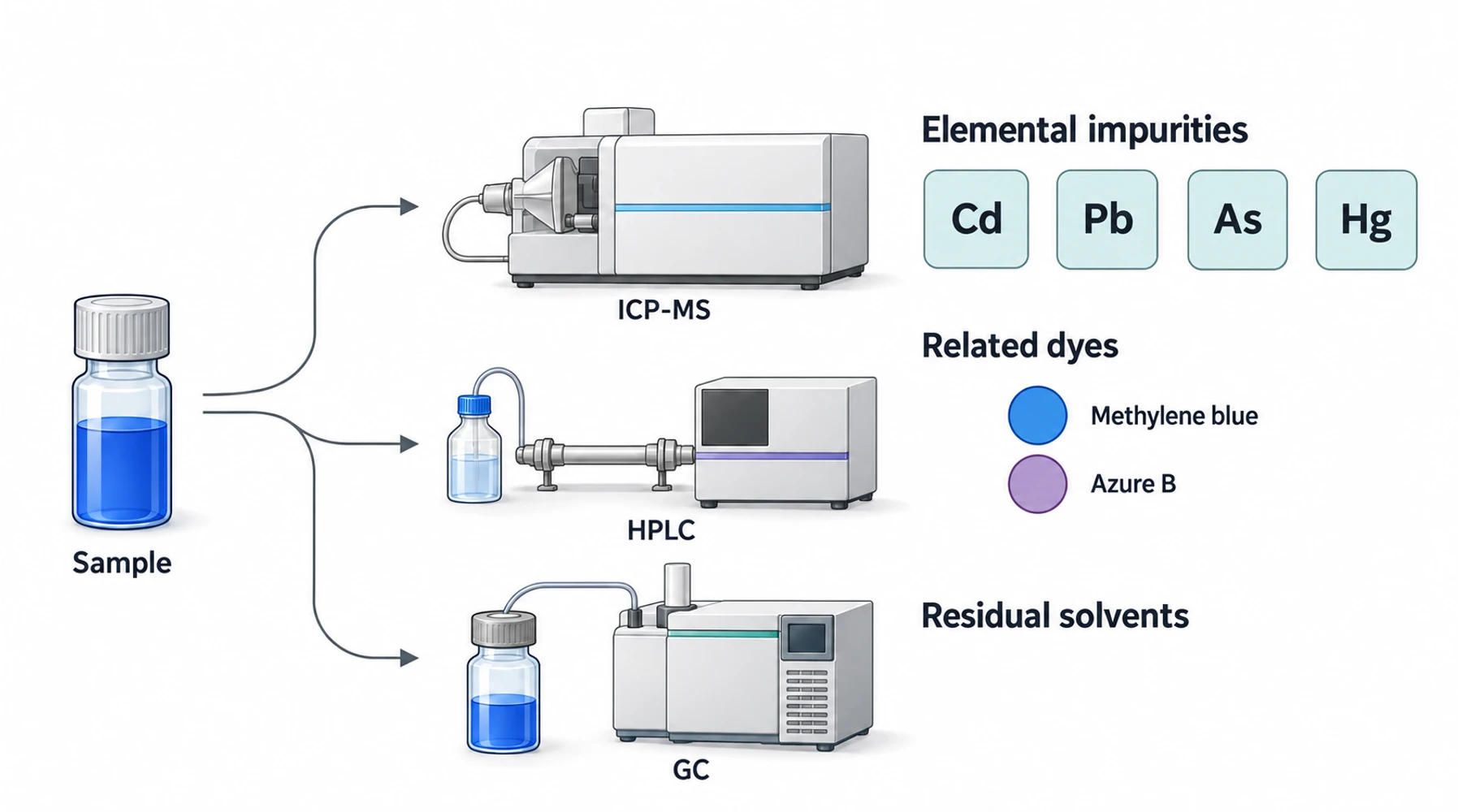
A heavy-metal panel can establish something useful about a methylene blue sample: the reported concentrations or bounds for the elements tested. It cannot establish how much Azure B is present, whether solvent residues remain, or whether a prepared bottle contains its stated concentration. Those questions require different measurements.
The practical task is to match each quality claim to a test that can support it. Start with the named substance, the sample, and the method. A blue appearance is an observation, not a substitute for this chain of evidence.
Three chemically different targets
Elemental impurities include lead, cadmium, arsenic, and mercury. “Heavy metals” is a common report heading, although arsenic is a metalloid. Element-specific analysis is more informative than the heading: a four-element panel has four named targets, not every possible contaminant.
ICP-MS means inductively coupled plasma mass spectrometry. The prepared sample enters a hot plasma, and the instrument measures ions according to their mass-to-charge ratios. The EPA's description of ICP-MS also explains why sample preparation and interference controls matter. The technique name alone does not establish that a particular methylene blue sample was prepared and measured correctly. EPA's environmental procedure is cited here to explain the technique, not as the required pharmaceutical method.
Related dyes are organic molecules chemically related to methylene blue. Azure B is one such compound. Measuring lead atoms cannot determine the amount of this dye. A chromatographic method must distinguish the relevant compounds, with suitable identification and quantification. For example, Kim and colleagues' LC-MS/MS study measured methylene blue and Azure B separately in rat plasma. That study demonstrates analytical separation in its validated sample matrix; it does not validate a supplier's powder assay.
Azure B can also be a metabolite. Its biological role does not remove the need to control its amount in starting material. The separate Azure B impurity and metabolite guide explains those contexts.
Residual solvents are another organic impurity category. USP's residual-solvent chapter describes volatile chemicals used or produced during manufacturing that may remain in a material. Gas chromatography, often with headspace sampling, is a common approach. In MilliporeSigma's headspace GC workflow, vapor above the sample is introduced for separation. This answers a different question from a related-dye chromatogram.
The cover maps these test families. The labeled dye symbols identify chemical targets without representing their quantities or chromatographic retention order.
An annotated comparison from two real reports
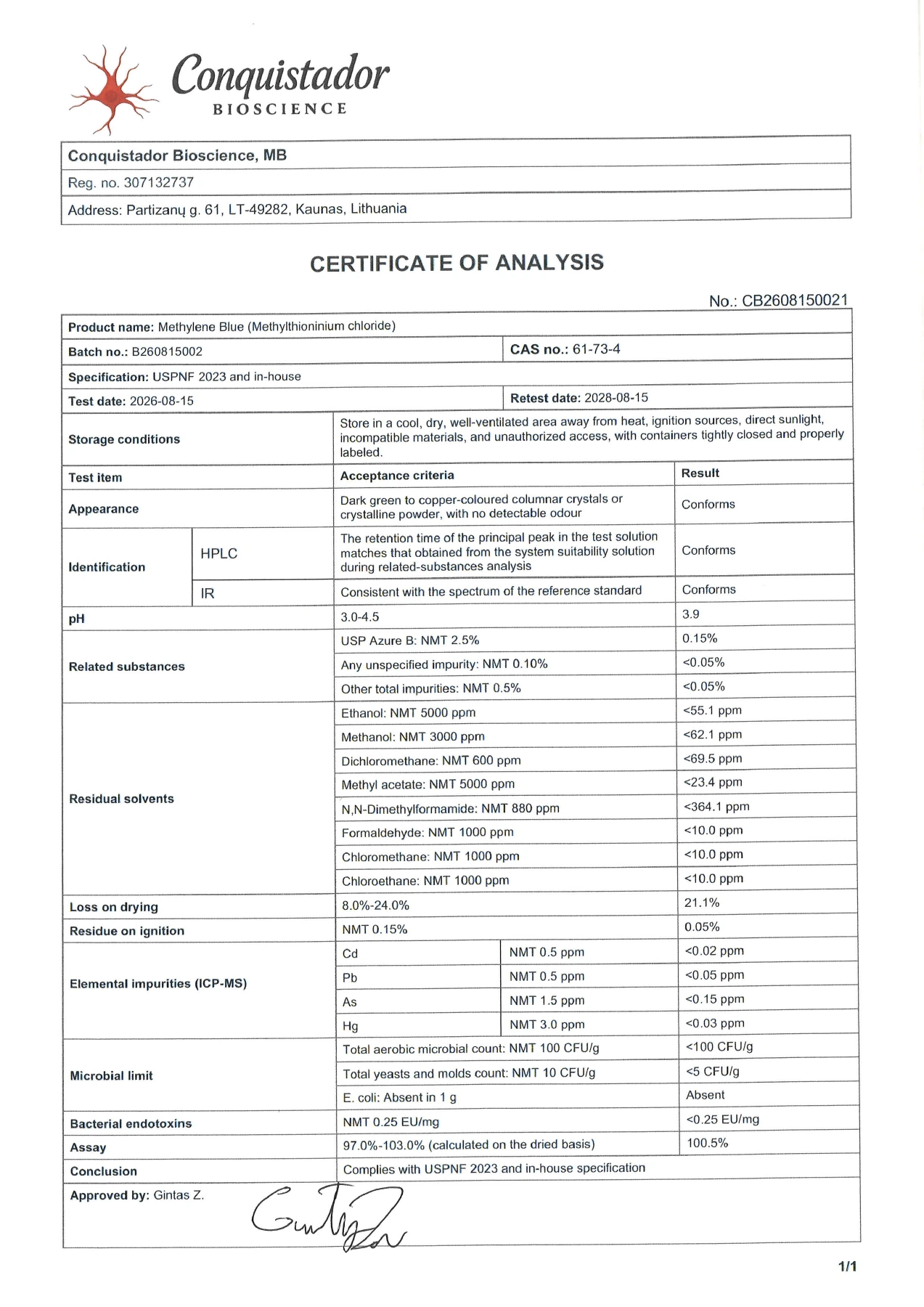
The examples below come from Conquistador Bioscience report CB2608150021, for ingredient batch B260815002, and the Macsen Laboratories certificate for batch MB-0125, hosted by Mediakos. Both were inspected on September 12, 2026. Blupreme sells methylene blue and displays the first report. These are document annotations, not independent retests or a ranking of suppliers.
| Test target | Actual report entry | Method information and interpretation |
|---|---|---|
| Lead, Conquistador | Result <0.05 ppm; limit 0.5 ppm | ICP-MS named. A bound below the limit, not zero lead. |
| Other named elements, Conquistador | Cd <0.02; As <0.15; Hg <0.03 ppm | ICP-MS named. Results concern these elements, not Azure B. |
| Azure B, Conquistador | 0.15%; maximum 2.5% | Listed under related substances; HPLC is referenced in identification. A complete impurity procedure is not printed. |
| Other related impurities, Conquistador | Any unspecified impurity <0.05%; other total <0.05% | Individual and aggregate impurity rules are distinct. “Other total” excludes the separately reported Azure B. |
| Methanol, Conquistador | <62.1 ppm; maximum 3,000 ppm | Solvent result; no solvent method printed. Do not assume GC was used solely from the analyte name. |
| Azure B, Macsen | Complies; specification <2.5% | No numerical result or analytical technique stated in this row. A compliance conclusion provides less detail than a measured value. |
| Hg, Cd, As, Pb, Macsen | Each passes; each maximum 0.00005% | Equivalent limit: 0.5 ppm. No element-analysis technique printed. The limit is not the measured concentration. |
| Other metals, Macsen | Passes; maximum 0.005% total | The entry does not name its constituent elements or procedure. Ask what the aggregate includes. |
The method column deliberately distinguishes a named technique from a missing procedure. Filling those gaps with the method normally used would make the table look more complete while making it less accurate.
What assay and drying results do not tell you
Assay measures content against a defined reference and calculation basis. The public USP methylene blue monograph preview specifies 97.0% to 103.0% on the dried basis. It does not expose the complete monograph, so this preview cannot independently verify every claimed compendial requirement.
A result near 100% is not an inventory proving that every impurity is absent. Nor should you subtract each reported impurity from 100 and expect the answer to reproduce a separate assay. Different analytical responses, calculation bases, and measurement uncertainty can prevent that arithmetic from being meaningful. The guide to methylene blue assay calculation bases explains this distinction in more detail.
Methylene blue also occurs in hydrated forms. Loss on drying measures mass removed under prescribed drying conditions; it is not a selective measurement of one metal or one dye. Residue on ignition measures what remains after the prescribed ignition procedure. Neither number identifies all the constituents responsible for it. These tests add information alongside specific impurity measurements.
Read bounds, units, and scope together
For mass fractions, 1 ppm equals 1 microgram per gram, and 1% equals 10,000 ppm. This explains the Macsen conversion in the table. Do not silently replace mass-per-mass units with mass-per-volume units when comparing a powder with a solution.
A result written as “<0.05 ppm” gives a bound. To understand the analytical sensitivity, ask whether that threshold is a detection limit, quantification limit, or reporting limit. A hypothetical “<5 ppm” result would not demonstrate compliance with a 0.5 ppm maximum: concentrations between those numbers would satisfy the reported bound while exceeding the specification.
Element selection also requires context. ICH Q3D's elemental-impurity framework uses risk assessment to develop controls for drug products. An attractive four-element result should not replace assessment of relevant manufacturing sources and the intended product. A concentration limit is meaningful within that specification, not as a universal declaration of safety for every use.
Ask for the missing evidence
Before commissioning additional testing, identify the unanswered question:
- Which material was tested? Link the report to the lot. Blupreme's batch records connect bottle batches to ingredient documentation; ingredient versus finished-product testing explains why these scopes differ.
- Which target is missing? Request named elements, specified related dyes, or relevant solvents. “Test purity” is too broad to define the laboratory's work.
- How was it measured? Request the procedure, acceptance criterion, result, units, and reporting threshold. Use the certificate-of-analysis reading guide to organize the document check.
- What remains outside the report? Concentration, microbiological quality, and suitability for a particular route need their own evidence. Chemical test results do not establish sterility.
A clear blue solution and a passing metal panel can coexist with an unanswered related-dye question. A useful quality record makes each answer, and its boundaries, visible.