
Article
Ingredient COA versus finished-product testing for methylene blue
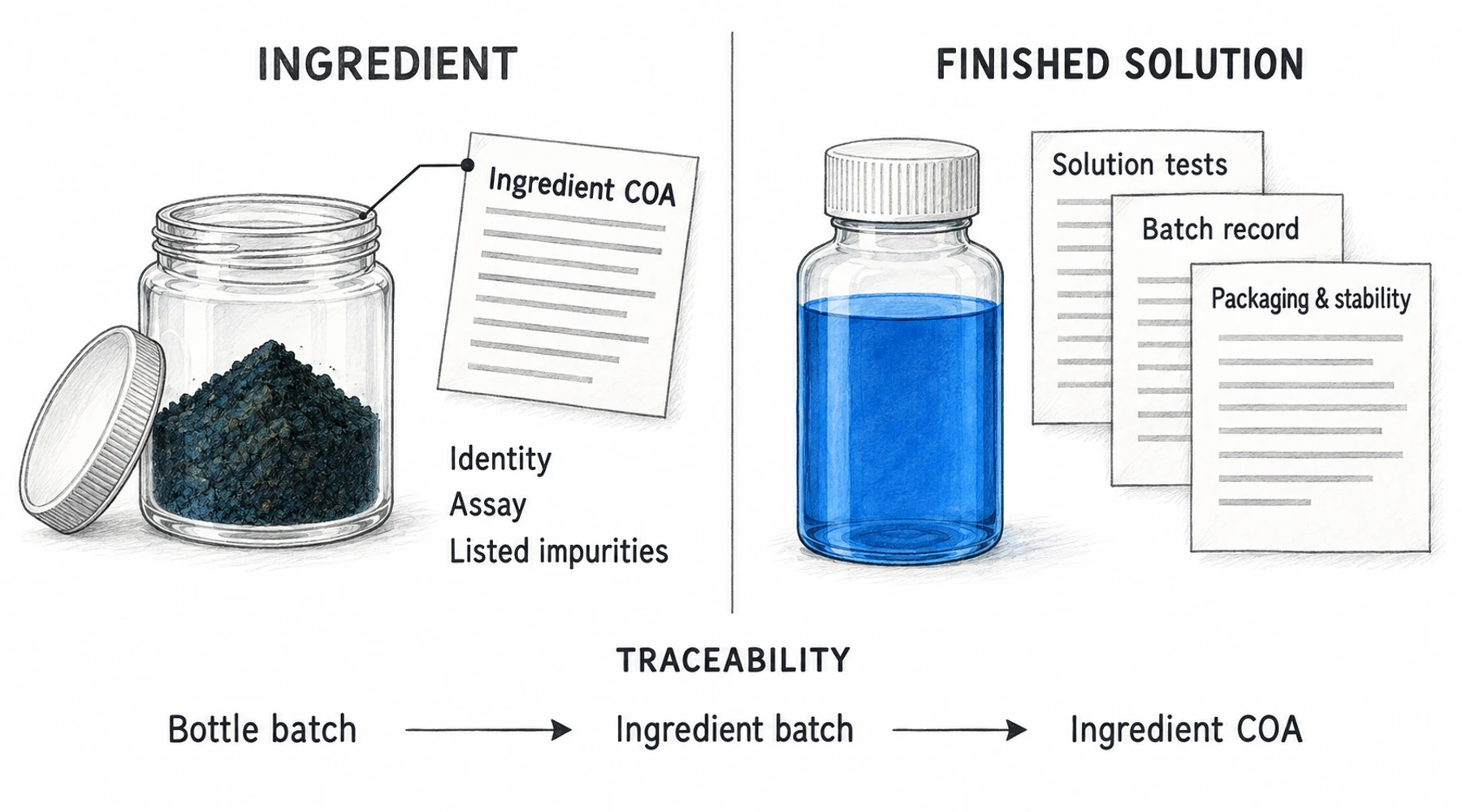
An ingredient certificate of analysis answers questions about the ingredient sampled for testing. It does not automatically describe the liquid subsequently made from that ingredient, the bottle used to contain it, or what happens during storage. A batch link makes the ingredient report relevant to a bottle. It does not change what the laboratory tested.
For methylene blue solutions, the useful question is therefore specific: Which record supports this particular claim about this particular material? Identity, concentration, microbial quality and shelf life require different evidence.
Start with the sample description
A COA is a report of defined tests against stated acceptance criteria. Look first for the material name, batch number and sample description. A document describing methylene blue powder remains an ingredient report even when a seller places it beside a solution product.
The FDA's guidance on ingredient certificates of analysis calls for identifying information, the tests performed, acceptance limits and numerical results when results are numerical. Those details delimit the report's meaning. An assay result cannot stand in for an unreported microbial test, and a metal panel does not establish every aspect of purity.
For a line-by-line explanation of methods, units and limits, use the guide to reading a methylene blue certificate of analysis.
What changes when powder becomes a solution?
Consider two hypothetical solution batches made from the same ingredient lot. One is prepared to its intended final volume. The other receives additional water. Their ingredient COA is identical, but their concentrations differ. This is why an ingredient assay percentage and a finished-solution concentration in mg/mL answer different questions.
Formulation introduces additional inputs and operations: water, any other ingredients, weighing, volume adjustment, mixing, equipment contact and filling. The relevant manufacturing record connects these operations to the product batch. A solution assay measures the sampled solution. Neither should be mistaken for the other: a recorded recipe describes preparation; a laboratory result describes a measurement.
The ICH Q6A quality framework separates drug-substance and drug-product specifications and treats testing as part of a broader system of manufacturing and stability controls. These pharmaceutical principles help distinguish evidence types; citing them does not establish that a retail product is an approved medicine.
Document coverage matrix
Use this matrix to identify the supporting record to request. These are document categories, not a statement that Blupreme publishes or performs every item listed.
| Quality question | What an ingredient COA can support | Additional supporting record or evidence |
|---|---|---|
| Is the starting material methylene blue? | Identity of the sampled ingredient when identity tests are reported | Traceability record connecting that ingredient lot to the product batch |
| What impurities were found in the ingredient? | Results for the named analytes, methods and limits | Solution-specific assessment or testing where formulation, processing or storage creates additional questions |
| Does the bottle contain the stated concentration? | Ingredient assay helps characterize the input; it does not measure the finished liquid | Finished-solution assay, with units and acceptance criteria; formulation and batch records |
| What water and other ingredients were used? | Usually outside the methylene blue ingredient report | Formulation, component specifications and batch records identifying actual inputs |
| Was this product batch made consistently? | No direct account of solution preparation | Manufacturing, mixing, filling and release records; justified sampling and process controls |
| Does the solution meet its microbial limits? | Only ingredient microbial results, if reported | Appropriate microbial testing of the solution with sample stage, method and limits identified |
| Does the formulation inhibit microbial growth during use? | Ingredient chemical purity alone cannot establish this | Formulation-specific antimicrobial effectiveness evidence and relevant preservative-content controls |
| Is the product sterile? | An ingredient chemical COA does not establish product sterility | Sterility assurance records for the process, applicable release evidence and container-closure controls |
| Does the product meet an endotoxin limit? | Only an ingredient endotoxin result, if actually included | Product-relevant endotoxin report with units, limit, sample identity and method-suitability evidence |
| Will the solution remain within specification in its bottle? | Ingredient stability does not establish solution shelf life | Stability data for the formulation and packaging, plus compatibility and protection evidence |
The last row matters because packaging is part of the product's storage environment. A change of closure or bottle material can change the questions that need investigation. The FDA's container-closure guidance evaluates protection, compatibility, safety and performance, with stability studies supporting suitability over shelf life. An attractive bottle is not itself such a study.
Bacteriostatic, sterile and low-endotoxin describe different properties
Bacteriostatic means inhibiting bacterial growth under the conditions being described. A claim about an ingredient's activity does not establish preservation of a particular bottled formulation. Concentration, organisms, exposure conditions and the complete formulation matter. Even a result showing growth inhibition would not establish that no viable microorganisms were present initially.
For preserved pharmaceutical liquids, Q6A distinguishes preservative content from preservative effectiveness. Measuring how much preservative is present and demonstrating that the formulation controls microorganisms are separate tasks. The words “bacteriostatic methylene blue” cannot substitute for either record.
Sterility concerns the absence of viable microorganisms. Its assurance depends on controlled production and packaging, with appropriate release evidence. As the FDA explains about the limitations of sterility testing, a sterility test is one component of a comprehensive contamination-control strategy. Testing sampled units does not inspect every bottle and cannot repair an uncontrolled process.
Endotoxins are bacterial components associated with Gram-negative bacteria. They can remain after bacteria die, a distinction explained in the FDA's account of pyrogens. Consequently, sterility and endotoxin control are separate questions. An endotoxin result also does not measure every possible pyrogen.
Read an endotoxin report for the tested sample, result, units and acceptance limit. “Passed” without those details hides the comparison. The FDA's endotoxin-testing guidance also addresses product interference with the assay: the formulation must not suppress or enhance the measurement in a way that invalidates the result. A result on powder cannot be relabeled as a result on bottled solution. None of these isolated claims establishes suitability for injection.
Blupreme's public traceability example
The Blupreme quality-testing page describes this route through its shared records:
Bottle batch number → ingredient batch number → ingredient COA.
Its published testing table covers ingredient identity, assay on a dried basis, named impurity categories, loss on drying, residue on ignition and specified elemental impurities. The page identifies these as ingredient records linked to product batches.
That link lets a customer locate the relevant ingredient evidence. It should not be read as a claim that the displayed ingredient COA reports the finished bottle's concentration, microbial limits, sterility, endotoxins or shelf life. The public page inspected for this article did not present those finished-solution results. That describes the evidence available on the page, not proof that no other records exist.
For a practical document request, name the bottle batch and the precise unresolved question: “Does the concentration result refer to the finished solution, and which report identifies that sample?” This is more informative than asking whether the product is simply “tested.” Combine the answer with the solution ingredients guide and the explanation of heavy metals, Azure B and other methylene blue impurities when comparing products.