
Article
What is in a methylene blue solution? Reading the ingredients
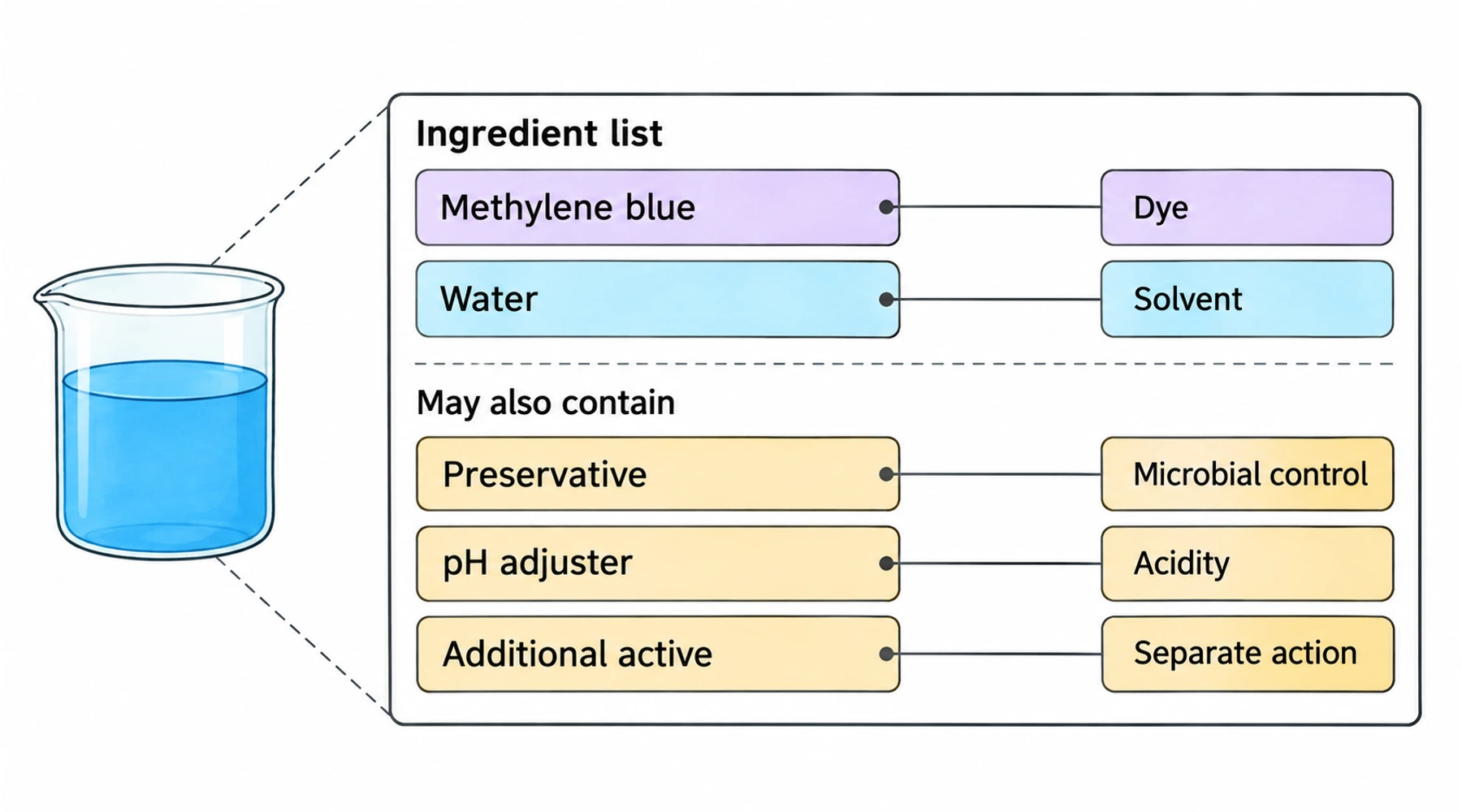
A methylene blue solution contains the dye dissolved in a liquid. What else it contains depends on the formulation. Some products contain only methylene blue and water; others include alcohol, a pH-adjusting compound, preservatives, or additional active ingredients. The words “methylene blue solution” do not identify a complete recipe.
Read the ingredient list alongside the concentration and intended use. These answer different questions: what is present, how much dye is present, and what the finished product is supplied to do. A short ingredient list cannot answer all three.
Start with the dye and the solvent
Methylene blue may also appear under the name methylthioninium chloride. It provides the characteristic blue color. Water is the solvent in an aqueous formulation: the liquid in which the dye is dissolved. “Aqueous” identifies a water-based preparation, but does not establish that water is the only liquid or that no other ingredients have been added.
Concentration is separate from ingredient identity. A label specifying 1% weight per volume means 1 gram of methylene blue in 100 mL of final solution, equivalent to 10 mg/mL. It does not mean the powder has 1% purity, or that the bottle contains 1% water. When comparing prepared methylene blue solution with powder, distinguish the amount of dye from the total liquid volume.
Annotated ingredient-label comparison
The following comparison uses two published product descriptions and one laboratory formulation. They illustrate how similar ingredient names can belong to products with different specifications and purposes. They are not interchangeable products.
| Formulation | Declared components | How to interpret the information |
|---|---|---|
| Blupreme 1% aqueous solution | USP-grade methylene blue and purified water; no added alcohol, flavorings, sweeteners, or preservatives | Two declared ingredients. The 1% statement describes dye concentration, not the purity of the whole liquid. |
| PROVAYBLUE injection | Methylene blue at 5 mg/mL and water for injection | The label also identifies a sterile intravenous prescription product. Those properties cannot be inferred merely from the presence of dye and water. |
| Loeffler's methylene blue stain in the FDA laboratory manual | Methylene blue, ethanol, and dilute potassium hydroxide solution | A formulated laboratory stain. Alcohol and alkaline conditions are part of the reagent recipe, rather than evidence that all methylene blue solutions need these ingredients. |
Blupreme's published formulation information specifies the two-ingredient composition shown above. That is a formulation statement. It should not be expanded into a claim that every possible trace impurity is absent, or that excluding additives improves medical outcomes.
The PROVAYBLUE prescribing information illustrates why the finished-product description matters. It specifies sterility, intravenous administration, concentration, and packaging, in addition to ingredients. An ordinary bottle containing methylene blue and water does not become suitable for injection because its ingredient names resemble that list.
The FDA's Loeffler stain formulation demonstrates the opposite problem: a familiar dye name can conceal an unfamiliar preparation. For laboratory work, check the complete reagent specification before substituting a plain aqueous solution.
Ingredient-function glossary
Use this glossary to annotate a label. An ingredient can have more than one function; the manufacturer should clarify its role when the label does not.
| Label term | Function in a formulation | Useful follow-up question |
|---|---|---|
| Methylene blue | The named dye or active substance, depending on the product's purpose | What is its concentration and stated chemical form? |
| Water or purified water | Solvent or liquid carrier | What water specification and finished-product controls apply? |
| Ethanol | A solvent or co-solvent; its purpose depends on the preparation | Is alcohol deliberately added, and at what concentration? |
| Preservative | Inhibits microbial growth in the formulation | Has effectiveness been established in this specific product? |
| Buffer or pH adjuster | Maintains or changes acidity or alkalinity | Is there a specified pH range for the intended application? |
| Flavoring or sweetener | Changes sensory properties | Is the full composition disclosed, including ingredients relevant to sensitivities? |
| Additional active ingredient | Adds a separate intended biological or pharmacological action | What is its amount, and what evidence concerns the combination? |
In medicines, “excipient” means a constituent other than the active substance, included for a particular purpose. The European Medicines Agency's explanation of excipients also makes a useful distinction: an ingredient described as inactive can still have an effect in certain circumstances. “Inactive” is not a promise of irrelevance to every person or application.
What alcohol-free and preservative-free actually tell you
An alcohol-free formulation excludes an intentionally added alcohol carrier as described by its manufacturer. It does not replace residual-solvent testing of the ingredient. A manufacturing residue and a deliberately added solvent are different categories, assessed through different records.
Likewise, preservative-free describes a formulation choice. It does not establish sterility, greater efficacy, or unlimited stability. Nor does the presence of a preservative establish poor quality. The meaningful question is whether the finished formulation meets its intended requirements.
The FDA's guidance on preservatives in drug manufacturing distinguishes testing preservative effectiveness from measuring preservative content. It also states that preservatives must not substitute for good manufacturing practices. Merely listing a preservative cannot demonstrate adequate microbial control.
Shelf life needs separate evidence. The FDA explains that drug expiration dates depend on stability data and labeled storage conditions. Do not borrow a storage period from another brand because both list water and methylene blue. Check the actual packaging and product-specific storage and shelf-life instructions, including any directions after opening.
Multi-ingredient blends need a different comparison
Suppose one product contains methylene blue in water, while another also contains caffeine and several botanical extracts. Even if their methylene blue concentrations match, the products differ in more than presentation. An effect reported after using the blend cannot automatically be attributed to methylene blue. The other ingredients, their amounts, interactions, and the circumstances of use remain possible explanations.
The same limitation applies to unwanted symptoms. A testimonial that names only the headline ingredient leaves out potentially relevant information. For a clinician or pharmacist reviewing an exposure, retain the complete ingredient panel, amounts, batch number, timing, and other products used. Seek medical advice for symptoms rather than testing the attribution by repeating exposure.
This comparison also matters when moving between gummies and liquid drops or capsules, tablets, and liquids. Compare the whole formulation per stated unit, not just the ingredient featured on the front label.
Before selecting a product, identify its complete composition, concentration, intended use, and supporting documentation. Each answers a separate question. The ingredient list is the starting point for that review, not its conclusion.