
Article
Methylene blue solution versus powder: concentration, handling, and cost
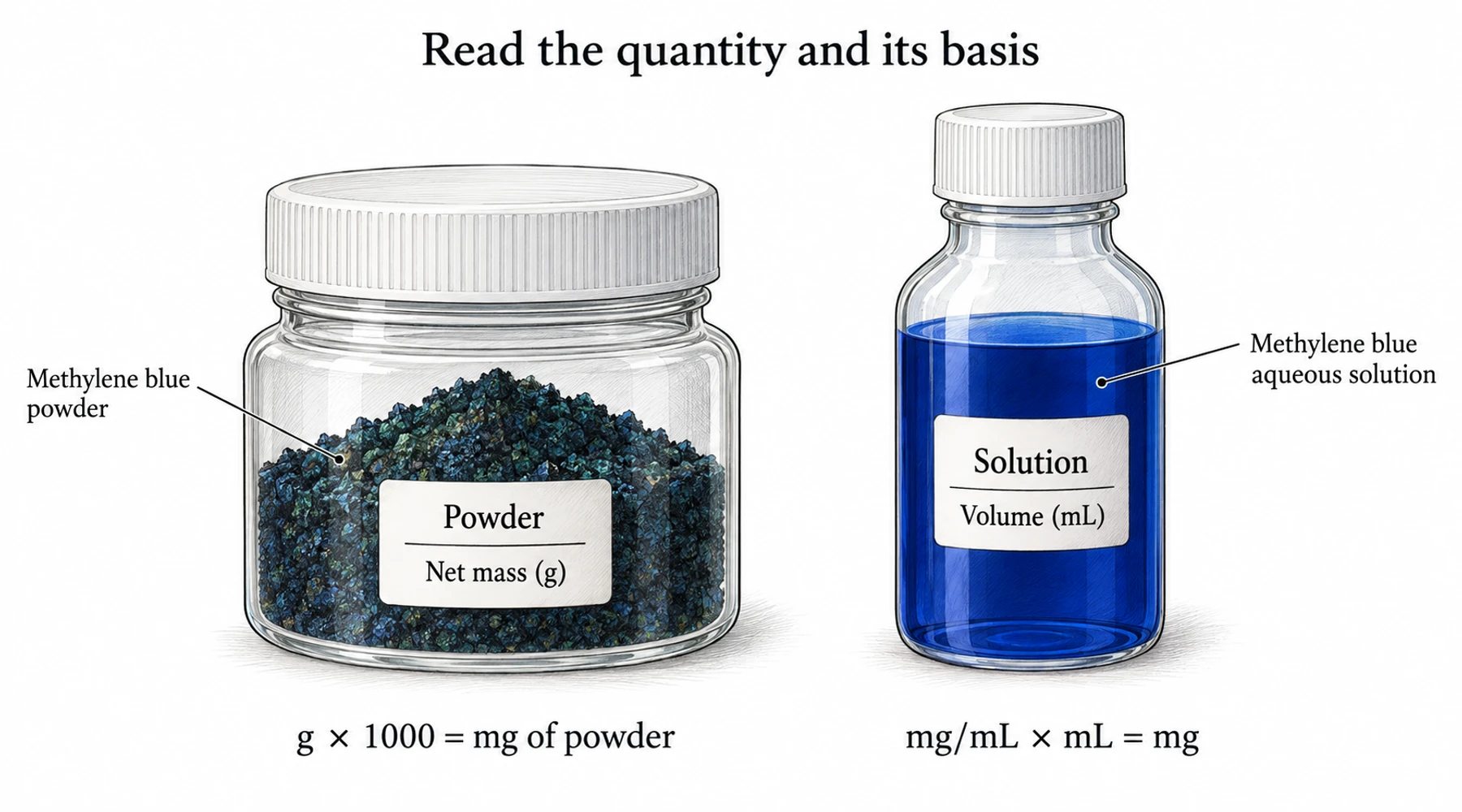
A bottle of methylene blue solution buys a specified liquid volume at a stated concentration. A powder pack buys a specified mass of solid material. Comparing their prices requires a common quantity, and that quantity is not automatically the number printed on the front of either package.
For procurement, start with suitability and documentation. Then calculate the cost of the documented amount. Powder can reduce the purchase cost per gram while adding preparation and verification work. A prepared solution can remove that work when its formulation and concentration already match the intended application. Neither format, by itself, establishes better absorption or clinical benefit.
What the package actually contains
The Blupreme solution listing specifies a 100 mL bottle, 1% weight per volume, and 10 mg/mL. These statements are consistent: 1% w/v means 1 g of the named substance in 100 mL of finished solution. Multiplying 10 mg/mL by 100 mL gives 1,000 mg of label-stated methylene blue in the bottle.
The 5 g powder listing specifies net powder contents. It does not turn a 5 g package into a batch-specific declaration of 5 g of anhydrous methylene blue. The chemical form, water content, and assay reporting basis determine how the material's mass relates to a particular analytical quantity.
This distinction is visible in other suppliers' documentation. Sigma-Aldrich's M9140 powder specification lists a hydrated formula and dye content of at least 82%. A dye-content specification is different from a pack weight. A minimum specification is also different from an exact batch result. It should not be entered as an exact measured value merely because it is the only percentage available.
| Question | Prepared solution | Powder |
|---|---|---|
| What quantity is sold? | Usually liquid volume | Usually net solid mass |
| What establishes methylene blue amount? | Concentration, basis, and total contents | Applicable assay or mass fraction, basis, and net contents |
| What work may remain? | Measuring liquid; any application-specific preparation | Weighing, dissolution, final-volume control, labeling, and verification |
| What else matters? | Solvent, additives, container, expiry, opening instructions | Chemical form, moisture, grade, container, and handling controls |
| Does the format prove suitability? | No | No |
Percentages need a denominator
For a w/v solution, multiply the percentage number by ten to obtain mg/mL. A 1% w/v solution is therefore 10 mg/mL, not 1 mg/mL. The denominator is the final solution volume, not the volume of water before a material is added.
For a w/w solution, the percentage describes grams of substance per 100 g of finished mixture. A 1% w/w mixture contains 10 mg per gram of mixture. If its pack contents are stated in milliliters, converting to substance mass requires the finished solution's density. Substituting a density of 1 g/mL without documentation silently changes an assumption into a result.
For powder, an applicable 90% mass fraction would mean 0.90 g of the stated analyte per gram of material as supplied. This is an illustrative definition, not a claim about Blupreme powder. An assay calculated on dried material cannot simply be multiplied by an undried pack weight. Likewise, an HPLC area percentage is not automatically a mass fraction. Ask the supplier to explain the basis if the documents do not make it clear.
The guide to mg, mL, percentages, and drops explains the measurement distinctions further. A drop count should not replace a documented package volume in a price comparison.
What current catalog prices do and do not show
The Blupreme catalog displayed these EUR prices on September 12, 2026. Check the live listing and checkout total before ordering; shipping and applicable taxes can change the comparison.
| Listing | Displayed price | Documented package quantity | Direct unit-price calculation |
|---|---|---|---|
| 1% w/v solution, 100 mL | €15.00 | 1 g label-stated methylene blue in solution | €15.00 per labeled gram |
| Powder, 5 g | €55.65 | 5 g net powder | €11.13 per gram of powder |
| Powder, 10 g | €94.17 | 10 g net powder | €9.417 per gram of powder |
The powder rows compare package material, while the solution row compares label-stated solute. They are useful purchasing figures, but they are not yet an equivalent-analyte ranking. For that ranking, obtain compatible chemical and assay bases for both formats.
Even a valid lower unit price can give a higher total purchase cost. A project requiring less material may leave most of a large pack unused. Preparation labor, suitable equipment, solvent, containers, waste, and quality checks also have costs. Count those explicitly when they matter; the catalog price does not include an estimate of your laboratory's work.
Use the format-cost calculator
Open the solution-versus-powder cost calculator. The self-contained HTML file also works offline when saved and opened in a browser. It compares two offers using one currency, pack counts, price, and the documented concentration or powder mass fraction.
Select the basis separately for each offer. The calculator supports mg/mL, % w/v, % w/w with contents in grams, % w/w with contents in milliliters and documented density, and powder with an applicable as-supplied mass fraction. Missing, negative, zero-content, and out-of-range mass-fraction inputs stop the calculation. It requires confirmation that the named chemical quantity is comparable before displaying a price comparison.
Results show total documented mass, price per gram, and the proportional material cost of the comparison quantity. This last number can represent part of a pack; it is not a checkout quote. The fictional example demonstrates the arithmetic without making product assay claims. No result is a dose, preparation recipe, or recommendation to administer either product.
Choose the format around the work
A prepared liquid removes powder weighing and initial dissolution. It still needs an application-appropriate composition and measurement method. For example, Thermo Scientific's 1% w/v aqueous reagent is labeled for research use. Its physical similarity to another blue solution does not make their intended uses interchangeable.
Powder adds opportunities for losses and mistakes during transfer, weighing, and preparation. Keep handling tied to the actual label and safety data sheet, including controls for dust and contact. Follow each product's storage conditions rather than assuming that dry material and liquid share a shelf life. The powder buying guide covers powder documentation and pack selection in more detail.
Finally, a comparison of oral absorption would need evidence from appropriately matched products, doses, routes, and conditions. A solution being already dissolved is a description of its physical state. It does not establish that a particular retail liquid outperforms a particular powder product in people. For this buying decision, the defensible comparison is documented contents, suitability, handling work, and cost.