
Article
Methylene blue powder: grades, pack sizes, and buying checks
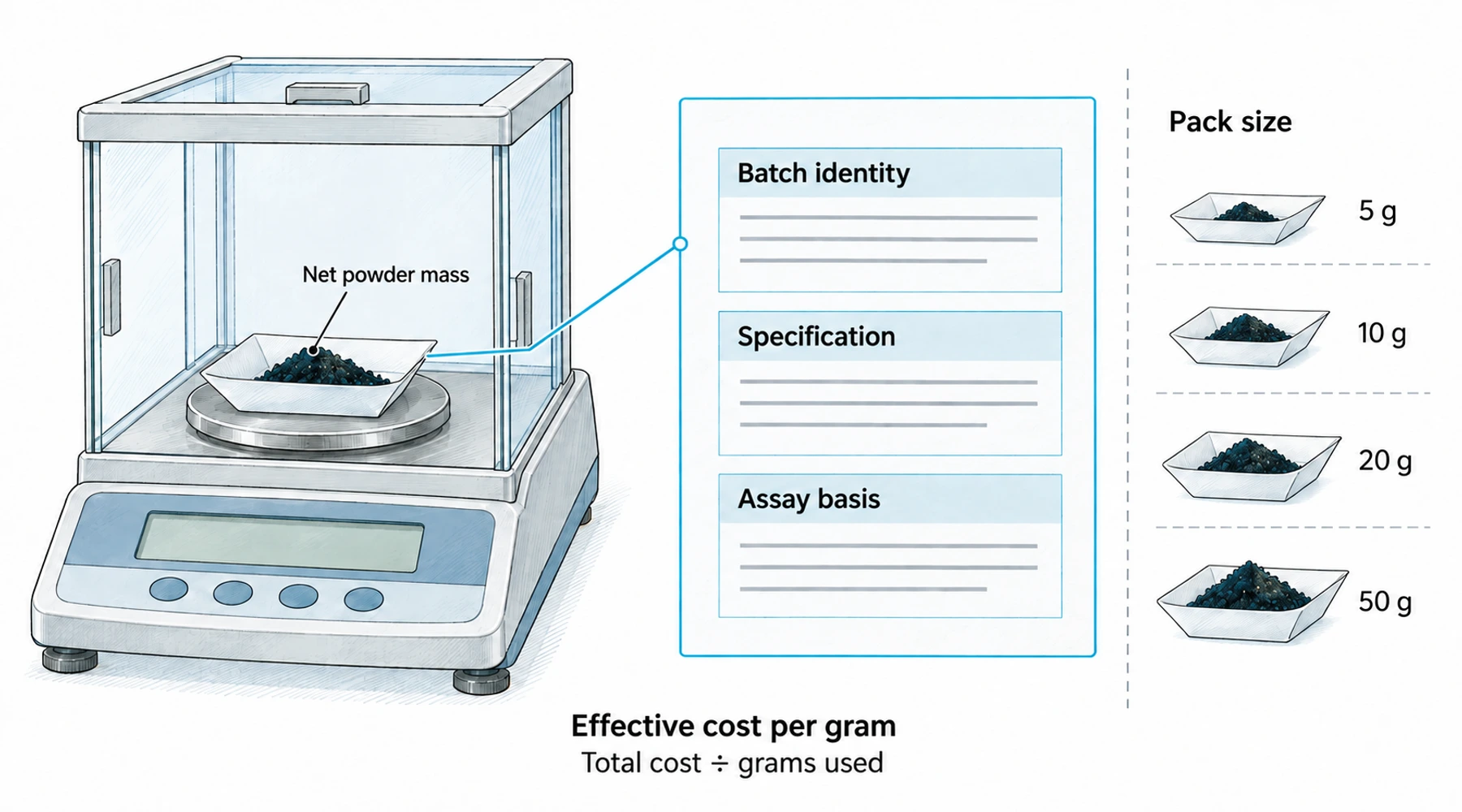
Choose methylene blue powder by the specification your work requires, then by the quantity you expect to use. A large pack can reduce the price per gram while increasing the amount left unused. A prominent purity percentage can be accurate while describing a different measurement from the one your procedure needs.
The purchase therefore has two parts: establish that the material is suitable, then compare the cost of suitable options. Reversing that order can leave you with inexpensive powder that cannot be accepted into your process.
Define what the powder must satisfy
Write the intended application into the purchasing request. A microscopy laboratory may need a dye qualified for a named staining method. An analytical laboratory may need a defined assay and impurity profile. A procurement team buying against a pharmaceutical specification needs documentation showing compliance with that specification.
These requirements cannot be reduced to a single ladder of impressive-sounding grades. For example, Sigma-Aldrich M9140 is a Biological Stain Commission-certified powder with dye content of at least 82%, qualified for specified staining applications. That is a concrete product specification, not a claim that every remaining percentage point is a hazardous contaminant. It is also not evidence that the product satisfies a different pharmaceutical specification.
Use this comparison when reading a powder listing:
| Wording or number | What to establish before accepting it |
|---|---|
| USP grade | Which applicable specification is claimed, and where are the supporting batch results? |
| Certified biological stain | Which staining applications are covered by the certification? |
| Reagent or laboratory grade | What actual tests and acceptance limits does the supplier define? |
| A purity percentage | What method, reporting basis, and impurity information accompany it? |
| Net weight | Does this mean the supplied powder, and what chemical form does that powder contain? |
Ask for missing details before comparing prices. A supplier's adjective cannot fill an empty specification field.
Separate pack weight from assay basis
A 10 g pack describes the quantity supplied. It does not, by itself, state how much anhydrous methylene blue that material represents.
The USP methylene blue monograph preview lists hydrated forms and defines an assay range of 97.0–103.0% calculated on the dried basis. The reporting basis matters: a dried-basis result is not the percentage of the entire as-supplied pack after simply dividing by its gross mass. Water associated with a hydrate is also different from a liquid carrier deliberately added to make a solution.
For work requiring an exact chemical quantity, ask which form is supplied and how the batch certificate reports water or loss on drying and assay. Let the validated preparation method determine any correction. Do not calculate a formulation from a large percentage printed on a product thumbnail.
This distinction also explains why two certificates should not be ranked by their headline numbers until their methods and reporting bases are understood. An absorbance-based dye-content specification and a dried-basis pharmaceutical assay answer different questions.
Compare the current pack prices
The following EUR prices were displayed in the Blupreme catalog on 12 September 2026. Calculations use listed product price divided by net pack weight; they exclude delivery and any checkout adjustments. Check the listing for your current order total.
| Powder pack | Listed price | Explicit calculation | Price per gram, rounded |
|---|---|---|---|
| 5 g | €55.65 | €55.65 ÷ 5 g = €11.13/g | €11.13/g |
| 10 g | €94.17 | €94.17 ÷ 10 g = €9.417/g | €9.42/g |
| 20 g | €188.34 | €188.34 ÷ 20 g = €9.417/g | €9.42/g |
| 50 g | €419.48 | €419.48 ÷ 50 g = €8.3896/g | €8.39/g |
At these prices, the 20 g pack has the same unit cost as the 10 g pack. The 50 g pack costs €51.37 less than five 10 g packs: €470.85 − €419.48. Package size alone does not guarantee an additional discount at every step.
Account for material you will not use
Unit price assumes you use the whole pack. For intermittent work, add a second calculation:
Effective cost per usable gram = total acquisition cost ÷ grams expected to be used within the material's acceptable storage and use period.
Consider an illustrative quote of €90 for 10 g and €400 for 50 g. If a project needs only 10 g, its material expenditure is €90 with the small pack or €400 with the large pack. Calling the large pack “€8 per gram” does not change the unused inventory. If another scheduled project can use the remainder, the comparison changes.
Estimate demand from actual preparations and planned repeats. Include the material consumed by incoming checks if those are required. Compare one large pack with multiple sealed packs: the latter may allow stock to remain unopened, but the benefit depends on the packaging and your handling process. Do not invent an extended shelf life simply because the product is dry.
Check the records before opening the pack
Blupreme's batch documentation process links product batches to ingredient batches and their certificates of analysis. Use that traceability rather than assuming that a certificate shown elsewhere on the site covers the pack in your hand.
A certificate of analysis and a safety data sheet serve different purposes. The certificate reports results for identified material. The safety data sheet describes hazards and handling. Neither replaces the other.
Keep this five-part checklist with a purchasing request:
- Application: record the intended method, required grade, and acceptance criteria.
- Identity and contents: record product code, chemical form, net powder weight, and any stated additives.
- Batch evidence: obtain the relevant certificate, connect it to the supplied lot, and check methods, limits, dates, and results.
- Handling readiness: confirm suitable weighing equipment, storage, protective equipment, and the applicable safety data sheet.
- Purchase comparison: record delivered cost, expected usable quantity, unit cost, and the reason for the selected pack size.
Include powder handling in the purchase decision
Powder requires controlled weighing and transfer. The Thermo Fisher methylene blue hydrate safety data sheet, revised in December 2025, specifies avoiding dust, using ventilation and protective equipment, and storing that product tightly closed in a cool, dry location. Follow the documentation for the product actually purchased.
Before ordering, establish where the pack will be opened and weighed, how its lot identity will remain attached to any working container, and who will check the preparation record. These practical requirements belong in the cost comparison because they consume equipment and staff time.
For the broader supplier decision, use the guide to choosing where to buy methylene blue. For the powder order itself, record three things together: the accepted specification, the matching batch evidence, and the quantity justified by your expected work.