
Article
How to choose methylene blue: a buyer's comparison checklist
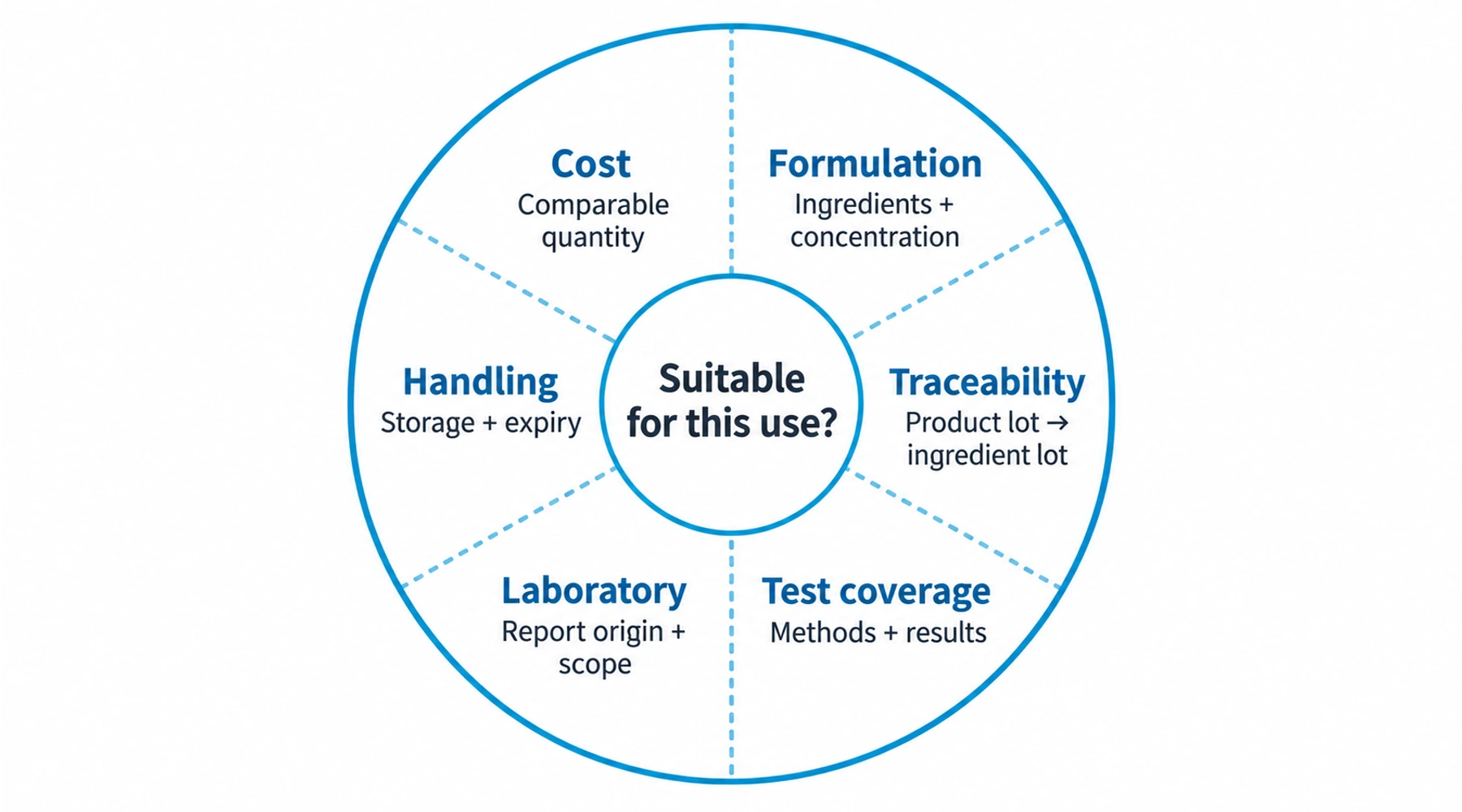
Choose methylene blue by matching a documented product to a defined use. A purity percentage, attractive bottle, or long list of customer reviews cannot establish that match on its own.
Blupreme sells methylene blue. This guide provides criteria you can apply to Blupreme and other suppliers. It does not identify a best brand or report independent comparative testing.
Start with the supplier-document comparison worksheet. Save the CSV and open it in a spreadsheet. It has space for three suppliers, the evidence supporting each answer, unresolved questions, and a purchasing decision. Set your requirements before entering brand names.
Define the use before comparing products
“Best methylene blue” is incomplete without an application. A laboratory may need a stain that performs consistently in a particular method. A procurement team may need a specified chemical form and traceable ingredient batches. A patient seeking treatment needs a clinical and pharmacy decision.
A search for the “best methylene blue supplement” does not establish that a product is suitable to consume. Intended use, legal supply, and clinical suitability require their own assessment. For US prescription purchases, the FDA recommends checking the online pharmacy's license, prescription requirement, and access to a pharmacist. Outside the US, use the relevant local regulator's requirements.
Write one sentence at the top of the worksheet: “We need this product for ___, in ___, subject to ___.” Treat requirements essential to that use as pass-or-hold conditions. A low price cannot compensate for the wrong formulation.
Compare the same material
Record the exact product, pack size, physical form, concentration, solvent, and other ingredients. Powder and an aqueous solution are different purchasing units. A percentage also needs a definition: what quantity is being expressed, relative to what total?
An ingredient assay and a solution concentration answer different questions. The former describes the tested ingredient on a stated analytical basis. The latter describes how much material is present in a volume or mass of solution. One cannot substitute for the other. Check the practical differences between solution and powder before normalizing prices.
Likewise, distinguish a USP-grade designation from the product's intended-use label. The words “laboratory,” “aquarium,” and “pharmaceutical” need to be read in their specific context. The comparison of methylene blue labels explains these distinctions. Ask which specification supports the seller's claim and which material that specification covers.
Follow the document back to the bottle
A certificate of analysis is useful only when you know what was tested and how it relates to the product offered. Record the bottle lot, the tested material's lot, the report identifier, and any batch record connecting them.
For example, Blupreme's quality documentation describes a route from the product batch to the ingredient batch and its COA. That is a traceability claim about the ingredient. It should not be silently expanded into a claim that every finished bottle underwent every test on the ingredient report.
Ask whether the sample was powder, bulk solution, or packaged product. If your application requires evidence about the finished solution, identify which additional records establish its concentration, preparation, packaging, or other relevant attributes. An excellent ingredient report leaves those questions open unless it actually addresses them.
Check coverage, not the number of badges
Use this table to organize documents. It is a purchasing framework, not a universal product specification.
| Item to compare | Evidence to record | Question it cannot answer alone |
|---|---|---|
| Intended-use label | Exact wording and restrictions | Is the product clinically appropriate for a particular person? |
| Ingredient identity and assay | Method, result, units, analytical basis, specification | What is the concentration of a separately prepared solution? |
| Impurity testing | Named analytes, methods, limits, results | Were substances outside the panel assessed? |
| Batch traceability | Bottle lot, ingredient lot, connecting record | Was every bottle individually tested? |
| Finished-product records | Which attributes were assessed and at what stage | Does an unmeasured attribute meet your requirements? |
| Storage and expiry | Instructions for the exact formulation and package | How long will it remain suitable under different conditions? |
A report saying “pass” can be interpreted only alongside its limit and method. A less-than result needs its reporting threshold; it does not mean absolute absence. Similarly, “heavy metals tested” does not identify the elements measured or establish a complete impurity profile. Use the guide to reading a methylene blue COA to examine individual entries.
An SDS serves a different purpose. OSHA describes safety data sheets as a way to communicate chemical hazards. Keep the correct SDS for handling and storage information, but do not count its presence as a batch test result.
Verify who issued the evidence
Record the laboratory's name, report number, date, and route for checking authenticity. If accreditation is claimed, check the accreditation body's directory and the relevant scope. ILAC explains that accredited testing activities are defined by that scope. A laboratory's accreditation is not an unrestricted endorsement of every claim printed beside its logo.
Keep “not provided” distinct from “failed.” Missing evidence does not prove the product is poor, but it prevents you from confirming the requirement. Request the specific missing record and put the decision on hold when it concerns an essential condition.
Compare cost after qualification
Compare the delivered cost of products that meet the same requirements. Use a consistent quantity and concentration basis, then include freight, tax, minimum order, preparation work, and the amount you can use before expiry. The price comparison guide develops this calculation.
The Blupreme catalog lists both solution and powder, illustrating why bottle price alone is a weak comparison. No current-price ranking is provided here: prices and available lots can change, while the comparison method remains useful.
Make a decision that can be checked
Suppose Supplier A provides a broad report for an unidentified sample. Supplier B provides a narrower report tied to the offered lot. Neither automatically wins. A has an unresolved traceability question; B may have unresolved test-coverage questions. The next action is to request the missing evidence against your requirements.
In the worksheet, mark each requirement confirmed, unresolved, does not meet requirement, or not applicable. Finish with a decision, the supporting document references, and a reviewer date. Recheck when the lot, formulation, specification, or intended application changes. This produces a defensible purchase decision without pretending that one brand is best for every task.