
Article
Methylene blue grades: what technical, reagent, aquarium, and USP mean
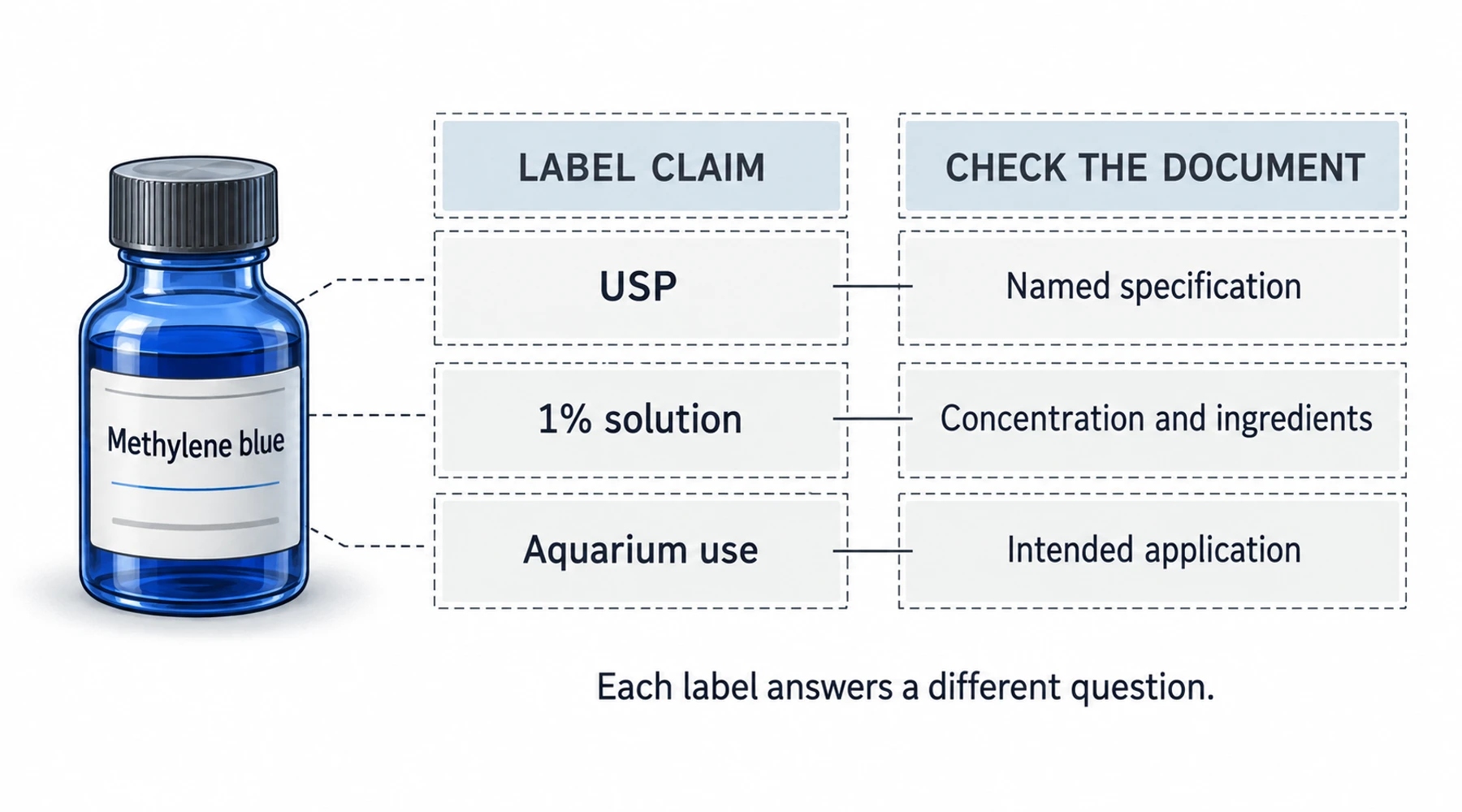
A methylene blue label can describe three different things: the specification the material meets, the formulation in the bottle, or the use the supplier intends. These distinctions determine what you can reasonably infer from words such as technical, laboratory reagent, aquarium, and USP.
They do not form one dependable ladder from low to high quality. A product can be well characterized for staining a specimen without being manufactured as a medicine. An aquarium solution can have a clearly stated composition without establishing suitability for human consumption. Start by identifying what kind of claim each label makes.
Label-meaning comparison
The table separates the claim from the evidence needed to evaluate it. The examples illustrate categories, not purchasing recommendations.
| Label | What it tells you | Example or applicable specification | What it does not establish |
|---|---|---|---|
| Technical grade | A supplier's category generally associated with manufacturing or less demanding laboratory work | Fisher groups technical, laboratory, and reagent products under supplier-defined quality where an official standard is not specified | A universal assay percentage, impurity profile, or suitability for ingestion |
| Laboratory reagent | A chemical supplied for laboratory work; the precise quality claim needs clarification | The supplier's product specification and batch certificate should define relevant limits | Automatic compliance with ACS or a pharmacopoeia |
| ACS reagent | A claim of compliance with the applicable American Chemical Society reagent specification | ACS Reagent Chemicals contains chemical-specific purity requirements and analytical methods | Suitability of the packaged product as a human medicine |
| Aquarium use | An intended application for fish or aquarium treatment | Kordon specifies a 2.303% aqueous solution of zinc-free methylene blue chloride | A universal “aquarium-grade” purity standard or permission for human use |
| USP | A claim of meeting the applicable United States Pharmacopeia requirements | The published Methylene Blue monograph preview defines an assay of 97.0–103.0% on the dried basis | That every finished solution made from the ingredient is sterile, approved, or appropriate for any route |
| Food grade | A claim requiring an identified food specification and a lawful intended food use | Ask for the exact standard, jurisdiction, and permitted use; food-contact listings need separate interpretation | General permission to consume methylene blue or use it as food coloring |
| Human grade / pharmaceutical grade | Descriptive wording that needs translation into verifiable product requirements | A named pharmacopoeia, batch documentation, dosage-form specifications, and product authorization where applicable | A complete, self-defining methylene blue specification from those words alone |
The laboratory distinctions follow Fisher's published chemical-grade definitions and the ACS description of its reagent specifications. The product and regulatory examples are examined below.
Laboratory labels describe suitability for a task
“Laboratory reagent grade” is incomplete information unless the supplier explains the tests behind it. A laboratory might need a dye that stains bacteria consistently, a reagent with controlled trace-metal levels, or a substance suitable for quantitative analysis. Those requirements overlap, but they are not identical.
For a concrete example, Sigma-Aldrich M9140 methylene blue is listed as a powder certified by the Biological Stain Commission, with dye content of at least 82% and staining applications. That is an application-specific product description. It is not a statement that the remaining percentage consists of toxic contamination, and it is not a pharmaceutical-use claim.
A percentage needs a definition. Dye content, chromatographic purity, and an assay corrected for water are different measurements. Comparing the biggest number on two listings can therefore compare different properties. Ask what was measured, by which method, and on what basis before ranking either product.
Aquarium use is not a universal purity grade
Kordon's methylene blue product information provides a useful example of an intended-use label with accompanying specifications. It describes the zinc-free chloride salt in a 2.303% water solution, identifies aquarium applications, and explicitly excludes human consumption. It also excludes use as a medication for food fish.
The word aquarium tells you the application. The concentration tells you the formulation strength. Zinc-free describes one aspect of the material. None of those statements supplies a complete pharmaceutical specification.
It is equally unjustified to assume that every aquarium bottle contains a particular heavy metal or additive. Establish the composition of the actual product. Do not replace missing evidence with either reassurance or an accusation. For fish-specific decisions, use the separate guide to methylene blue for aquarium fish.
What a USP claim needs behind it
The USP Methylene Blue monograph preview defines the substance and gives an assay range of 97.0–103.0%, calculated on the dried basis. The upper limit is an analytical acceptance limit, not a claim that a bottle can contain more than 100% matter. The dried-basis qualification also matters when comparing hydrated material with an as-supplied dye-content result.
The preview is not the complete monograph. One passing assay result cannot establish that all applicable requirements were met. Ask which edition or effective specification was used and request documentation tied to the supplied batch. The separate explanation of USP-grade methylene blue develops this distinction further.
Also identify what the claim covers. “Made with USP-grade methylene blue” concerns an ingredient. Dissolving, filling, and storing that ingredient creates additional questions about the finished product, including concentration, other ingredients, contamination control, packaging, and stability.
A medicinal product label is more specific. The FDA-hosted 2024 ProvayBlue labeling describes a sterile intravenous solution containing 5 mg/mL methylene blue and water for injection, with strength expressed in terms of the trihydrate. These are product and route details. A retail USP ingredient claim does not supply them.
Why food-grade and human-grade wording needs scrutiny
Food grade should lead to a specific standard and permitted food use, not a general belief that a blue chemical is edible. The FDA summary of permitted color additives does not list methylene blue as an approved human-food color. Approval for one category or application cannot be transferred to another.
There is a further search-result trap: methylene blue appears in the FDA food-contact substance inventory, which points to a specific regulation and tells readers to check their intended use. A food-contact entry is not blanket authorization to add the substance to food or swallow it. These examples concern the United States; a seller serving another market should identify that jurisdiction's applicable requirements.
“Human grade” and “pharmaceutical grade” likewise need supporting detail. Ask the seller to name the specification and identify the finished product's intended route and regulatory status. As the FDA explains about product approval, registering a facility or listing a drug does not itself establish approval. A quality claim also cannot decide whether a medicine is appropriate for a particular person.
Read the documents in this order
- Intended use: Does the actual label cover the application you need?
- Formulation: Is this powder or solution, with what concentration, ingredients, and chemical form?
- Specification: Which named standard or supplier limits apply, and to the ingredient or finished product?
- Batch evidence: Does the certificate identify your lot and report methods, limits, and results for the relevant tests?
Use the guide to reading a methylene blue certificate of analysis to examine the final step. A useful answer connects the label, specification, and batch. An impressive adjective cannot fill a gap between them.