
Article
Methylene blue for aquarium fish: uses, limits, and tank decisions
Methylene blue has specific uses in aquarium care, particularly around fish eggs and certain external problems. Whether it belongs in your treatment plan depends on three things: what is wrong with the fish, what the bottle actually contains, and where treatment will take place.
A bare container of eggs and a planted community aquarium are different treatment environments. A direction written for one cannot be transferred to the other simply because both contain water and fish. Start with the problem and the system before calculating an amount.
What an aquarium product is intended to do
Kordon's methylene blue product information describes a 2.303% aqueous product for fungal control on fish eggs and superficial fungal infections, with secondary uses against some external protozoans. It also describes assistance in known nitrite or cyanide poisoning. The manufacturer excludes bacterial infections, flukes, Oodinium, and more severe fungal disease from its indications. This is an ornamental-fish product, not a food-fish medication or a product for human consumption.
Those boundaries matter. “Fish medication” is a category, not a diagnosis. A keeper describing every white growth as fungus can select a product whose intended use does not match the underlying problem. The guide to methylene blue for fish eggs addresses that particular application; aquarium treatment comparisons explains why other agents are not interchangeable choices.
Check water quality before interpreting symptoms
When several fish become unwell, record which species are affected, when the change began, and what changed recently: stocking, feeding, water replacement, equipment, or treatment. Do not turn those observations into a disease name before checking the environment.
The UF/IFAS fish health management guide recommends checking water quality first when fish appear sick. Its minimum outbreak screen includes dissolved oxygen, ammonia, nitrite, and pH. Surface gasping, rubbing, or lethargy signal a problem but do not identify its cause. Ulcers, persistent respiratory distress, or continuing deaths warrant prompt assessment by an aquatic veterinarian or fish health specialist.
A clear-looking aquarium can still contain ammonia. UF/IFAS explains that ammonia is colorless and odorless at concentrations harmful to fish, and that interpretation of total ammonia requires temperature and pH. A dye cannot replace those measurements. For example, if a filter has stopped operating, a medication decision does not resolve the lost waste-processing capacity.
Nitrite, nitrate, ammonia, and low dissolved oxygen are also different problems. The discussion of methylene blue and nitrite poisoning in fish separates the blood-related mechanism from correcting the water itself.
Aquarium decision tree
Follow the rows in order. A “stop” means that the information needed for a treatment decision is missing, not that the fish should be left without care.
| Decision | If yes | If no or unknown |
|---|---|---|
| 1. Have water quality and urgent equipment failures been assessed? | Record the results and continue. | Test the water and address the immediate husbandry problem; obtain urgent help if fish are deteriorating. |
| 2. Does the identified problem match this product's aquarium indications? | Check the intended species and life stage. | Stop the medication selection and obtain a diagnosis. |
| 3. Are the exact product, active concentration, and instructions readable? | Record the formulation and the specific treatment method. | Do not substitute a dose from another bottle or an internet recipe. |
| 4. Can the proposed tank meet the label's compatibility conditions? | Plan aeration, monitoring, and equipment handling. | Evaluate a separate treatment system or another suitable approach with a specialist. |
| 5. Is actual treatment-water volume known in the units the label uses? | Use that volume with the product's own directions. | Measure it before preparing treatment water. |
| 6. Is there a defined observation and completion plan? | Record changes and follow the specified course. | Clarify duration, removal, monitoring, and escalation before starting. |
This decision tree joins three decisions that are often made separately: selecting a treatment, establishing its concentration, and selecting the exposure environment. Passing the concentration check cannot compensate for failing the diagnosis check.
Bottle concentration is not aquarium concentration
The percentage on a bottle describes the stock solution. The treatment directions describe how much of that stock enters a specified amount of water, under specified conditions. These are different quantities.
For a simple arithmetic example, consider two hypothetical aqueous stocks labeled 1% and 2% on the same concentration basis. Equal measured volumes of the 2% stock contain twice the dye. That comparison says nothing about which concentration a particular fish should receive. It shows why a familiar number of drops is not a portable instruction.
Write down the product name, concentration, measured water volume, volume unit, and intended method together. A short dip and a longer exposure are different protocols; do not combine the concentration from one with the duration from the other. The guide to interpreting aquarium methylene blue dosing instructions covers these distinctions.
The tank is part of the treatment
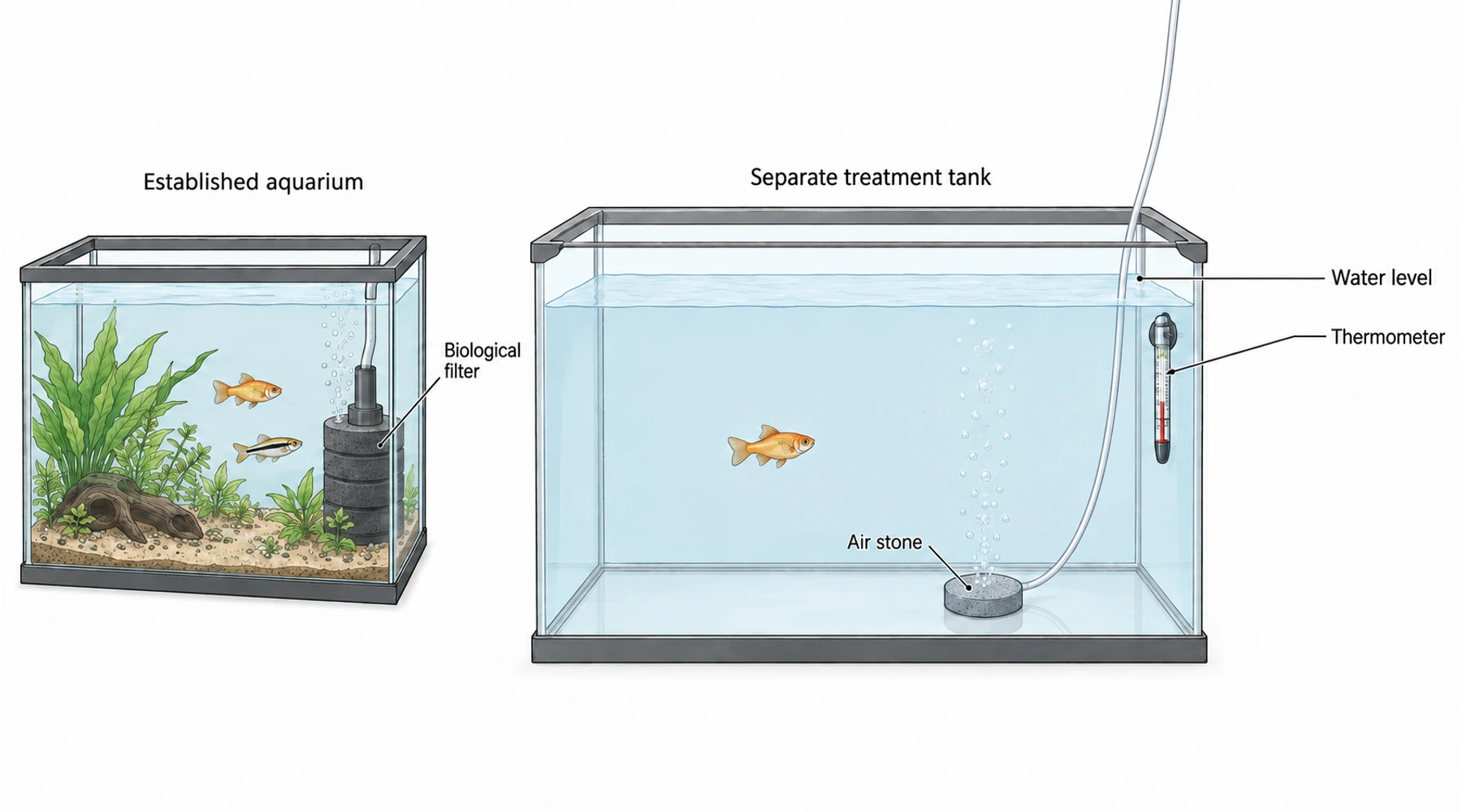
Kordon cautions against use in systems relying on biological filtration, warns of interference with plant growth, and notes removal by activated carbon and absorption by porous materials. Its directions favor bare treatment environments and warn that aquarium silicone can become permanently colored. Review the current bottle instructions alongside the tank and livestock compatibility guide.
There is a practical reason to protect biofiltration. Nitrifying organisms process ammonia and nitrite; the fish continue producing waste during care. A treatment that disrupts that process creates a second problem to manage. A separate tank protects the display system from exposure, but it does not automatically provide adequate water quality for the patient.
UF/IFAS guidance on chemicals in recirculating systems recommends isolating affected fish for treatment where possible and explains that chemical effects depend on exposure and system conditions. Keep treatment equipment separate and plan monitoring, temperature control, and aeration. Do not assume that fish-only directions establish compatibility with shrimp, snails, corals, or every fish species.
Routine use needs a reason
Blue shipping water is not evidence that every new fish benefits from a preventive bath. In experiments reported by the University of Florida Tropical Aquaculture Laboratory, methylene blue used as a prophylactic bath did not improve the measured appearance or behavior of fish. A separate transport experiment with velvet swordtails found better immediate appearance with methylene blue, but treatment-group appearances were similar after a week. These were different exposures and observations, not a universal shipping recommendation.
For new arrivals, establish a quarantine and observation plan. UF/IFAS guidance for responsible aquarium ownership places quarantine, suitable filtration, nutrition, and water quality within routine disease prevention. Medication should answer an identified need within that plan.
Before using methylene blue, be able to state the problem being addressed, the exact product being used, and how the treatment environment will be monitored. If one of those answers is missing, resolve it before turning the water blue.