
Article
Methylene blue and nitrite poisoning in fish
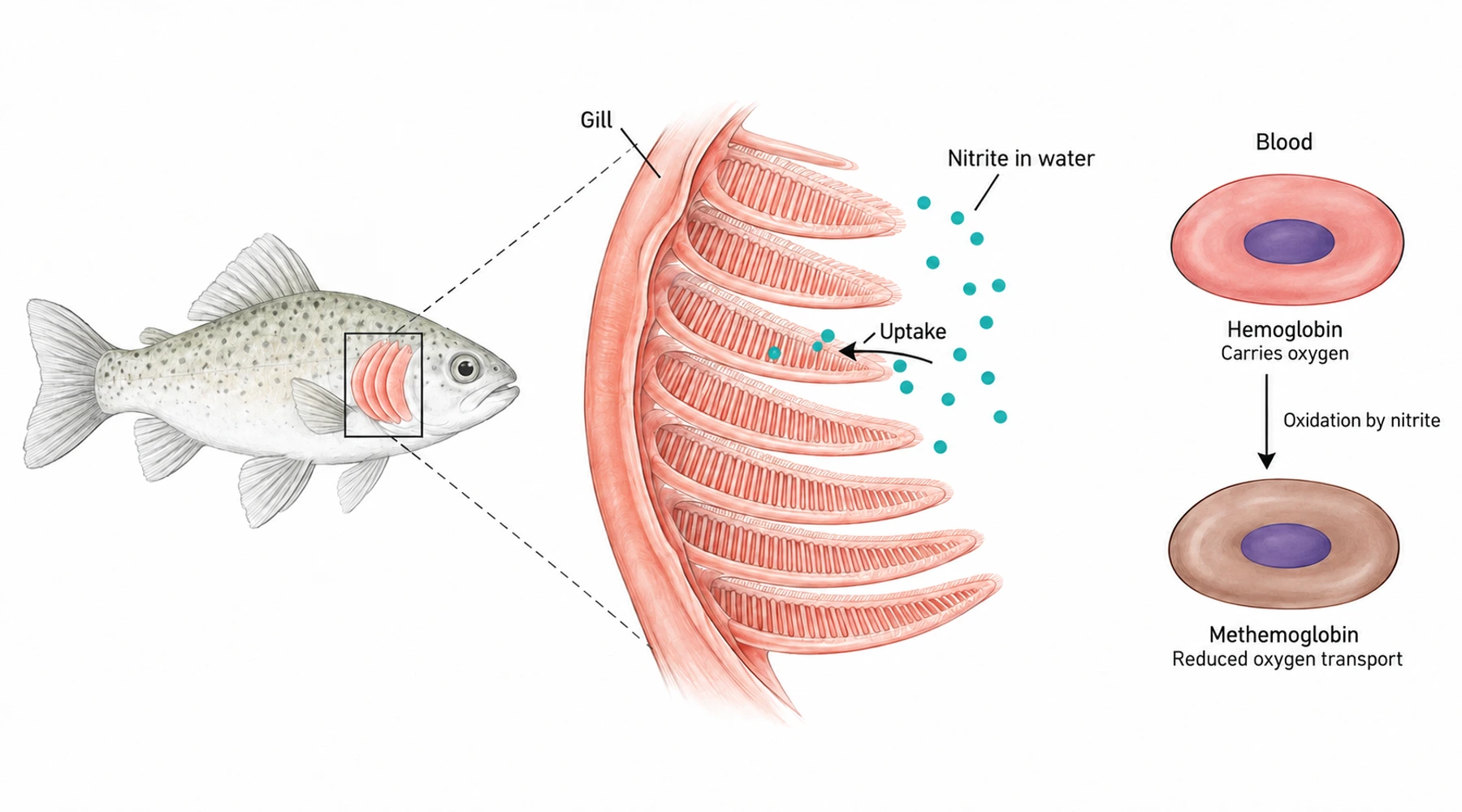
Methylene blue has a product-specific role as an aid for nitrite poisoning in aquarium fish. It does not replace correcting contaminated water, and a fish gasping at the surface has not necessarily been poisoned by nitrite. Start with the water measurements and recent tank history before choosing a treatment.
The useful distinction is between oxygen available in the water and oxygen the blood can transport. Nitrite can damage the second even when the first appears adequate. Adding aeration supports the fish, but it does not remove the nitrite exposure.
What nitrite does to fish blood
Fish take up nitrite through their gills. In the blood, nitrite oxidizes hemoglobin into methemoglobin, which cannot bind oxygen normally. The resulting condition, methemoglobinemia, is often called brown blood disease because affected blood can become brown.
The USDA's account of experimental nitrite exposure in channel catfish describes this oxygen-transport mechanism. A red blood cell may still be circulating while part of its hemoglobin can no longer perform its usual job. An oxygen reading measures the water surrounding the fish; it does not measure how much functional hemoglobin remains inside the fish.
The illustration above separates those two locations: nitrite enters at the gill, while the loss of oxygen-carrying function occurs in blood. It represents the mechanism, not a blood test or a visual diagnosis of a particular fish.
Nitrite commonly becomes a problem when biological filtration is immature, overloaded, or disrupted. Purdue's veterinary diagnostic explanation of brown blood disease connects these situations with accumulation of nitrogenous waste and identifies water changes as one way to dilute the exposure. Correcting the immediate concentration and restoring the system's ability to process waste are separate tasks.
Where methylene blue fits
Kordon's methylene blue product documentation describes its 2.303% aqueous formulation as an aid in reversing nitrite poisoning in freshwater and marine aquarium fish. The manufacturer relates that use to conversion of methemoglobin back to hemoglobin. This is a claim about a particular aquarium product, not evidence that every blue solution is an interchangeable treatment.
The same documentation warns against use in recirculating systems with biological filtration because the product interferes with nitrifying bacteria. That matters especially when impaired filtration caused the exposure. It also excludes medication use in food fish. A separate treatment setting, species suitability, and the bottle's complete directions therefore need consideration before use.
Read the broader guide to methylene blue uses and limitations in aquariums for the surrounding treatment context. Do not transfer a human methemoglobinemia treatment protocol to a fish bath: administration route, formulation, and patient are different.
Read the label as a complete instruction
Use this checklist with the actual bottle and its current manufacturer instructions. Record answers before making a dilution; a concentration alone is not a treatment plan.
| Check | Information to record | Error this prevents |
|---|---|---|
| Product identity | Manufacturer, active ingredient, formulation strength, and expiry | Treating the compound name as a complete product specification |
| Intended use | Whether nitrite poisoning and the relevant aquarium context are included | Borrowing an egg-treatment or other-use instruction |
| Animals and setting | Species, life stage, freshwater or marine conditions, ornamental or food production | Extending a label beyond its stated setting |
| Exposure instructions | Actual water volume, quantity, duration, and follow-up instructions | Copying a dose while losing its exposure conditions |
| System compatibility | Biological filtration, other treatments, plants, and removal requirements | Creating a second water-quality problem during treatment |
The separate discussion of aquarium dosing and product concentration explains why the amount poured from a bottle and the resulting concentration in water are different quantities. Consult aquarium compatibility and safety considerations before combining treatments.
Nitrite, nitrate, ammonia, and chlorine are different problems
Similar names do not imply similar treatment. The MSD Veterinary Manual's environmental hazard comparison distinguishes these exposures and emphasizes substantial variation in nitrite susceptibility between species and water conditions.
| Suspected problem | What needs checking | What a nitrite-use label does not establish |
|---|---|---|
| Nitrite, NO₂⁻ | Nitrite result, reporting units, species, and water chemistry | That every episode of rapid breathing is brown blood disease |
| Nitrate, NO₃⁻ | A separate nitrate measurement and longer-term accumulation | That methylene blue removes nitrate |
| Ammonia | Total ammonia nitrogen, pH, and temperature | That methylene blue corrects ammonia exposure |
| Chlorine or chloramine | Source-water treatment and appropriate chlorine testing | That the dye is a general dechlorinator |
| Low dissolved oxygen | Oxygen measurement and aeration performance | That a medication supplies adequate oxygen to the water |
Check units before comparing a test result with a reference. A result expressed as nitrite-nitrogen, NO₂-N, describes only the nitrogen mass. Multiplying by approximately 3.3 converts it to the mass concentration of the full nitrite ion. Thus 0.30 mg/L NO₂-N is approximately 0.99 mg/L NO₂⁻, not 0.30 mg/L NO₂⁻. This arithmetic example is not a safety threshold.
Why chloride and transport history matter
Chloride competes with nitrite for entry across freshwater fish gills. The University of Florida's aquaculture salt guidance explains that increasing water chloride can reduce nitrite uptake. Chloride is not the disinfectant chlorine. This protective mechanism also differs from acting on methemoglobin already in blood.
A 96-hour experiment in juvenile Nile tilapia tested two external chloride concentrations. Higher chloride reduced nitrite toxicity and methemoglobin formation under those study conditions. It does not establish a universal salt addition for a mixed aquarium: species, existing chloride, exposure, and other inhabitants remain relevant. The experiment did not test methylene blue.
Transport adds another set of possible causes. In University of Florida on-farm transport trials, methylene blue tested as an antimicrobial additive did not improve the reported appearance and behavior outcome. That finding concerns the tested transport setting, not treatment of confirmed nitrite poisoning. The same guidance explains how accumulating ammonia, changing pH, temperature, and oxygen influence transport stress. Higher pH and temperature increase the proportion of toxic unionized ammonia. Blue transport water cannot demonstrate that these variables are controlled.
Separate the immediate response from the recovery plan
For distressed fish, support aeration and promptly assess both the fish and the water. An aquatic veterinarian or fish-health service should assess severe breathing difficulty, loss of balance, or continuing deaths. Have the species, tank volume, test results with units, recent maintenance, and all products used available.
Use appropriately conditioned, compatible replacement water when diluting a documented water-quality problem. Recheck conditions rather than assuming one intervention resolved the exposure. Review feeding, stocking, and filtration capacity to find why waste accumulated. The University of Florida's recirculating-system guidance identifies these as central determinants of water quality.
A fish that breathes more normally provides encouraging evidence about its condition. A repeat water test answers a different question: whether the environment is safe enough for recovery to continue.