
Article
Methylene blue for methemoglobinemia: why it is used in hospitals
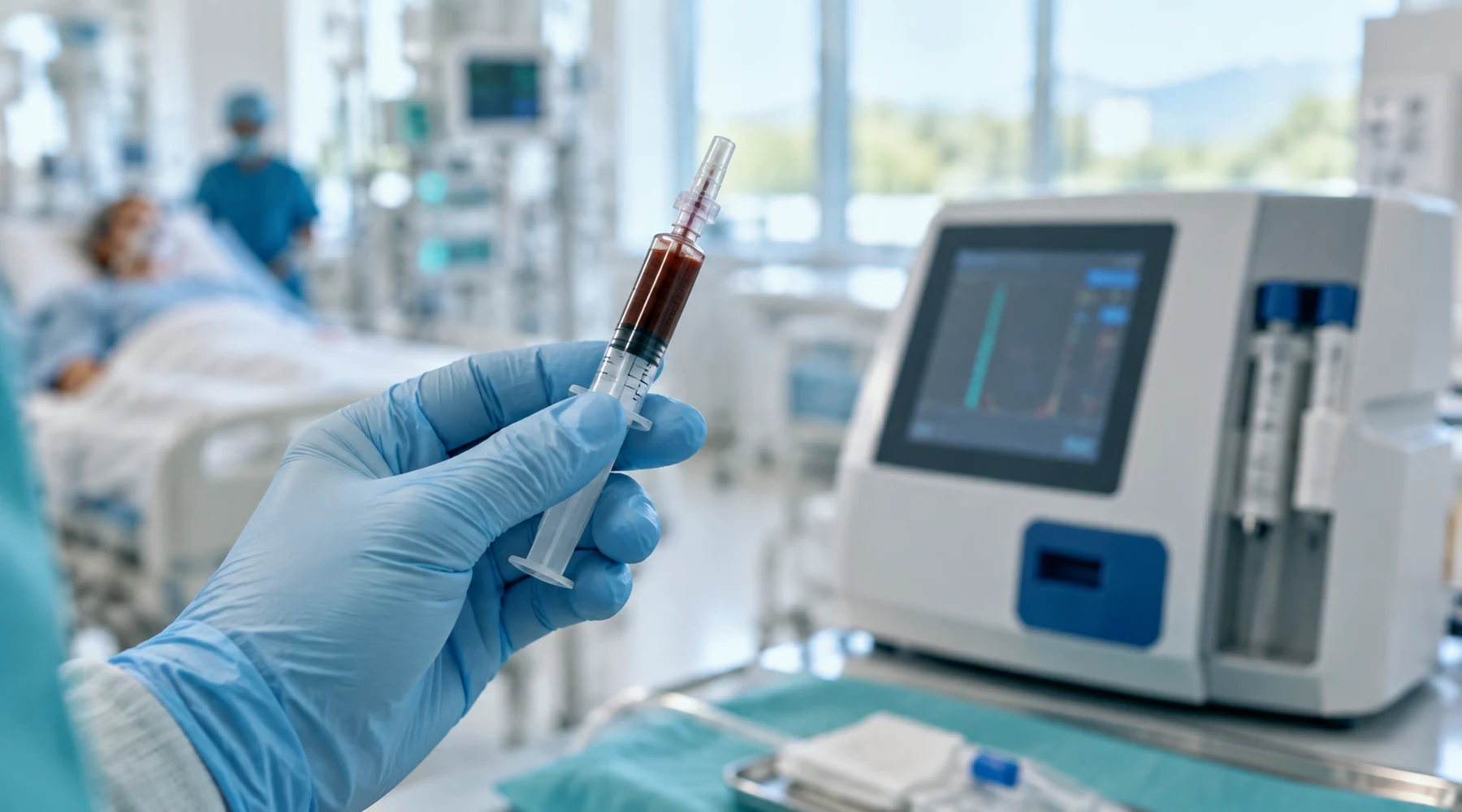
A patient arrives with lips the color of slate, breathing fast, answering slowly. The monitor says oxygen saturation is 85 percent. The nurse turns the oxygen up. The number does not move. Blood is drawn and it comes out chocolate brown, and it stays brown when held to air. That sequence is the classic entry point to methylene blue methemoglobinemia care, and it shows why this condition confuses both families and machines.
The problem is not the lungs. It is the iron inside hemoglobin.
Two states of the same iron atom
Each hemoglobin molecule carries iron in the ferrous state, written Fe2+. In that state it binds oxygen in the lungs and releases it in tissue. Oxidant chemicals can strip one more electron from that iron, converting it to the ferric state, Fe3+. The resulting pigment is methemoglobin. Ferric iron cannot bind oxygen, and worse, it makes the remaining ferrous sites in the same molecule hold their oxygen more tightly, so less oxygen is released where it is needed.
Healthy blood keeps methemoglobin below about 1 percent because a repair enzyme runs constantly. The main repair route uses NADH and cytochrome b5 reductase, fed by normal glycolysis in the red cell. A backup route uses NADPH, but under ordinary conditions it does little work. Symptoms track roughly with the percentage, though anemia or heart and lung disease can make a lower number dangerous. Values near 10 to 20 percent can cause visible cyanosis and fatigue. Values above 30 percent commonly bring headache, breathlessness, and confusion. Values near 70 percent are often fatal. The numbers are bands, not promises, because what matters is oxygen delivery, not the laboratory value alone.
Common acquired triggers include dapsone, nitrites and nitrates, aniline compounds, and local anesthetics such as benzocaine and prilocaine. Congenital enzyme deficiencies exist but are rare. Most hospital cases are acquired, which means the first treatment step is always to stop the exposure.
The shuttle hospitals borrow
Methylene blue does not supply oxygen. It supplies electron transport. Inside the red cell, an enzyme reduces the blue dye to its colorless form, leucomethylene blue, using NADPH. That colorless form then hands electrons to ferric iron non-enzymatically, restoring ferrous hemoglobin, and returns to the blue form. The dye cycles. The relay itself is described in how methylene blue moves electrons between donors and acceptors, and the colorless reduced form is explained in the comparison of methylene blue and leucomethylene blue.
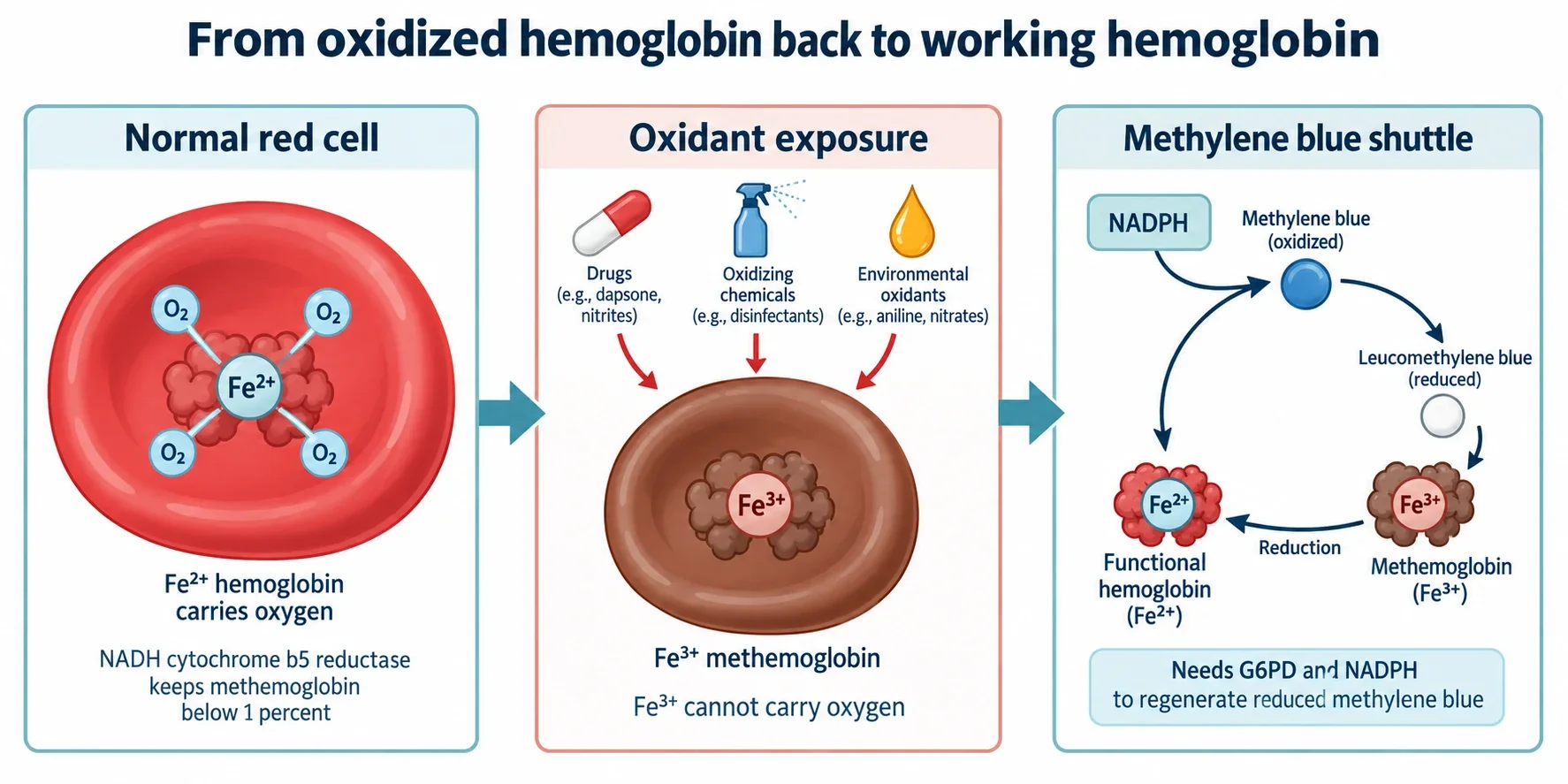
This mechanism explains two limits that surprise newcomers. First, the shuttle needs NADPH, and red cell NADPH depends on glucose-6-phosphate dehydrogenase, G6PD. In G6PD deficiency the dye may fail to convert to its active form while adding oxidant stress of its own, which is why the hospital label lists G6PD deficiency as a contraindication. Second, methylene blue is itself an oxidant at high cumulative doses. Past roughly 7 mg per kg total, or sometimes lower with repeated dosing, it can raise methemoglobin and destroy red cells instead of repairing them. More dye is not more rescue. The dose window is narrow by design.
Why the obvious test misleads
Families often search for a methylene blue test they can do at home. There is no such test. The phrase usually points to the diagnostic workup for suspected methemoglobinemia, and that workup belongs in a laboratory.
Standard pulse oximeters read only two wavelengths of light. As methemoglobin rises, absorption at those two wavelengths converges, and the displayed saturation drifts toward about 85 percent regardless of the true state. Extra oxygen does not correct the number because the sensor is not measuring what is wrong. Arterial oxygen pressure, PaO2, can look normal at the same time, because it measures oxygen dissolved in plasma rather than oxygen carried by hemoglobin. A blood gas analyzer that calculates saturation from PaO2 can therefore report a reassuring number while the patient remains cyanotic. The gap between the finger probe and the calculated arterial value, often more than 5 percentage points, is called the saturation gap, and it is a clue, not a diagnosis.
Confirmation requires multi-wavelength co-oximetry on a blood sample, which measures methemoglobin directly. Chocolate brown blood that does not brighten with oxygenation points the same way. Any treatment decision for methemoglobinemia starts from that measurement plus symptoms, never from a pulse oximeter alone.
What supervised treatment looks like on the label
This section describes a prescription injection given by clinicians. It is not a guide to oral use, and none of these details transfer to drops or capsules sold for consumer use.
The current prescribing information for methylene blue injection defines treatment for acquired methemoglobinemia in adults and children as 1 mg per kg given intravenously over 5 to 30 minutes. With the standard 5 mg per mL product that equals 0.2 mL per kg. If methemoglobin remains above 30 percent or symptoms persist after one hour, a second 1 mg per kg dose may follow. If two doses do not resolve the problem, the label directs clinicians to alternative treatment rather than a third dose.
Administration details matter. The line must be a working intravenous line, never a subcutaneous injection. The solution may be diluted in 50 mL of 5 percent dextrose to reduce local pain, especially in children, and used promptly. It must not be diluted in sodium chloride solutions, because chloride lowers the solubility of the dye. Unused portions are discarded and the solution is inspected before use.
Three warnings shape every hospital decision. The boxed warning covers serotonin syndrome, which can be fatal when methylene blue meets serotonergic drugs including SSRIs, SNRIs, MAO inhibitors, some opioids, and dextromethorphan. Patients are told not to take such drugs for 72 hours after the last dose, and when the combination cannot be avoided the label calls for the lowest possible dose with close observation. Serotonin interactions are covered in methylene blue drug interactions and serotonin syndrome. Hemolysis is the second warning: red cell breakdown with Heinz bodies, rising indirect bilirubin, falling haptoglobin, and anemia that can appear a day or later and may need transfusion. The third is loss of effect or rebound, seen with dapsone or aniline type exposures and in G6PD deficiency, where the label again points to alternative therapy. Renal impairment does not forbid use, but moderate to severe impairment limits the course to a single 1 mg per kg dose. Adverse events in the adult label dataset included headache, nausea, diarrhea, low potassium and magnesium, muscle jerks, and seizure like events, with one serious seizure like event among 31 patients. The dye also falsely lowers pulse oximeter readings after infusion, so clinicians follow co-oximetry and symptoms instead.
Supportive care runs alongside: high flow oxygen, airway and circulation support, glucose correction, and observation. Mild asymptomatic cases may resolve once the trigger is removed. Commonly cited thresholds treat symptomatic patients from about 20 percent, or from 10 to 20 percent when oxygen delivery is already compromised, and consider treatment in asymptomatic patients from about 30 percent. Severe symptoms are treated without waiting for the laboratory number. Ascorbic acid, exchange transfusion, and hyperbaric oxygen are rescue options when methylene blue cannot be used or fails, but ascorbic acid acts far more slowly. Purity documentation for any injectable product is a separate manufacturing question, explained in how to read a methylene blue certificate of analysis.
Benzocaine and the teething gel question
A large share of consumer searches comes from parents who have used an oral benzocaine gel or spray and then see blue lips or a low oximeter number. Three stages need to stay separate.
Suspected exposure is the home stage. Benzocaine is a recognized oxidant trigger, and regulators have warned that over the counter oral benzocaine products should not be used for teething or in children under 2 years because benzocaine related methemoglobinemia can be severe and the benefit for teething pain is small. Stop the product, note the time and amount, note symptoms such as unusual paleness, gray or blue color of lips and nail beds, breathlessness, unusual sleepiness, or poor feeding, and seek emergency evaluation promptly. Do not give methylene blue at home in any form. There is no home dose and no home test that rules the condition out.
Diagnosis is the hospital stage. Clinicians confirm with co-oximetry, review all oxidant exposures including dapsone, nitrites, and aniline compounds, and assess symptoms and oxygen delivery rather than one number in isolation.
Supervised treatment is the ward stage described above. Whether benzocaine was the trigger does not change the dosing table. The current injection label does not name benzocaine specifically; a benzocaine case falls under acquired methemoglobinemia and is managed under the same supervised protocol, including the G6PD, renal, and serotonin checks.
When methylene blue is not the answer
It is not the answer when G6PD deficiency is known. It is not the answer after two labeled doses have failed or when methemoglobinemia rebounds, which points to continued absorption of drugs such as dapsone. It is not the answer as prevention, as a supplement routine, or as a home remedy after a chemical exposure. High dose or repeated use can worsen the exact number it is meant to lower, and hemolysis can declare itself a day later when the patient is already home. That delayed risk is one reason hospitals observe rather than discharge quickly.
The honest summary is short. Methemoglobinemia is oxidized iron that cannot carry oxygen. Methylene blue is an electron shuttle that lets red cells reduce that iron, provided the cell can make NADPH and provided the dose stays inside a narrow labeled course. Diagnosis needs co-oximetry because simpler monitors mislead. Everything else, from the dextrose diluent to the serotonin history to the benzocaine tube in the medicine cabinet, is detail in service of that one shuttle.