
Article
Methylene blue interactions: antidepressants, opioids, and serotonin syndrome
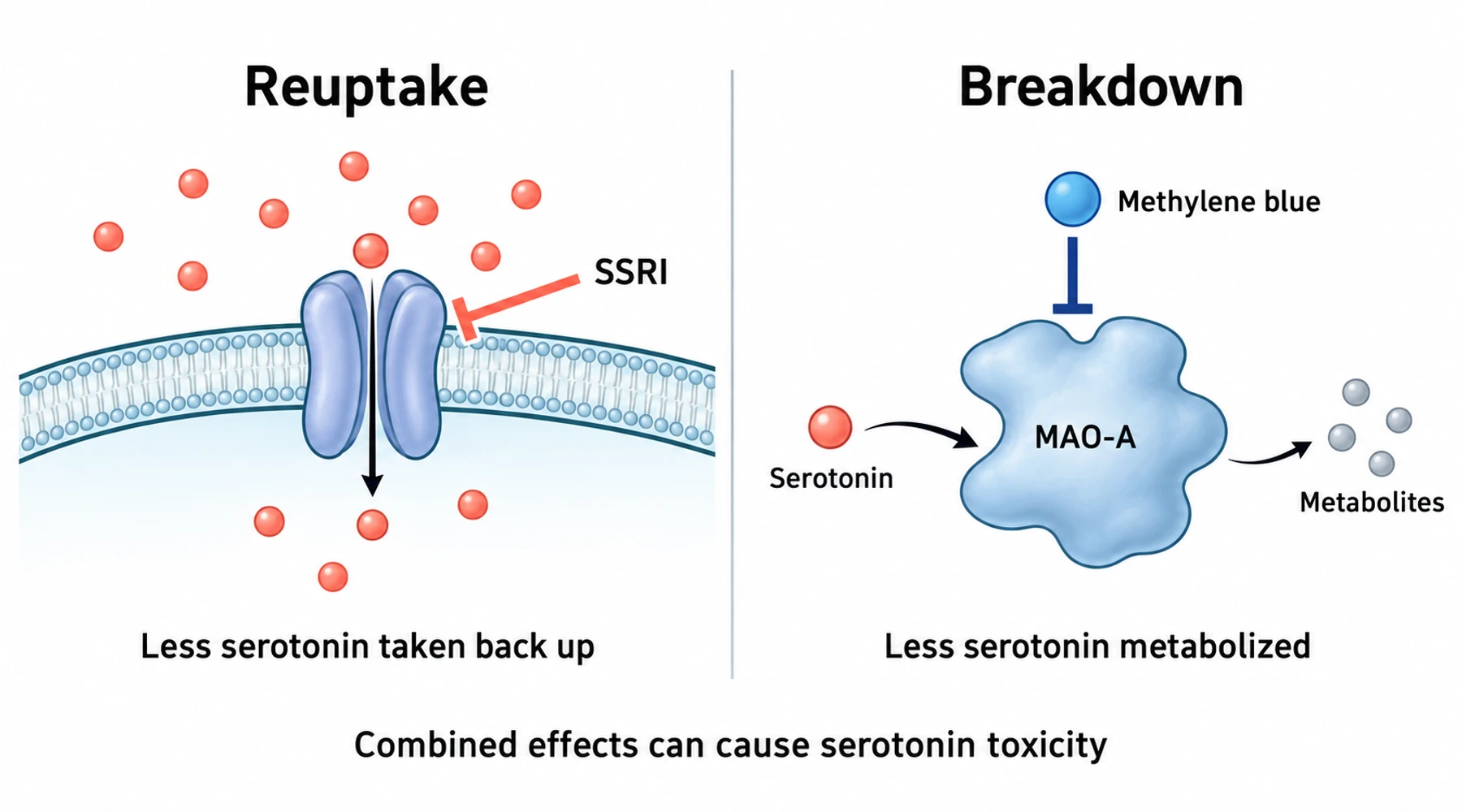
Methylene blue can cause a serious interaction with medicines that affect serotonin. The PROVAYBLUE intravenous prescribing information carries a boxed warning about potentially fatal serotonin syndrome with serotonergic medicines and opioids. An oral product is not automatically exempt from that concern.
Before adding methylene blue, have a pharmacist or prescriber check the complete medication list, including occasional medicines, cough products, supplements, and the proposed methylene blue formulation. Do not stop an established medicine to make room for it. The useful question is whether the exact combination is appropriate for the individual, not whether someone online has tried it.
Why a dye interacts with antidepressants
Serotonin is a chemical messenger. Its effects depend partly on how quickly cells take it back up and metabolize it. Selective serotonin reuptake inhibitors, or SSRIs, reduce reuptake. Monoamine oxidase A, abbreviated MAO-A, is an enzyme involved in serotonin breakdown. Inhibiting both processes can produce excessive serotonergic activity.
In Ramsay, Dunford, and Gillman's 2007 enzyme study, methylene blue strongly inhibited purified human MAO-A. The reported inhibition constant was approximately 27 nanomolar. MAO-B required substantially higher concentrations. This was a laboratory experiment, not a trial establishing an acceptable oral dose or measuring the probability of an interaction.
The inhibition was reversible. That describes the enzyme interaction; it does not mean an adverse reaction will be mild or safe to manage at home. The laboratory finding explains a mechanism behind clinical reports without supplying a personal safety threshold.
Interaction table: class, route, and evidence
The table separates a clinical warning from a plausible mechanism and from insufficient direct evidence. Examples do not cover every medicine in a class. The route column refers to methylene blue, unless another route is specified.
| Medication class or question | Route-specific evidence | What the finding means |
|---|---|---|
| Serotonergic antidepressants: SSRIs, SNRIs, and clomipramine | The IV label warns against co-use. Published clinical reports include parenteral exposure; an oral combination-product case also exists. | This is an established serious interaction concern, not merely a theoretical compatibility question. |
| MAO inhibitors, including psychiatric MAOIs and linezolid | The IV label names these medicines among combinations to avoid. | Methylene blue adds MAO inhibition; a medicine's usual purpose does not identify all its interaction risks. |
| Bupropion, including Wellbutrin | Bupropion labeling specifically addresses IV methylene blue and hypertensive reactions. | Being outside the SSRI class does not establish compatibility. |
| Amphetamine stimulants, including Adderall XR | Current amphetamine labeling includes IV methylene blue in its MAOI contraindication because of hypertensive crisis risk. | Cardiovascular toxicity matters alongside serotonin toxicity. Oral co-use has no clearance established by that IV wording. |
| Opioids, including buprenorphine/naloxone or Suboxone | SUBOXONE labeling identifies IV methylene blue among interacting serotonergic medicines and discusses MAOI-related opioid toxicity. | A partial opioid agonist still requires an interaction assessment. This warning does not mean every opioid has identical risk. |
| Other serotonergic medicines, including buspirone and dextromethorphan | The IV methylene blue label specifically names these agents. | An anxiety medicine or nonprescription cough ingredient can matter as much as an antidepressant. |
| Gabapentin and related anticonvulsant questions | A forum describes symptoms after co-use. This is not a verified route-specific clinical interaction study. | A reported reaction deserves assessment; it does not prove that gabapentin caused serotonin syndrome. |
| PDE5 inhibitors, including sildenafil or Viagra | Experimental nitric oxide pathway findings provide mechanistic context, not a human oral-combination safety trial. | Neither a predicted change in effect nor a claim of compatibility is established by the mechanism alone. |
| Ivermectin and other poorly studied combinations | No controlled human interaction study was located in the sources checked for this article. | The combination remains insufficiently characterized. An empty interaction search is not evidence of safety. |
The IV label's interaction section also names mirtazapine and bupropion. A list restricted to drugs ending in familiar antidepressant brand names will miss relevant medicines.
What changes when methylene blue is swallowed?
Route changes exposure, so an IV report cannot provide a numerical risk estimate for an oral solution. The reverse inference also fails: fewer oral reports do not establish a safe oral combination.
Zuschlag and colleagues' 2018 report describes suspected serotonin syndrome after an oral urinary analgesic containing methylene blue was introduced in a patient taking several serotonergic medicines. Their accompanying review identified 50 previous cases involving parenteral methylene blue and concurrent serotonergic antidepressants.
That distinction is useful. The oral case involved a combination medicine, not a controlled experiment with a single-ingredient consumer solution. It cannot tell us how often a particular bottle causes an interaction. It does, however, contradict the claim that swallowing methylene blue makes serotonin toxicity impossible. Case reports identify hazards; without the number and characteristics of everyone exposed, they do not measure incidence.
Wellbutrin, stimulants, and Suboxone need their own reasoning
Wellbutrin is bupropion, not an SSRI. Its prescribing information identifies hypertensive-reaction risk with IV methylene blue. Therefore, “it does not mainly work through serotonin” is not a sufficient answer to the combination question.
For stimulants, the ADDERALL XR label explicitly includes IV methylene blue in its MAOI contraindication. A substantial blood-pressure reaction is a separate concern from the serotonin mechanism illustrated above. Different stimulant medicines still need individual assessment.
Suboxone contains buprenorphine and naloxone. Its interaction table describes serotonin syndrome and MAOI-related opioid toxicity, including respiratory depression or coma. The presence of naloxone does not provide a general interaction clearance. People receiving treatment for opioid use disorder should involve their treatment team before adding methylene blue.
Gabapentin: a reaction report is not a diagnosis
A Phoenix Rising forum question about gabapentin and methylene blue describes disorientation and sensory overstimulation. The writer wondered whether serotonin syndrome was responsible. That question cannot be resolved from the post: it lacks a clinical examination and a verified explanation of the symptoms.
Gabapentin has different pharmacology from an SSRI. Its label describes binding to the alpha-2-delta subunit of voltage-activated calcium channels, while acknowledging uncertainty about the precise therapeutic mechanism. This distinction prevents misclassification; it does not prove that adding methylene blue is harmless. Do not reproduce a forum's proposed rescue treatment to test what caused a reaction.
Sildenafil and ivermectin: mechanisms do not settle compatibility
Sildenafil supports the nitric oxide/cyclic GMP pathway by inhibiting PDE5. The EMA's scientific discussion of Viagra describes this pathway and experimental use of methylene blue. In isolated-vessel and purified-enzyme experiments, methylene blue interfered with nitric oxide signaling, with different effects at different targets and concentrations.
These observations make claims about a possible change in sildenafil's effect biologically understandable. They do not establish a predictable human outcome, a safe combination, or a method for balancing one drug against another. PDE5-inhibitor questions belong in cardiovascular pharmacology, not automatically in the same evidence category as an SSRI interaction.
For ivermectin, the absence of a controlled interaction study in the material located leaves an evidence gap. Laboratory papers that mention both compounds may be comparing them or using one as an assay control. That is not a trial of people taking them together. Similarly, informal experience discussions do not supply the medication histories and systematic follow-up needed to clear a combination.
Symptoms that need urgent assessment
Serotonin toxicity can involve a combination of agitation or confusion, fever or heavy sweating, rapid heartbeat, tremor, muscle stiffness, and involuntary jerking. These features appear in the amphetamine label's serotonin-syndrome warning. They are not a home diagnostic checklist.
After a suspected interacting exposure, new symptoms warrant prompt medical advice. Severe confusion, high fever, seizures, collapse, or breathing difficulty require emergency care immediately. Provide the product packaging, medication list, route, amount, and timing; do not take more methylene blue while seeking advice.
For a planned medication check, use the questions to ask a clinician about methylene blue. The broader methylene blue safety guide covers risks beyond interactions, including the separate issue of G6PD deficiency and hemolysis. A complete assessment needs both the medication list and the person's relevant health history.