
Article
Methylene blue and G6PD deficiency: why the risk matters
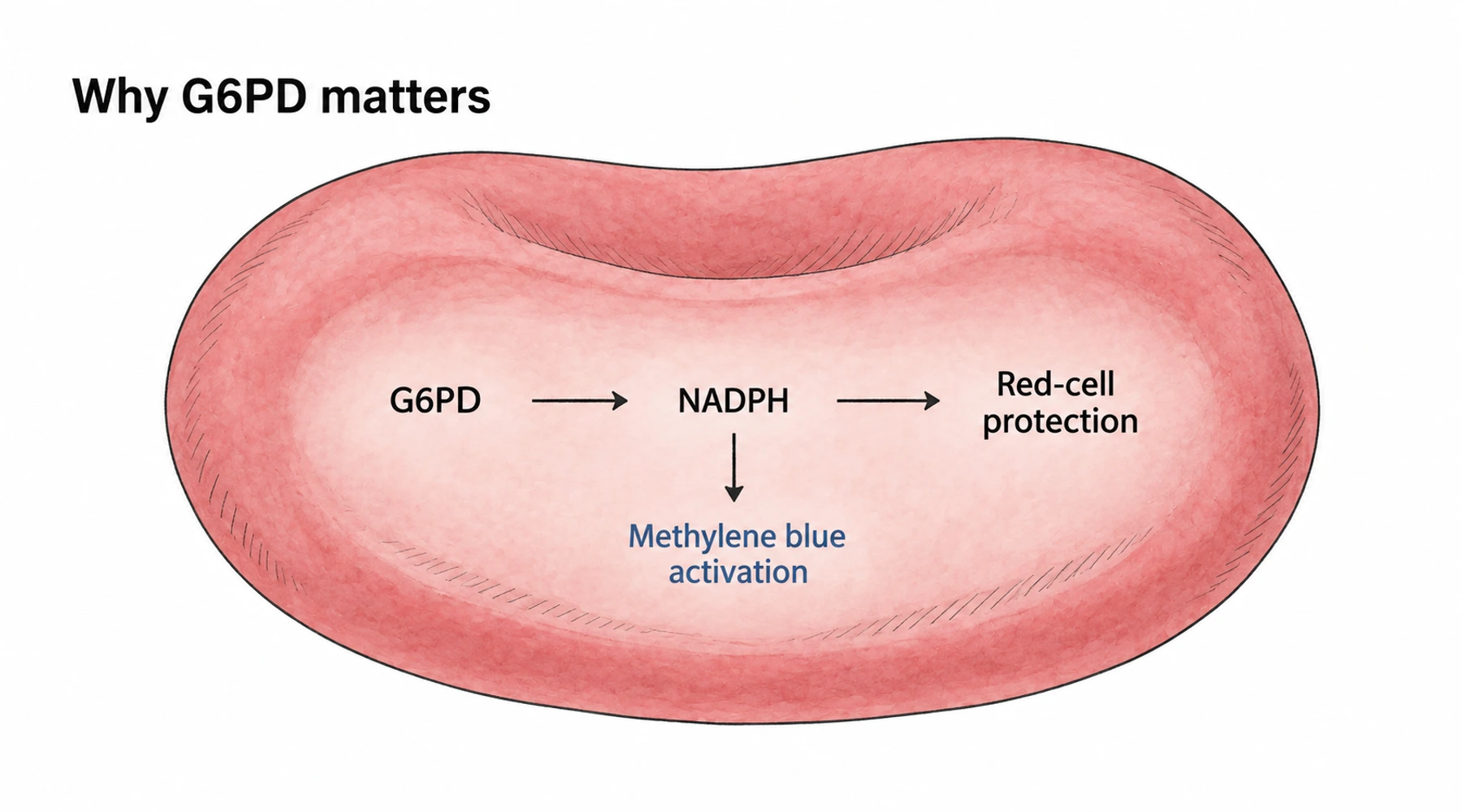
Methylene blue is contraindicated in people with glucose-6-phosphate dehydrogenase deficiency, usually shortened to G6PD deficiency. The PROVAYBLUE prescribing information identifies hemolytic anemia as the reason. This means red blood cells can break down faster than the body replaces them. The same deficiency can also prevent the drug from working as intended against methemoglobinemia.
These are connected problems. Methylene blue needs a supply of reducing power inside the red cell. G6PD helps maintain that supply, which the cell also needs for protection against oxidative damage. A product's purity does not correct an enzyme deficiency in the person receiving it.
What G6PD does in a red blood cell
G6PD is an enzyme in the pentose phosphate pathway, a route for processing glucose. One of this pathway's outputs is NADPH, a molecule that donates electrons to other reactions. Those electrons allow several protective processes to keep operating.
The CPIC guideline on medicines and G6PD genotype explains why this matters especially in red cells: their available source of NADPH is the pentose phosphate pathway. G6PD and another enzyme, 6-phosphogluconate dehydrogenase, generate NADPH within that pathway. Reduced G6PD activity limits the cell's ability to respond when oxidative stress increases.
One protective use of NADPH is recycling glutathione. Glutathione reductase uses NADPH to restore reduced glutathione, which helps glutathione peroxidase remove peroxides. The PharmGKB red-cell pathway description connects these reactions. Without sufficient reducing capacity, oxidants can damage hemoglobin and the surrounding cell.
G6PD deficiency therefore concerns the capacity to withstand a challenge. It does not mean every affected person has ongoing anemia or feels ill every day.
Why methylene blue depends on the same supply
Hemoglobin normally contains iron in the ferrous state, Fe²⁺. Oxidation changes it to the ferric state, Fe³⁺, producing methemoglobin. That altered iron cannot bind oxygen normally. When too much accumulates, oxygen delivery is impaired.
Methylene blue can help reverse this change, but an intermediate step matters. Inside the cell, NADPH-dependent reduction converts methylene blue to leucomethylene blue. Leucomethylene blue then reduces methemoglobin back toward functional hemoglobin. This sequence is described in the drug label's mechanism of action.
There is also a separate, normal housekeeping pathway: NADH-dependent cytochrome b5 reductase handles most background methemoglobin reduction. NADH and NADPH are different molecules. G6PD deficiency does not simply switch off every route for maintaining hemoglobin. The problem becomes especially important when an oxidant exposure increases demand and methylene blue is introduced. Our guide to methylene blue for methemoglobinemia explains the clinical setting.
Two consequences of insufficient NADPH
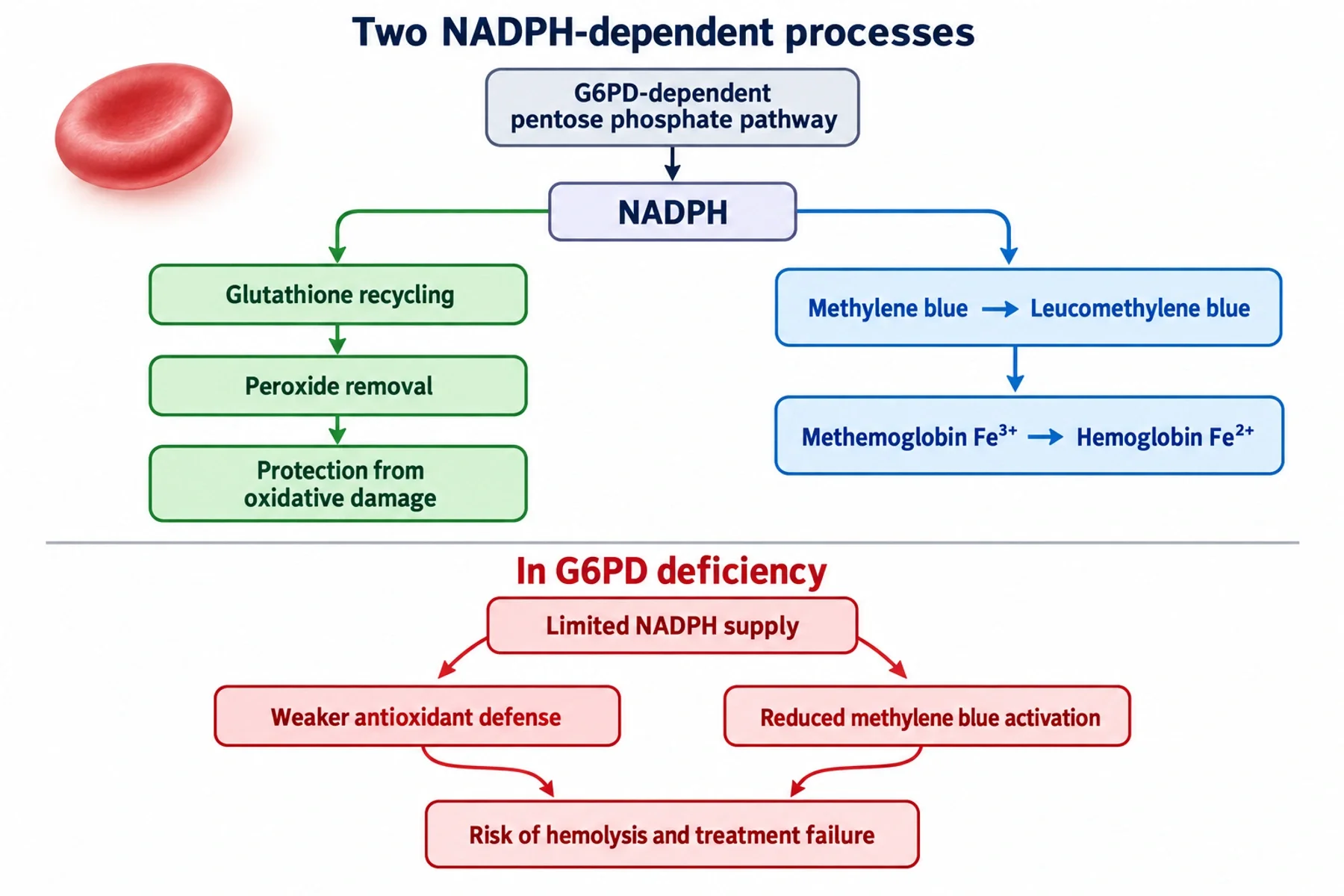
Figure 1. Simplified dependency map. The arrows connecting pathway boxes show support for a process; they are not a complete set of chemical reactions. In the drug branch, leucomethylene blue supplies reducing power for the Fe³⁺ to Fe²⁺ conversion. Methylene blue itself can add oxidative stress. This conceptual illustration combines the prescribing information and the linked PharmGKB pathway.
The EHA and EuroBloodNet recommendations identify both reduced effectiveness and potential harm in G6PD deficiency:
- Treatment may fail. Insufficient NADPH can limit conversion of methylene blue into its reducing form, leaving methemoglobin inadequately corrected.
- Oxidative injury may increase. Methylene blue is itself an oxidant. In a vulnerable cell, it can contribute to hemolysis and can worsen methemoglobinemia.
These outcomes can coexist: fewer intact red cells and less effective oxygen transport in the cells that remain. This is why an inadequate response is not a reason for someone to keep adding methylene blue independently.
Why feeling well does not establish safety
According to MedlinePlus Genetics, many people with G6PD deficiency have no symptoms and do not know they have it. Infections, certain medicines and other oxidative triggers can reveal the vulnerability. Although the condition is associated with X-linked inheritance and is more common in males, females can also have clinically important deficiency.
A useful experimental detail illustrates the difference between resting conditions and stress. In a 1996 study by Bozzi, Parisi and Strom, freshly collected human red cells with severe G6PD deficiency had reduced-glutathione levels close to those of normal cells. After an experimental peroxide challenge, however, deficient cells showed marked glutathione loss and impaired recovery compared with normal cells. These were laboratory experiments on blood cells, not a trial establishing a safe methylene blue dose. The finding explains why an apparently normal baseline need not predict resilience during exposure.
What to do with this information
If you have diagnosed G6PD deficiency, tell the clinician or pharmacist before methylene blue is considered. The CPIC guideline classifies methylene blue as a high-risk medicine. A seller's low-dose description or a previously uneventful exposure is not clearance to override the contraindication.
If your status is uncertain, bring any previous G6PD result and relevant family history to the discussion. Recent hemolysis or a blood transfusion can affect interpretation of an enzyme result. The laboratory guide to G6PD testing explains the test and its limitations; a routine blood count alone does not answer the same question. G6PD status is also only one part of the broader methylene blue safety assessment.
After an exposure, new marked weakness, breathlessness, jaundice, dark urine or a racing heartbeat warrants prompt medical assessment. Severe breathing difficulty, chest pain, collapse or confusion requires emergency care. Bring the product container or its details, including concentration, amount and time of exposure. Do not use urine color alone to decide whether red-cell breakdown is occurring.
When methemoglobinemia occurs in someone with G6PD deficiency, treatment selection belongs to the emergency team. Specialist recommendations discuss alternatives including ascorbic acid and, in severe cases, exchange transfusion. These are not interchangeable home remedies: ascorbic acid acts more slowly, and the patient's oxygen delivery, hemolysis and clinical condition determine what support is needed.