
Article
Methylene blue side effects, contraindications, and safety
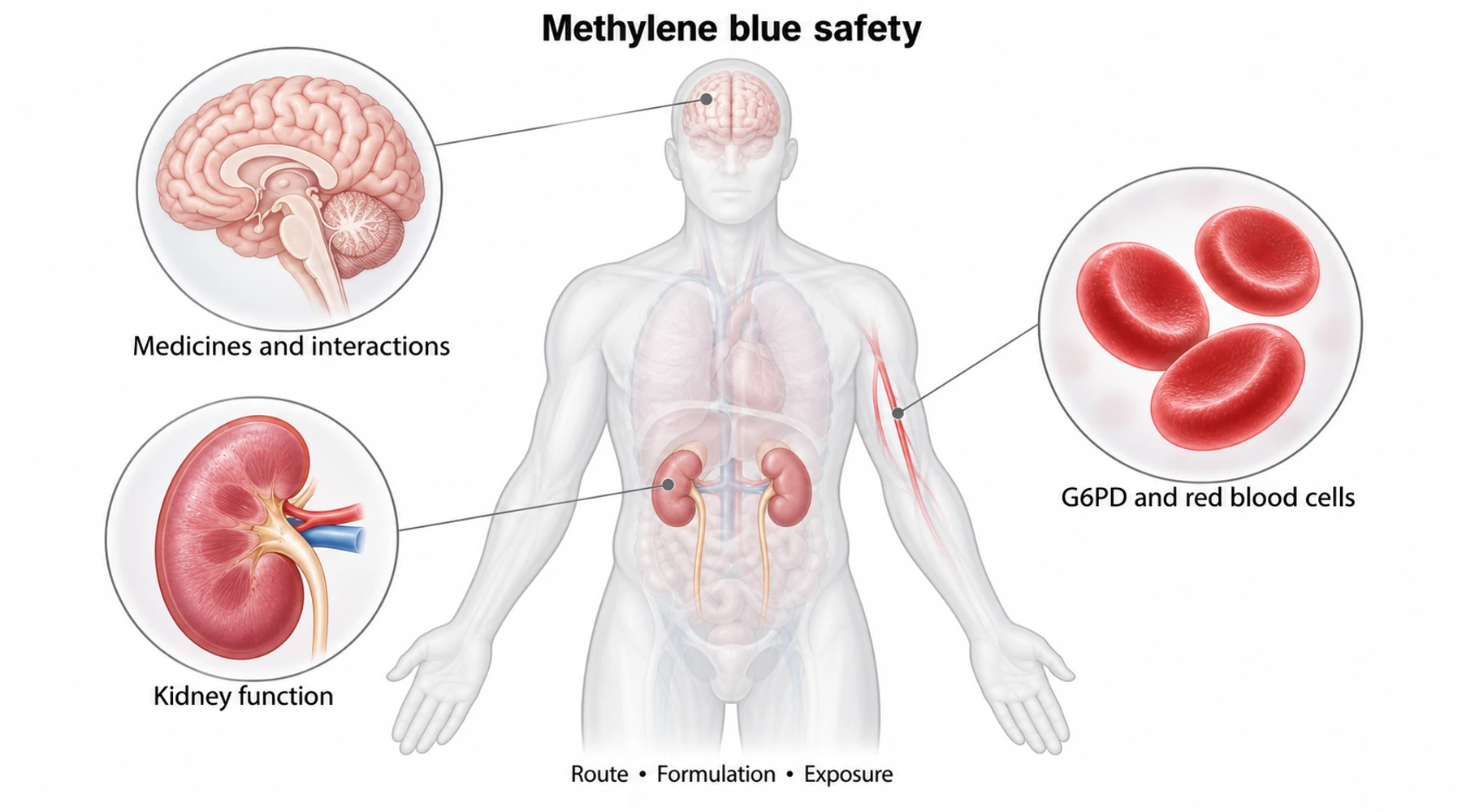
Methylene blue is not safe for everyone. Its risks depend on the product, route, amount, accompanying medicines, and the person's health. A hospital treatment for a defined blood disorder does not establish the safety of repeated self-directed use for energy or concentration.
After exposure, call emergency services for breathing difficulty, collapse, seizures, or severe confusion. Agitation with fever, heavy sweating, and muscle rigidity or jerking can indicate a serious reaction. The US prescribing information describes potentially fatal serotonin syndrome and severe allergic reactions. Do not wait for an online explanation when symptoms are severe. For a suspected excessive or uncertain exposure, contact a poison information service promptly; our poisoning and overdose guide explains the clinical context.
Start with route and formulation
The European Medicines Agency describes Proveblue as an intravenous antidote for medicine- or chemical-induced methemoglobinemia. In that disorder, an abnormal form of hemoglobin cannot carry oxygen effectively. The product is administered by a healthcare professional.
That evidence has boundaries. Swallowing a solution, receiving an injection, and applying a preparation locally are different exposures. A solution's percentage does not identify its full ingredients, intended route, or suitability for a person. Neither a familiar chemical name nor a purity claim establishes that a laboratory or aquarium preparation is a medicine.
The useful safety question is therefore specific: “What is known about this formulation, by this route, for this purpose, in someone taking these medicines?” A report involving one product cannot automatically answer that question for another. The absorption and distribution guide compares route-specific evidence.
Which adverse effects are established?
The UK Proveblue product information lists dizziness, tingling, altered taste, nausea, sweating, injection-site pain, and skin or urine discoloration. Blue-green urine can reflect the dye. Its presence does not measure benefit, prove an appropriate exposure, or exclude another problem.
Frequency claims need context. The US label's adult safety dataset included just 31 patients with acquired methemoglobinemia; reported events included headache, nausea, diarrhea, electrolyte disturbances, muscle jerks, and a seizure-like event. Those data do not provide reliable frequency estimates for daily and long-term use in healthy people.
The same label describes delayed red-cell breakdown and interference with pulse-oximeter readings and urine tests. Tell the clinical team about recent exposure before interpreting results.
Safety summary with source dates
This table distinguishes different kinds of evidence and the question each should prompt. Sources were checked on 12 September 2026. A source's publication or revision date is different from the date it was accessed.
| Safety issue | What the source establishes | Practical implication and dated source |
|---|---|---|
| G6PD deficiency or thiazine-dye allergy | These are contraindications; G6PD deficiency increases the risk of red-cell destruction. | Identify known deficiency or previous serious dye reactions before exposure. The EMA overview, updated 7 May 2018, also lists certain poisoning-related contraindications. |
| Serotonergic medicines and opioids | The US boxed warning identifies serious, sometimes fatal serotonin syndrome. | Obtain a complete interaction check. The US label was revised February 2024; DailyMed updated its record 28 May 2025. |
| Pregnancy, breastfeeding, and young infants | Human pregnancy data are inadequate; animal reproductive toxicity and infant vulnerability require specific assessment. | Do not extrapolate adult experience. The UK product information, updated 1 July 2024, restricts pregnancy use to clear necessity and gives breastfeeding precautions. |
| Kidney or liver impairment | Kidney impairment can increase exposure; experience in severe liver impairment is limited. | Bring recent diagnoses and available test results. The EMA risk management plan, version 3.4, March 2025, identifies these populations explicitly. |
| Tinnitus or feeling overstimulated after use | A personal account establishes a reported experience, not its cause or frequency. | Record timing and all ingredients. The forum discussion dated 15 May 2023 contains such reports and competing explanations. |
Interactions require a medication history
Ramsay and colleagues' 2007 experiments with purified human enzymes demonstrated potent, reversible inhibition of monoamine oxidase A. This supports a mechanism for interaction with medicines that affect serotonin. It was an enzyme study, not a trial establishing a safe home regimen.
The European product information identifies antidepressants, some opioids, and dextromethorphan among relevant combinations. Include cough medicines and nonprescription products in an interaction check. Do not stop a prescribed medicine or plan a washout yourself to accommodate methylene blue. The interaction guide separates documented risks from mechanistic concerns and unstudied combinations.
What about tinnitus and overstimulation?
The forum report linked above describes tinnitus and stronger effects with coffee. Other participants speculate about additional product ingredients. This is a reason to investigate the whole exposure, not a basis for diagnosing “high dopamine,” excess catecholamines, or a particular serotonin level. Subjective symptoms cannot provide those measurements.
NIDCD explains that tinnitus has several possible associations, including hearing loss, noise exposure, ear conditions, and some medicines. A symptom that follows a product may be related, coincidental, or influenced by another exposure. Timing matters, but timing alone does not settle causation.
New or persistent tinnitus warrants clinical assessment. If it accompanies a sudden reduction in hearing, seek immediate assessment: NIDCD treats sudden hearing loss as a medical emergency. Do not assume the hearing change will resolve when the dye leaves the body.
Bring an exposure record, not only a symptom name
Use this compact record when contacting a clinician or poison information service:
- Product: photograph the label; record manufacturer, ingredients, concentration, batch number, and source.
- Exposure: record route, amount actually used, measurement method, date, time, and repeat exposures. Mark uncertain quantities as uncertain.
- Other substances: list prescriptions, nonprescription medicines, supplements, caffeine, and recent changes.
- Symptoms: describe onset, sequence, severity, duration, and any available measurements. Include what happened before exposure.
- Health context: include known G6PD deficiency, allergies, kidney or liver disease, pregnancy or breastfeeding, and previous similar episodes.
For a planned discussion, the questions to ask a clinician help turn this information into a focused appointment. For a child, use the pediatric evidence guide to distinguish clinical uses from adult-based assumptions. Athletes should also check competitive-sport requirements; sporting eligibility and clinical safety are separate questions.
Report a suspected reaction
You do not need to prove causation to report a suspicion. In the US, FDA explains how consumers can report medicine problems through MedWatch. Its guidance routes dietary-supplement events through the Safety Reporting Portal and offers SmartHub for finding the appropriate pathway. Outside the US, use the national medicines regulator's reporting system.
Include the exposure record and relevant clinical findings when available. Reporting helps regulators detect patterns; it does not provide urgent medical assessment or establish that the product caused the event.