
Article
Daily and long-term methylene blue use: what has been studied?
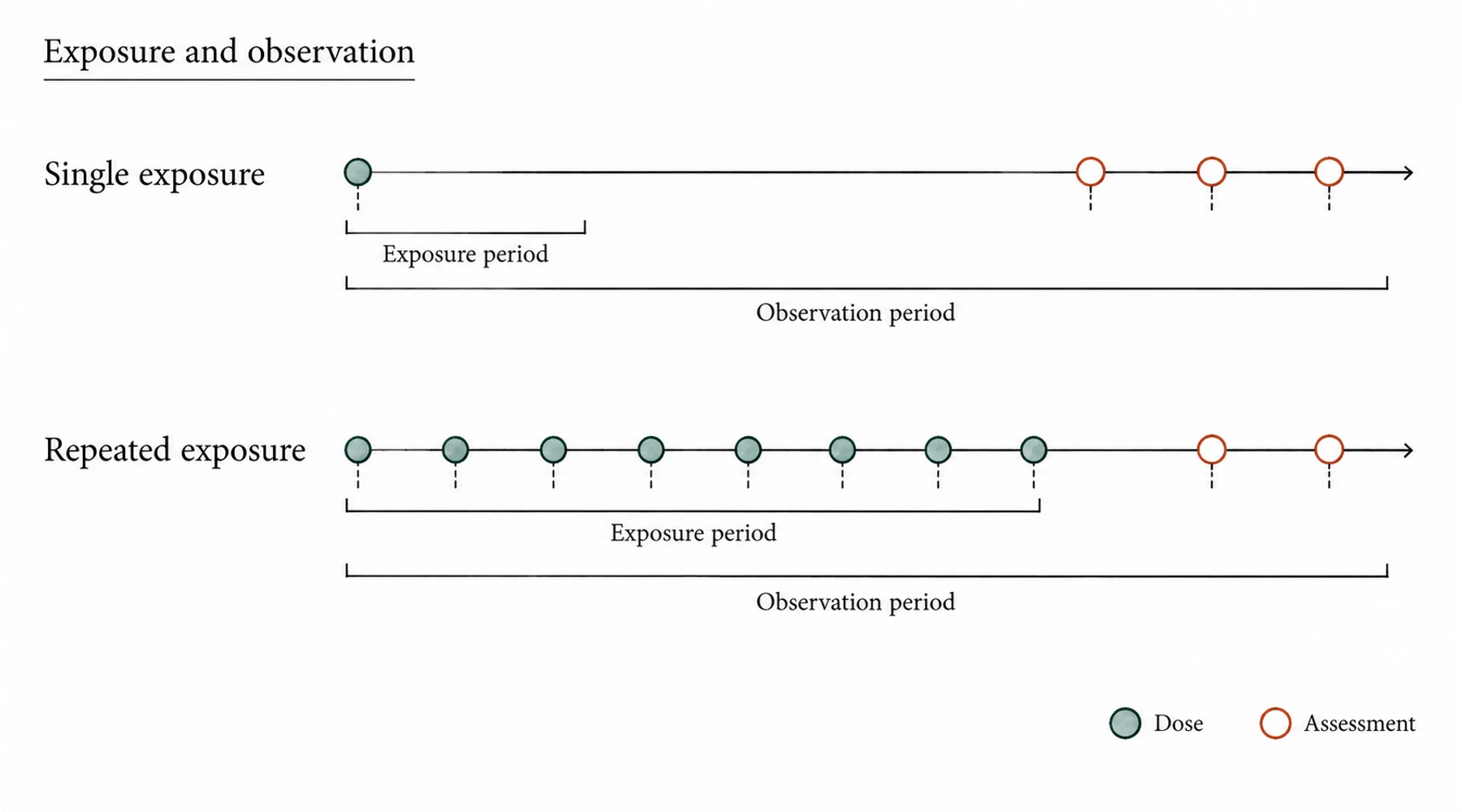
Research does not establish a general daily methylene blue regimen for healthy adults. Repeated human exposure has been studied, including a small six-month psychiatric trial. Longer trials also exist for a related but chemically distinct formulation. Neither category establishes that an unspecified retail solution is safe or beneficial for indefinite use.
The useful question is more precise than “Has anyone studied it long term?” It is: which substance, given by which route, to whom, for how long, and with which outcomes measured?
Read exposure and follow-up separately
An exposure period describes when treatment was administered. Follow-up describes when researchers checked participants afterward. A three-month follow-up after five treatment days does not mean three months of dosing. Likewise, a study ending when mice are 30 months old does not necessarily involve 30 months of treatment.
The cover illustrates this distinction schematically. Its dots are explanatory, not measured study data. The chart below gives actual durations from selected studies. “No separate follow-up reported” means the cited report does not establish an additional treatment-free observation period; it does not mean every possible later outcome was assessed and normal.
Study-duration chart
| Study and model | Formulation and route | Exposure period | Observation or follow-up | Main question measured |
|---|---|---|---|---|
| Rodriguez and colleagues: healthy-adult brain imaging | USP methylene blue, methylthioninium chloride; oral | One administration | Baseline and repeat MRI beginning 60 minutes afterward | Acute brain blood-flow and network changes, not chronic safety |
| Ibarra-Estrada and colleagues: 91 patients with septic shock | Methylene blue in saline; intravenous infusion | Three daily infusions, each lasting six hours | Clinical outcomes assessed through day 28 | Vasopressor use, hospital outcomes, mortality and adverse effects |
| Zoellner and colleagues: 42 participants with PTSD | Methylene blue; oral, alongside psychotherapy | Administration after five daily imaginal-exposure sessions | Assessments through three-month follow-up | Symptoms and functioning after a brief combined intervention |
| Gureev and colleagues: C57BL/6 mice | MB at two reported daily exposure levels; delivery route not clearly specified in the methods | Four weeks | Weekly fecal sampling; maze testing during the final five days; no separate recovery follow-up reported | Microbiome composition and maze performance |
| Jena and Chainy: female Wistar rats | Methylene blue in drinking water; oral | 30 days | Terminal blood, liver and kidney sampling | Selected oxidative-stress and serum measurements; five animals per group |
| Alda and colleagues: 37 participants with bipolar disorder | Methylene blue capsules; oral; higher versus lower active dose | 26-week crossover: two 12-week treatment periods plus titration and crossover weeks | Regular visits during treatment; cognition assessed at baseline, weeks 13 and 26 | Residual mood symptoms, cognition and tolerability with existing treatment |
| Poudel and colleagues: skeletal aging in mice | MB in drinking water for aged female C57BL/6J mice; MB in feed for male and female UM-HET3 mice | Six or 12 months in aged females; 15 months in UM-HET3 mice, from age seven to 22 months | Bone measurements at designated endpoints; no separate treatment-free follow-up | Age-related bone structure, not a comprehensive human safety assessment |
| Gauthier and colleagues: 891 patients with Alzheimer’s disease | Leuco-methylthioninium bis(hydromethanesulfonate), LMTM; oral | 15-month randomized treatment period | Clinical and safety assessments during the trial | Cognition, daily functioning and adverse events; low-dose LMTM control |
| Auerbach and colleagues: F344/N rats and B6C3F1 mice | Methylene blue trihydrate in methylcellulose; oral gavage | Two years, five days per week | Survival monitoring and tissue pathology through study termination | Chronic toxicity and carcinogenicity |
These rows are not interchangeable dose recommendations. Oral gavage delivers material directly into the stomach; drinking water and feed allow different patterns of intake. Intravenous infusion bypasses intestinal absorption. Exposure duration cannot correct those differences.
What repeated human use tells us
The bipolar trial provides more relevant information about repeated oral methylene blue than a single brain scan does. However, only 27 of its 37 participants completed the trial. Participants had bipolar disorder, were already receiving lamotrigine, and were monitored during treatment. The comparison used a lower methylene blue dose rather than an inert placebo. This design cannot establish the safety of continuous use in healthy people or reliably exclude uncommon harms.
The Alzheimer trial requires an additional distinction. LMTM is a stabilized reduced methylthioninium formulation with different counterions, not ordinary methylene blue chloride solution. Its 15-month duration should not be presented as 15 months of testing a consumer methylene blue product. The prespecified primary analysis did not show benefit at the higher doses versus the low-dose control. Gastrointestinal and urinary adverse events and reductions in hemoglobin were reported. Longer observation generated safety information; it did not establish absence of risk.
What the animal studies add
Animal studies can examine tissues and repeated exposures that would be difficult to investigate in people. They also show why a favorable result on one measure is insufficient.
In the 30-day rat experiment, liver lipid peroxidation increased while the kidney measure decreased. Several antioxidant measurements did not change. Calling the entire study “antioxidant protection” would conceal this organ-specific difference. In the four-week mouse experiment, the higher exposure produced larger microbiome shifts. The study did not establish whether those changes persisted after stopping.
Longer exposure did not automatically produce the intended benefit either. The skeletal-aging experiments did not prevent age-associated bone loss. Their relevance to longevity claims depends on the endpoint: bone morphology, survival, and human lifespan are separate questions.
The National Toxicology Program’s chronic study identified carcinogenic activity with different evidence levels across sex and species. The associated two-year paper also reported anemia in some exposed groups. These findings do not supply a numerical cancer risk for a human retail regimen. They do rule out treating two years of animal dosing as uncomplicated reassurance. The carcinogenicity evidence explained examines those findings separately.
Addiction, withdrawal, tolerance and cycling
These terms describe different questions.
- Addiction involves impaired control and continued use despite harm. The studies above do not establish a methylene blue addiction syndrome. They also were not designed to prove the absence of dependence liability in long-term unsupervised users.
- Withdrawal means a reproducible syndrome after reducing or stopping a substance. I did not locate controlled evidence defining a characteristic methylene blue withdrawal syndrome. Fatigue, anxiety or poor concentration after stopping is a report to investigate, not enough by itself to identify withdrawal. Recurrence of an underlying problem, other substances and sleep changes can complicate interpretation.
- Tolerance means a reduced response to the same exposure over time. A fading subjective “boost” does not identify its cause or show that a larger dose is appropriate. Trials would need repeated standardized outcomes and exposure measurements to test that claim.
- Cycling means planned periods on and off the substance. The cited evidence does not validate a schedule that prevents tolerance, dependence or cumulative harm. A five-days-per-week animal toxicology protocol is an experimental schedule, not a human cycling recommendation.
Search results can also confuse the substance under investigation with the substance causing dependence. For example, an experiment on opioid tolerance and withdrawal used methylene blue in a cell model exposed to opioids. It was not a study of withdrawal from methylene blue.
Questions that remain unresolved
For healthy adults taking methylene blue repeatedly, the cited research does not establish a duration at which benefit remains sustained, an optimal stopping point, a validated cycling schedule, or reliable rates of delayed adverse effects. It also does not establish whether a normal short-term laboratory result predicts safety years later.
Cumulative risk and drug accumulation are related but distinct. Repeated exposure can matter even when the drug does not accumulate indefinitely, and a new interacting medicine can change risk after an uneventful period. The current intravenous PROVAYBLUE label documents serious serotonergic interactions, hemolytic anemia risk and higher exposure with impaired kidney function. It does not authorize indefinite oral use.
For an individual decision, the useful information is the exact formulation, route, amount, frequency, start date, other medicines and any symptoms. Review how long methylene blue stays in the body alongside its side effects and contraindications. A history of tolerating it is evidence about that past exposure, not a guarantee about the next one.