
Article
How long does methylene blue stay in the body?
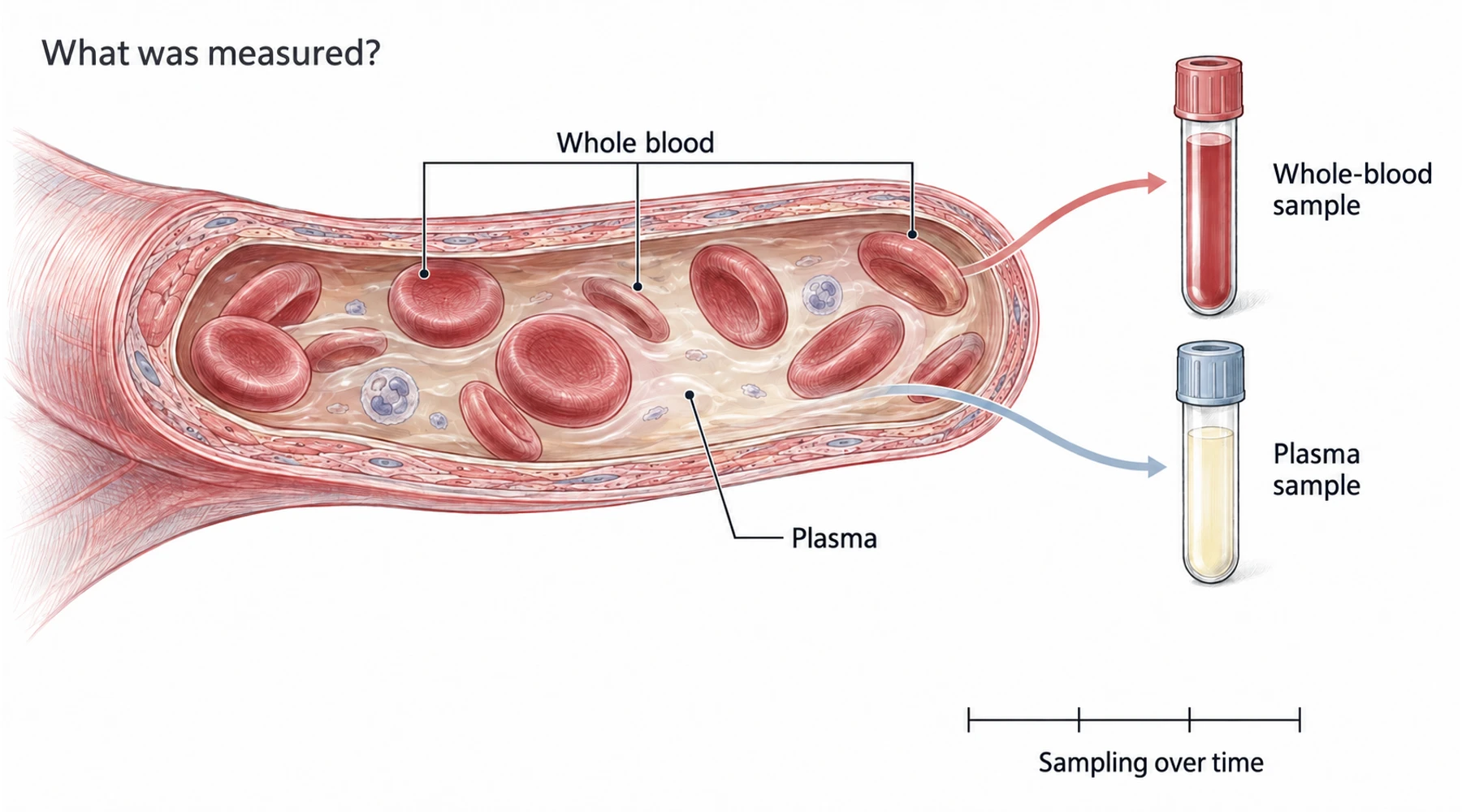
Methylene blue does not have a single proven “out of your system” time. Current PROVAYBLUE injection labeling reports a human half-life of approximately 24 hours. An older volunteer study estimated 5.25 hours after intravenous administration. These numbers describe measured concentration decline under different conditions, not a deadline after which every tissue is free of the drug.
The useful question is more specific: which formulation and route, in which people, measured in which sample, over what period? A blood-concentration estimate cannot by itself tell you when a subjective effect should begin, when an interaction becomes safe, or whether daily use is appropriate.
What half-life actually measures
An elimination half-life is the time taken for a measured concentration to fall by half during the elimination phase being analyzed. A terminal half-life describes the later portion of the concentration curve. It is not necessarily the steep initial decline after an injection.
For a simplified example, suppose a concentration falls from 100 arbitrary units to 50 over one half-life. Over a second identical interval it falls to 25, rather than to zero. This is arithmetic for an idealized model, not a personalized estimate of methylene blue remaining in the body.
Three other terms answer different questions:
- Time to peak concentration, or Tmax: when the highest sampled concentration occurs.
- Exposure, or AUC: the area under the concentration-time curve, combining concentration and duration.
- Clinical response: a change in the condition or outcome being treated, such as a measured reduction in methemoglobin.
Peak concentration need not coincide with maximum benefit. A lower concentration does not automatically mean that a biological effect or interaction has ended.
Human study comparison
The table is an original comparison of the Peter study, the Walter-Sack study and its full methods, and the FDA clinical pharmacology review for PROVAYBLUE. Study doses identify the experiments; they are not instructions for use. MB means methylene blue.
| Evidence | Route and population | Analyte, sample, and method | Sampling and reported result |
|---|---|---|---|
| Peter et al., 2000 | 100 mg IV and oral; seven volunteers | MB in whole blood; high-performance liquid chromatography | Blood profile through 4 hours, as tabulated by FDA; IV terminal half-life 5.25 hours |
| Walter-Sack et al., 2009, IV arm | 50 mg IV; 16 healthy adults enrolled, 15 completed crossover | MB in plasma and whole blood; chromatography with tandem mass spectrometry | Repeated samples through 24 hours; mean half-life 18.5 hours in plasma and 13.6 hours in whole blood |
| Walter-Sack et al., 2009, oral arm | 500 mg aqueous oral formulation; same crossover population | Same analyte, compartments, and assay | Samples through 24 hours; mean half-life 18.3 hours in plasma and 14.7 hours in whole blood; mean plasma Tmax 2.2 hours |
| FDA review, 2016, injection development studies | Single IV exposure in healthy volunteers; review summarizes a 2 mg/kg, five-minute infusion | MB and Azure B measured separately in whole blood and plasma by liquid chromatography with tandem mass spectrometry | Measurements extended to 72 hours; review describes an approximately 24-hour terminal MB half-life |
Download the study comparison as a Markdown table.
These are not interchangeable estimates of a universal biological constant. Nor does the table establish a simple rule that oral exposure always lasts longer than IV exposure. In the crossover study, the chosen sample compartment changed the estimate even within the same route.
Why the numbers differ
Whole blood and plasma are different samples. Whole blood includes cells suspended in plasma. Plasma is the liquid portion obtained after separating the cells. An assay that counts drug in both cells and fluid answers a different measurement question from one restricted to fluid.
The observation window matters. A study that stops early has less information about the later decline. The FDA review specifically identifies sampling duration and blood-versus-plasma measurement as reasons for variability in published methylene blue pharmacokinetics. Longer observation can reveal a slow phase that early sampling does not characterize well.
The measured chemical matters. A parent-drug result, a metabolite result, and a total that includes chemically converted forms should not share an unlabeled “methylene blue level.” The comparison identifies the reported analytes instead of treating all blue-related measurements as equivalent.
Formulation matters. The oral crossover experiment tested a particular aqueous preparation. Its finding does not validate an unspecified capsule, retail liquid, or other route. Likewise, the rat tissue-distribution experiments included in Peter’s paper are separate from its human volunteer blood measurements. They do not provide a human brain-clearance clock.
How long does it take to work?
That depends on what “work” means. In medically treated acquired methemoglobinemia, clinicians can follow a defined blood endpoint. The injection label reports that 9 of 12 adults with the relevant early measurements had at least a 50% reduction in methemoglobin at one hour after dosing. That is a treatment-response observation, not methylene blue’s elimination half-life.
For an oral preparation, reaching a plasma peak around two hours in a volunteer experiment does not establish a two-hour onset of improved focus, energy, or memory. The pharmacokinetic study measured drug concentrations, not those benefits. A person's reported sensation also cannot identify their plasma concentration or demonstrate complete clearance when the sensation stops.
Urine color, repeated use, and medication timing
Blue or green urine is not a calibrated concentration test. The label recognizes body-fluid discoloration, but it does not provide a color threshold that establishes systemic clearance. Watching the color fade cannot substitute for an interaction assessment.
Kidney function also changes the interpretation. The current label reports increased exposure with renal impairment, even though half-life was unchanged in mild to moderate impairment. That distinction shows why half-life alone is an incomplete safety measure. Our methylene blue safety guide explains the broader patient factors.
Repeated use introduces another question: what remains when the next exposure occurs? A single-dose half-life does not establish a safe daily schedule, an effective cycling pattern, or the safety of months of use. Those require evidence about the actual repeated regimen and its outcomes.
Do not use a half-life calculation to stop, restart, or separate prescription medicines. Decisions involving antidepressants and other interacting drugs need the actual medicine list, formulation, route, exposure history, and clinical circumstances. The methylene blue drug-interaction guide explains these distinctions. For a clinician or pharmacist, record the product, amount, route, time of each exposure, medicines taken, and any symptoms. Those details are more useful than an estimated clearance date.