
Article
Methylene blue and longevity: cells, animals, and human evidence
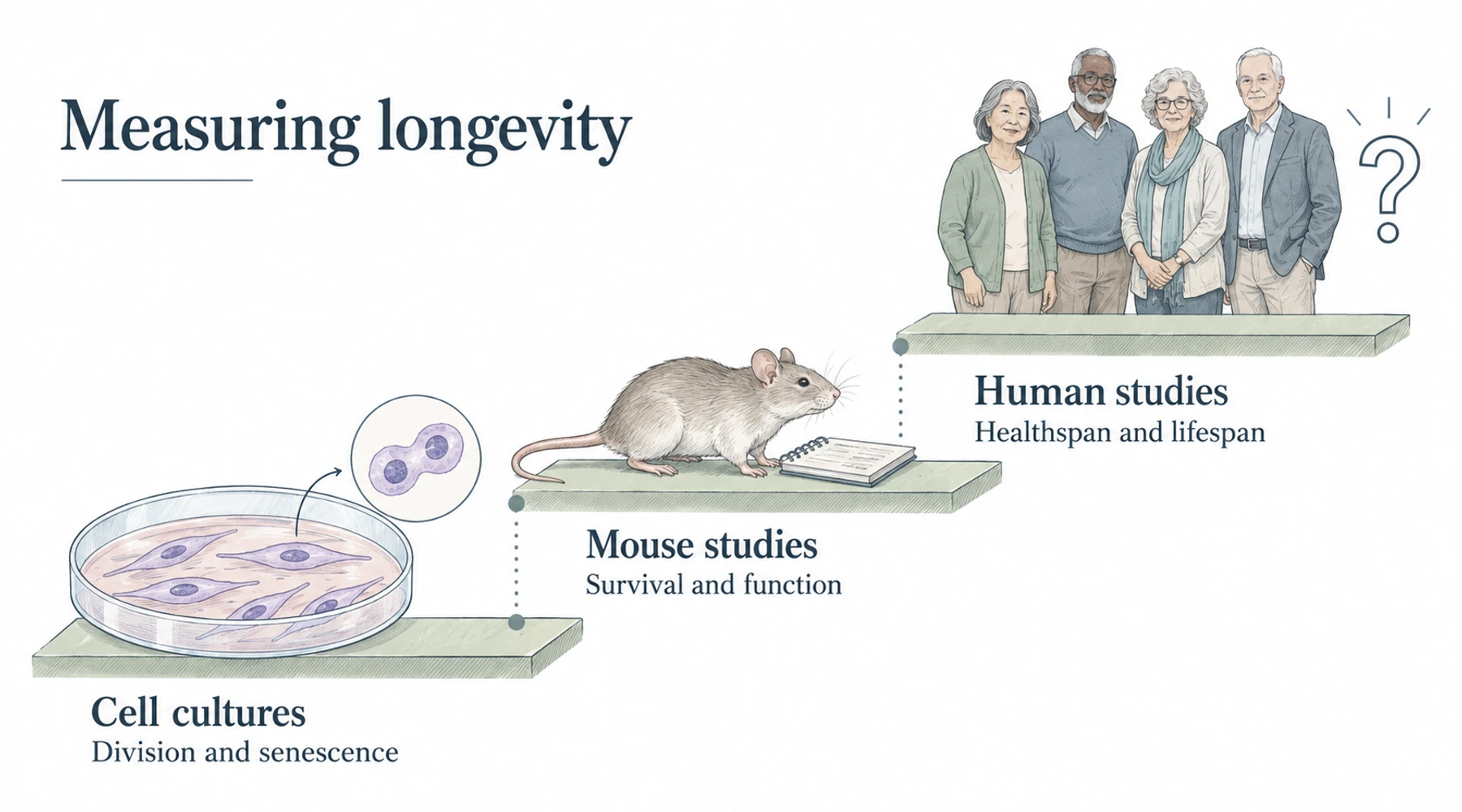
Methylene blue has not been demonstrated to extend human lifespan in the research located for this review. Some laboratory findings are relevant to aging, but their endpoints differ substantially: cells continuing to divide, mice surviving to old age, and people completing a memory task are separate results.
The most useful question is therefore specific: what lived longer, under which conditions, and how was longevity measured? The answer prevents a promising mechanism from becoming a claim about extra years of human life.
Four meanings of an anti-aging claim
- Cellular senescence: a state in which cells stop dividing and develop other changes. Delaying this state in a culture is different from removing already senescent cells.
- Lifespan: the time an organism remains alive. A survival study follows animals or people, including deaths, rather than only measuring their cells.
- Healthspan: time lived with preserved health and function. A test of bone structure or physical performance can inform one part of healthspan without showing longer survival.
- Biological age: an estimate derived from selected measurements. A change in that estimate is an endpoint in its own right, not an observation that someone has lived additional years.
A paper can be strong evidence for one of these claims and provide little evidence for another. The human-benefits evidence overview applies this distinction to other methylene blue claims.
What the cell studies show
In Atamna and colleagues' fibroblast experiment, methylene blue added to culture medium delayed senescence in IMR90 human lung fibroblasts. The researchers reported more than 20 additional population doublings relative to controls. Cultures were repeatedly counted and reseeded, so “lifespan” described their capacity to keep proliferating.
A population doubling means the cell population doubles in number. Twenty extra doublings do not mean 20 extra years, or a 20% increase in the donor's lifespan. The experiment also measured mitochondrial changes, supporting a biological hypothesis without establishing whole-body rejuvenation. How fibroblast experiments measure senescence explains the distinction between proliferation and senescent-cell removal.
The second often-cited paper studied a specific disease model. Xiong and colleagues' progeria research exposed fibroblasts from people with Hutchinson-Gilford progeria syndrome to methylene blue in culture medium. Nuclear and mitochondrial abnormalities improved; growth was tracked for 12 weeks, with other measurements at shorter intervals.
These were human-derived cells, not treated human participants. The disease involves abnormal progerin protein, so improving that cellular phenotype does not establish a treatment for progeria or a general effect on healthy aging. The progeria cellular-model explanation covers that narrower research question. Cosmetic and topical outcomes belong to the separate skincare evidence review.
Evidence ladder: organism, endpoint, and duration
Read down this ladder toward the question of human longevity. Greater relevance to that question does not guarantee a positive result. Each row names what was actually observed.
| Evidence level and study | Model and exposure | Duration | Endpoint and interpretation |
|---|---|---|---|
| 1. Replicative cell aging | Human IMR90 fibroblasts; methylene blue in culture medium versus untreated cultures | Continuous exposure through serial weekly passages to senescence | Population doublings and mitochondrial measurements; extended cell proliferative lifespan |
| 1. Disease-associated cell changes | Normal and progeria fibroblasts; 100 nM culture exposure versus vehicle in the cited growth experiment | Growth tracked for 12 weeks; selected mitochondrial and nuclear assays at 5–8 weeks | Cellular growth and structure; no patient survival endpoint |
| 2. Whole-animal survival | Male and female UM-HET3 mice; methylene blue hydrate in feed versus control feed | From age 4 months through lifespan follow-up | No significant pooled median benefit; female 90th-percentile lifespan increased 6% |
| 3. An aging-related functional domain | Female C57BL/6J mice aged 18 months; methylene blue in drinking water versus regular water | 6 or 12 months | Bone micro-CT; no protection against age-related bone loss |
| 4. Human short-term experiment | 26 healthy adults; one oral methylene blue administration versus placebo | Testing before and 1 hour after administration | Task-related brain activity and memory performance; no lifespan or long-term healthspan measurement |
The concentrations and routes identify experiments. They do not provide a human longevity regimen. In particular, adding a chemical directly to cell medium bypasses absorption, distribution, and elimination in an intact body. The research library organizes studies by these design details.
Why the mouse result needs two lifespan measures
The three-site Interventions Testing Program study used genetically heterogeneous mice. Its methods specify 28 mg methylene blue hydrate per kilogram of feed; the results section reports 27 mg/kg diet. Both describe a food concentration, not milligrams per kilogram of body weight.
Pooled survival curves did not improve significantly in either sex. In females, however, the 90th-percentile lifespan increased from 1,072 to 1,138 days, approximately 6%, with P = .004. The investigators did not consider the overall findings sufficient to support an effective anti-aging intervention at the tested exposure.
Median lifespan is the age when half a group has died. A 90th-percentile lifespan describes the older tail, when about 90% have died. Here, “maximum lifespan” refers to that percentile-based measure, not the age of a single record-breaking animal. An intervention can affect one part of a survival distribution without improving its midpoint. A female-specific animal result also cannot establish benefit in women.
Healthspan must be tested separately
The 2024 skeletal-aging experiment illustrates why a mechanism is insufficient. Despite the rationale for targeting mitochondrial dysfunction, methylene blue did not prevent bone loss in aged female mice given it in drinking water. A separate experiment in the same paper also found no skeletal protection with dietary exposure in genetically diverse mice.
This does not prove every possible functional outcome is unaffected. It does show that a positive result in cultured cells cannot be assumed to protect an aging organ. The skeletal-aging evidence review examines that translation problem in detail.
What human tests and personal reports can establish
The randomized human imaging study examined an acute response after oral administration. It cannot answer whether repeated exposure preserves independence, prevents age-related disease, or extends survival over years. A drug can have a measurable short-term effect without improving any of those outcomes.
The same reasoning applies to biological-age tests. Even if a score falls after someone starts methylene blue, the observation establishes a score change. Demonstrating a survival benefit requires evidence that the intervention improves survival, or a rigorously validated surrogate for that treatment and population. A score that predicts risk across people does not automatically show that changing the score changes that risk.
Multi-intervention self-reports have an additional problem. If someone changes diet, exercise, sleep, several supplements, and methylene blue together, a subsequent improvement cannot isolate methylene blue's contribution. Repeated testing and selective reporting can further distort the impression. Such accounts can generate research questions, but cannot calculate years gained.
What this means for a longevity decision
The available findings support further research, not an established longevity dose or schedule. Years of preventive use would require evidence about cumulative harms as well as benefits. The current injectable product label documents serious serotonergic interactions and contraindication in G6PD deficiency because of hemolysis risk. It does not validate chronic oral use for aging.
Before considering personal use, review the side effects and contraindications and discuss the exact product and medication list with a clinician. For assessing a longevity claim, require the study's organism, route, exposure duration, comparator, and actual endpoint. If the endpoint is cellular growth or a test score, the claim should remain about cellular growth or that test score.