
Article
Methylene blue benefits: what human research supports
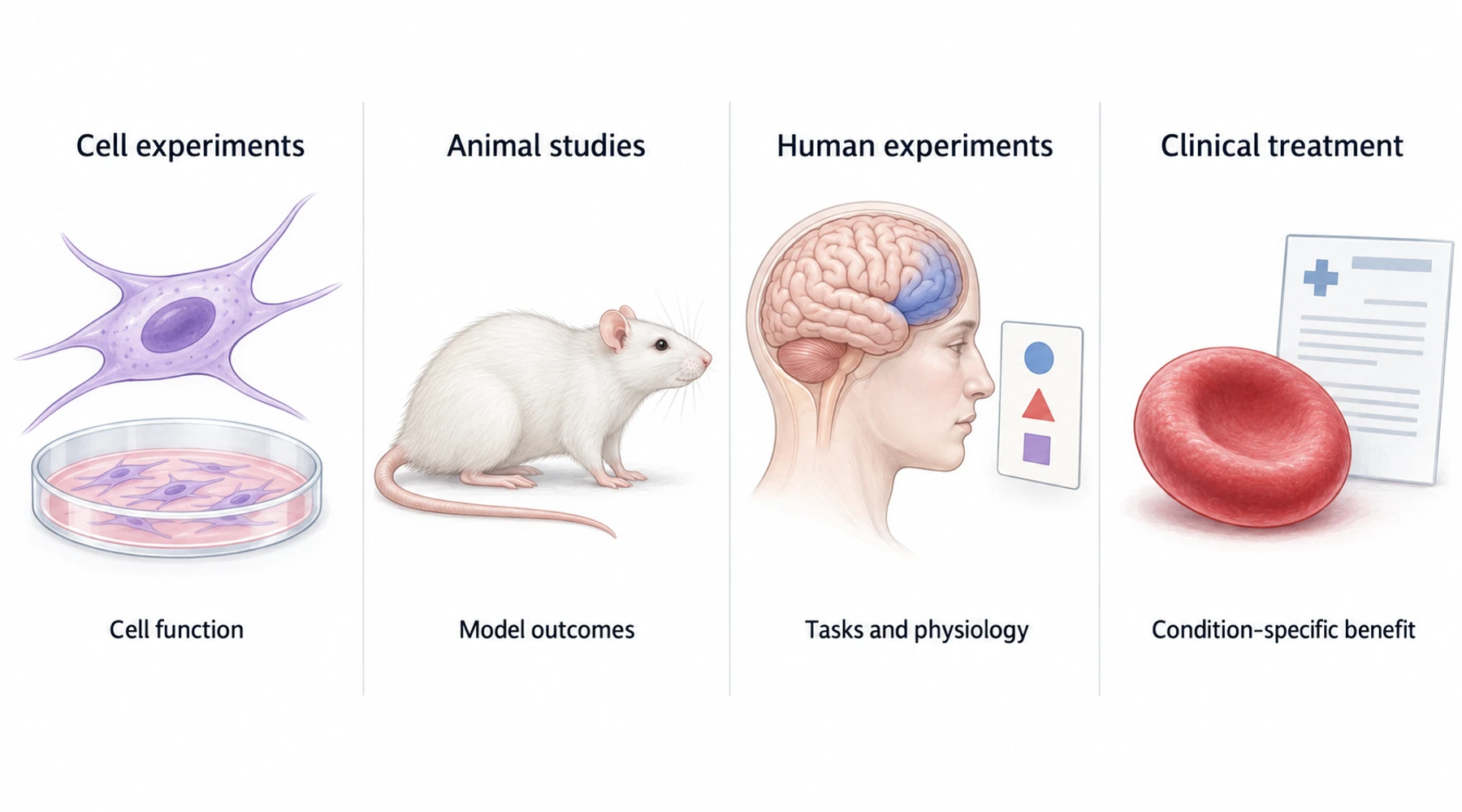
Methylene blue has a demonstrated medical use, but that does not establish it as a general health supplement. Human research includes small experiments on memory and brain metabolism, studies in specific patient groups, and results that do not match popular claims about increasing energy. The useful question is: benefit for which person, measured by which outcome?
A drug can correct a particular disease process without improving an already healthy system. A change on a brain scan can show that a substance is active without showing that someone thinks more clearly. Keeping those distinctions intact changes how the evidence reads.
What benefit is established?
In the United States, the prescribing information for intravenous ProvayBlue identifies treatment of acquired methemoglobinemia in adults and children. In this condition, oxidation alters hemoglobin so that it cannot carry oxygen normally. Methylene blue helps convert that altered hemoglobin back toward its functional form.
This is a specific treatment with a defined formulation, route, diagnosis, and monitoring. It does not mean an oral retail solution increases oxygen delivery or improves health in someone without methemoglobinemia. The distinction concerns what was demonstrated, not whether the substance has biological activity.
Claim-by-claim evidence table
This table separates patient outcomes from experimental measurements. It is a focused evidence map, not an inventory of every proposed application. A positive finding applies to the study conditions shown.
| Benefit claim | Population and study conditions | Endpoint and finding | Main limitation |
|---|---|---|---|
| Treat acquired methemoglobinemia | Adults and children receiving a prescription intravenous product | Restoration of functional hemoglobin is the basis of the approved indication above | A disease-specific treatment, not evidence of wellness enhancement |
| Improve memory or attention | 2016 randomized trial: 26 healthy adults; one oral administration versus placebo; testing one hour later | Altered task-related brain activity; about 7% improvement in correct retrieval responses within the methylene-blue group | Behavioral drug-by-time comparison was not significant, P = .09; attention reaction time did not improve |
| Boost brain energy | 2023 crossover experiment: eight healthy women; intravenous methylene blue at two exposures and placebo on separate days | Cerebral blood flow and estimated oxygen metabolism decreased | Small, acute physiology study; neither an oral wellness trial nor proof of clinical harm or benefit |
| Improve depression or anxiety | Alda and colleagues' bipolar-disorder trial: 37 participants taking lamotrigine; six-month crossover comparing higher and lower oral doses | Residual depression and anxiety symptoms improved; cognitive effects were not significant | Adjunctive treatment in a selected patient group; lower-dose active comparator; cannot establish general mood enhancement |
| Treat Alzheimer's disease | 2016 phase 3 LMTM trial: 891 patients with mild or moderate disease; 15 months | Prespecified primary analyses found no benefit on cognition or daily activities at the higher doses versus low-dose control | LMTM is a distinct reduced methylthioninium formulation; its results cannot validate retail methylene-blue drops |
| Improve septic-shock recovery | 2023 single-center trial: 91 patients analyzed; intravenous treatment added to intensive care versus placebo | Median time to stopping vasopressors was 69 versus 94 hours | Mortality was similar; trial was not powered to establish survival benefit; hospital treatment context |
| Slow skin aging | 2017 fibroblast and reconstructed-skin experiments: cultured human cells and three-dimensional tissue models | Changes included reduced oxidative stress and improved model-skin hydration and thickness | Human-derived material is not a trial in people; no evidence here that drinking methylene blue reduces wrinkles |
| Extend human lifespan | The 2021 anti-aging review discusses mechanisms, cell experiments, animal work, and selected clinical research | Biological plausibility and experimental aging-related effects | The review is not a human lifespan trial; the cited findings do not establish longer human life |
How much does the memory study show?
The 7% figure needs its comparison attached. Improvement from a group's own baseline is not the same as a demonstrated advantage over placebo. Repeating a task can improve performance through familiarity, which is one reason a control group matters.
In the trial above, the statistical comparison of the groups' changes did not meet the conventional significance threshold. That does not prove there was no effect. It makes the behavioral finding preliminary. Nor does increased task-related imaging activity establish improved everyday attention, work performance, or protection against dementia. See the memory and cognition evidence review for the outcome-specific assessment.
Does methylene blue increase energy?
“Energy” can mean feeling less tired, producing more cellular ATP, using more oxygen, or exercising longer. These are different endpoints. Evidence for one cannot silently substitute for another.
The eight-woman study is particularly informative because the investigators expected increased brain metabolism and observed the opposite. Separate rat experiments also found reduced blood flow and glucose metabolism under the tested conditions. The authors discussed dose-dependent effects and the possibility that healthy brains respond differently from impaired systems.
This does not identify an alternative exposure that reliably improves energy. Intravenous and oral administration also produce different exposure profiles. The study supports testing a mechanism directly rather than assuming that mitochondrial activity always increases. Our mitochondrial evidence review examines that distinction in more detail.
Why animal and cell results do not settle health claims
Preclinical experiments help identify mechanisms and decide what deserves a human trial. They can precisely control the concentration around a cell, create a particular injury in an animal, or measure tissue changes that cannot easily be studied in people.
Those strengths also limit translation. Protecting an experimentally stressed cell does not show that a healthy adult will feel better. A reconstructed skin sample does not reproduce a person's circulation, metabolism, medication use, or years of exposure. The skin study is a clear example: its human origin does not turn laboratory tissue measurements into clinical cosmetic outcomes.
Likewise, a review whose title contains “anti-aging” can summarize promising experiments without establishing longer life. Separate the outcome being proposed from the one that was actually measured. The longevity and anti-aging evidence review follows that question across the research.
Are benefits different for men and women?
The available studies do not establish separate general wellness benefits by sex. An all-female physiology sample tells us who participated; without a male comparison, it cannot demonstrate a female-specific response. Studies enrolling both sexes also need adequate numbers and a planned comparison before supporting claims of different effects.
For men, the research inspected here does not establish testosterone, fertility, or sexual-performance benefits. For women, it does not establish menopause relief or hormone balancing. Targeted searches for testosterone and menopause trials did not locate convincing human treatment evidence for those claims. That is a statement about the evidence located, not proof that every possible effect has been ruled out.
Pregnancy changes the risk assessment: the prescription label warns of potential fetal harm. A general “benefits for women” claim cannot remove that concern.
Is it good for you?
There is no demonstrated universal benefit that answers this question for every reader. The intended outcome, health condition, route, and other medicines all matter. The prescription label contraindicates use in G6PD deficiency because of hemolytic anemia risk and warns about serious serotonin syndrome with serotonergic medicines and opioids. Read the side effects and contraindications overview alongside any benefit claim.
Before treating a positive study as a personal recommendation, identify the population, comparison, measured outcome, and follow-up period. Ask whether the result concerns symptoms or daily function, or only a laboratory measurement. Bring the exact study and product details to a clinical discussion using these questions to ask about methylene blue. Do not change prescribed medicines to make an experimental wellness regimen possible.