
Article
Methylene blue for memory and focus: what the human trials measured
A 2023 paper on methylene blue and the living human brain opens its case with a sentence now repeated across reviews, videos, and product pages: the compound "was also shown to dose-dependently enhance cognitive performance, learning and memory in both humans and in experimental animals."
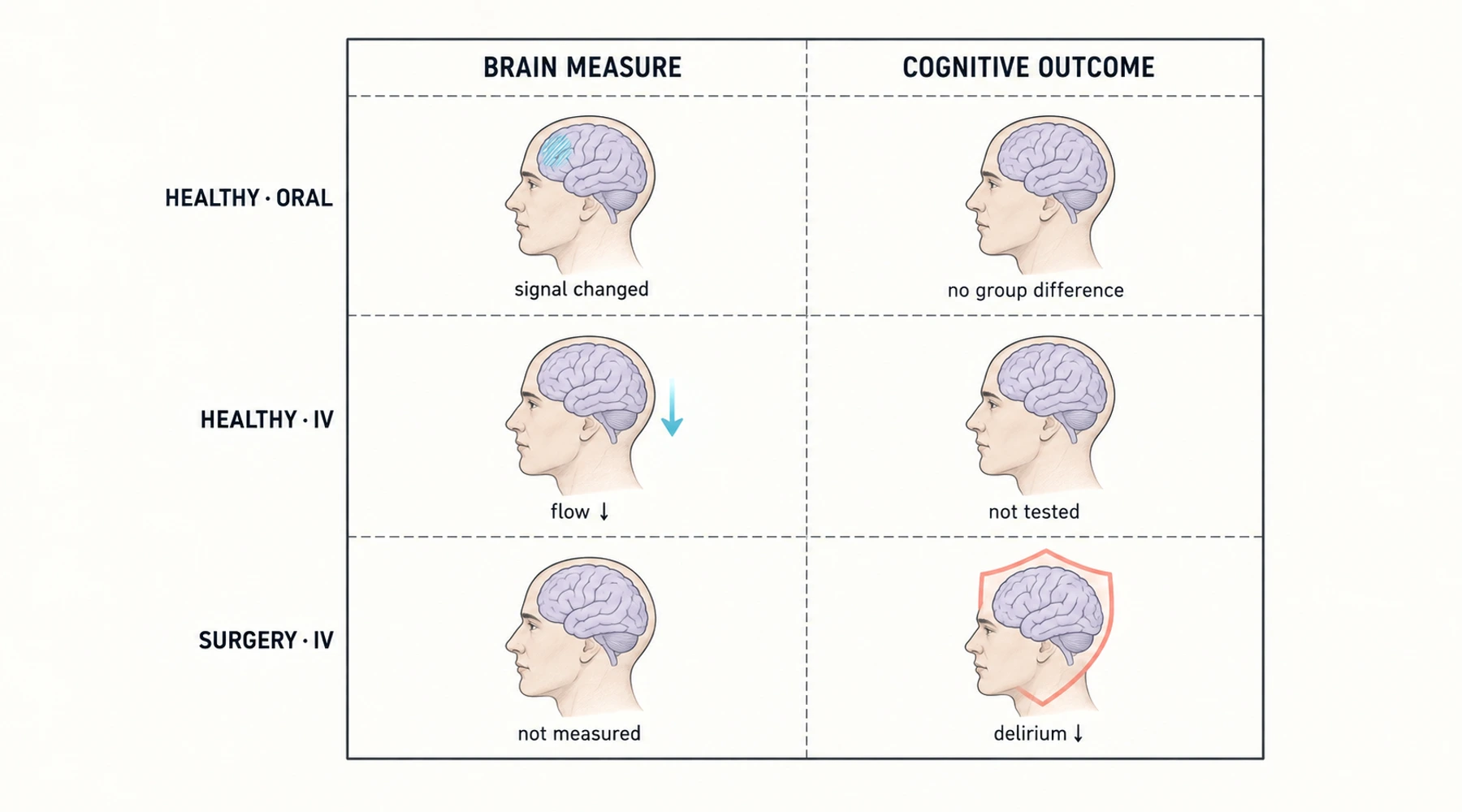
The animal half of that sentence is easy to support. The human half rests on a small number of experiments, and reading them takes the phrase "cognitive performance" apart. Searches for this article located five human studies with a cognitive or brain-imaging endpoint, plus three surgical trials with a cognitive outcome. One healthy-adult experiment produced a memory improvement, and it did not survive the comparison between groups.
Four kinds of human result are usually treated as one
| What was done | Who received it | What changed | What it cannot show |
|---|---|---|---|
| One oral dose, 280 mg, before brain scans (Rodriguez, 2016) | 26 healthy adults, aged 22 to 62 | Brain activation during attention and short-term memory tasks; reaction time unchanged | Benefit to everyday memory, work, or study |
| The same dose, in a connectivity analysis (Rodriguez, 2016) | 28 healthy adults enrolled | Resting connectivity between regions; blood flow fell in a task network | Anything behavioural. No test score was recorded |
| Intravenous doses during a scan session (Singh, 2023) | 8 healthy women | Cerebral blood flow and oxygen metabolism both fell | Nothing cognitive: no cognitive test was given |
| 2 mg/kg intravenously during surgery (Deng, 2021; Zhang, 2025; Deng, 2026) | 779 elderly surgical patients across three trials | Fewer cases of postoperative delirium and early cognitive dysfunction | Memory or focus in people who are not having surgery |
Read down that table and the pattern is visible. The studies with a real cognitive endpoint are the surgical ones, and they used an intravenous drug in anaesthetised patients. The studies in healthy volunteers measured brain signals rather than thinking.
What the 2016 healthy-adult experiment found
The most cited human study gave 26 healthy adults a single 280 mg oral dose, about 4 mg/kg, or a placebo capsule filled with FD&C blue no. 2 to make the two look alike. Participants were scanned before dosing and again an hour later while performing a psychomotor vigilance task, which measures how quickly someone notices a simple visual cue, and a delayed match-to-sample task, a short-term visual memory test.
Brain responses changed. Methylene blue increased the signal in the bilateral insular cortex during the attention task (Z = 2.9 to 3.4, P = .01 to .008) and across prefrontal, parietal, and occipital regions during the memory task (Z = 2.9 to 4.2, P = .03 to .0003).
The behavioural results are the part that gets compressed in retellings.
- Reaction time did not improve. The placebo group went from 230 to 220 milliseconds. The methylene blue group went from 230 to 230 milliseconds. The comparison between groups gave F = 0.65, P = .43.
- Correct retrieval responses rose about 7% inside the treated group, P = .01 on a before-and-after comparison within that group.
- That 7% did not survive the between-group test. The repeated-measures comparison of the change in correct responses produced F = 2.96, P = .09.
A within-group change alongside a non-significant interaction is the signature of a result that might be real and might be noise. The paper's own conclusion is appropriately narrow: the findings "support the notion that methylene blue enhances memory performance" and provide a foundation for future trials. A foundation is not a finding. Our review of the broader human evidence tracks how much has been built on it since.
What the tests actually measure
None of these instruments measures "memory" or "focus" in the sense a reader means. Each puts a specific demand on a person and scores the response, and the limits of the instrument set the limits of every claim made from it.
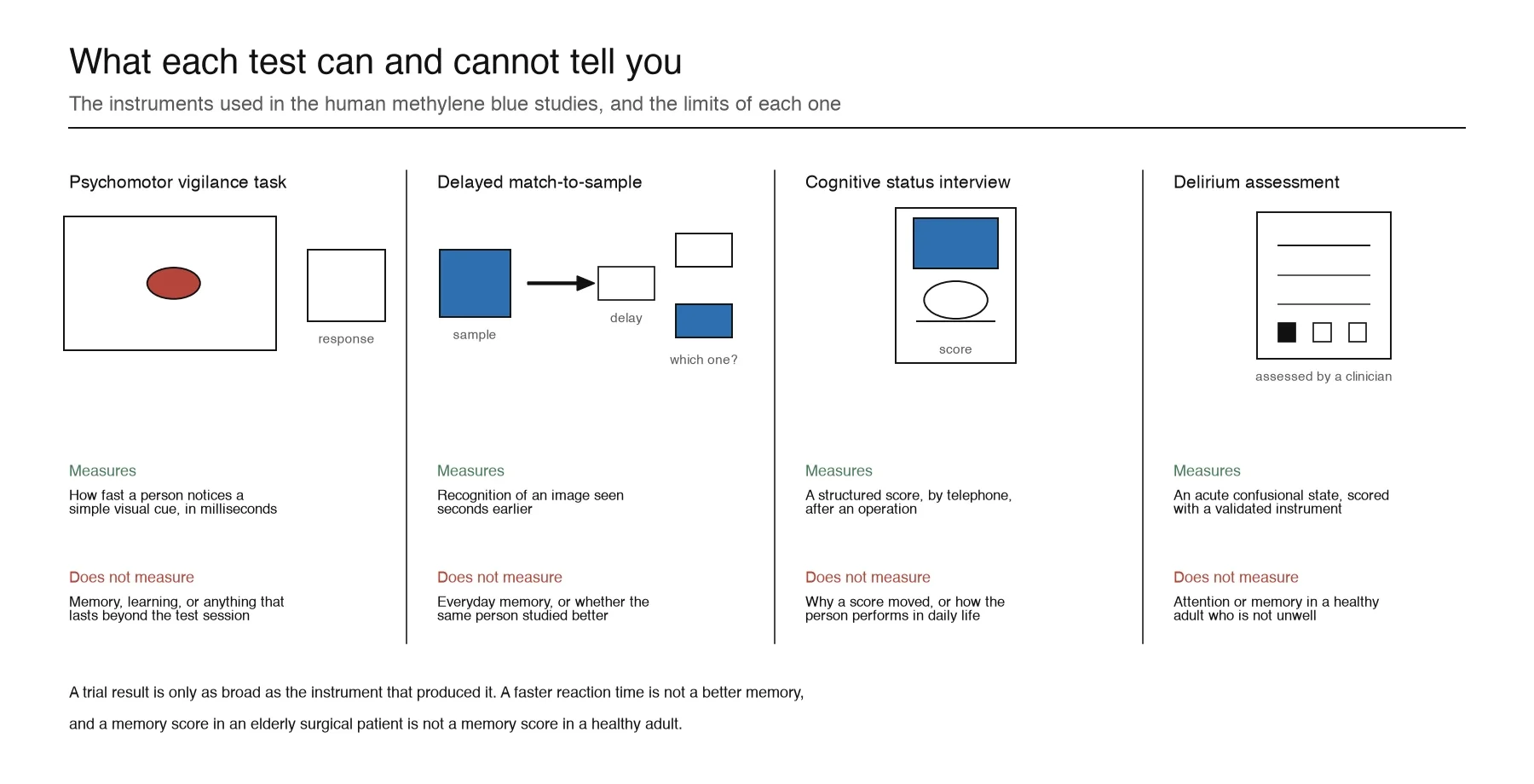
So a result can be statistically solid and still narrow. A reaction time that does not move rules out faster detection of a cue; it does not rule out better recall of a lecture. A delayed match-to-sample score that improves means an image was recognised more often; it does not mean the person will remember a name tomorrow. The guide to how the animal literature measures memory follows the same distinction through the mazes and object-recognition tests behind most of the claims.
The companion study recorded no scores at all
The same research programme published a second analysis from the same recruitment window, same university, same dose and same placebo, this time looking at resting-state connectivity. Twenty-eight participants were enrolled; the imaging analyses used roughly 13 to 15 per group.
Methylene blue was associated with reduced cerebral blood flow within a visuospatial network and with stronger resting-state connectivity in several pairs of regions, including the left hippocampus and the right cerebellum. Both are interesting observations about network behaviour. Neither is a memory result, and the paper says so itself: "The lack of behavioral scores for this study is also a limitation."
Two reports from one group, one recruitment period, and one dose is one experiment, not two. The human brain-imaging evidence for cognitive benefit has not been independently replicated.
The independent study found the opposite direction
The independent measurement came from another group and used another route. Singh and colleagues gave eight healthy women an intravenous infusion of a placebo and of 0.5 and 1 mg/kg methylene blue on separate days, then measured cerebral blood flow, oxygen extraction, and the cerebral metabolic rate of oxygen.
All three fell. Global cerebral blood flow dropped about 8% at both doses, and the metabolic rate of oxygen fell significantly. The authors had predicted an increase and reported the reversal plainly, offering two explanations: the doses sit where methylene blue's effects turn from stimulatory to inhibitory, and a healthy brain may have little room for enhancement.
That reversal is why a "more is better" reading of this compound fails. The hormesis guide covers the shape of the curve; the dose range described as enhancing in this literature is 0.5 to 4 mg/kg, and the papers using it state that above 10 mg/kg the direction reverses.
The cognitive endpoint that did move is postoperative delirium
Delirium is an acute confusional state that develops over hours to days, most often in older people after major surgery. It is not the same thing as remembering where the keys are, but it is measured with validated instruments, and it is a cognitive outcome.
Three randomised trials have tested whether an intravenous dose given during surgery reduces it.
| Trial | Patients | Dose | Delirium in control | Delirium with methylene blue | Reported effect |
|---|---|---|---|---|---|
| Deng, 2021, open-label | 248 elderly, major non-cardiac surgery | 2 mg/kg | 24.2% | 7.3% | OR 0.24, 95% CI 0.11 to 0.53, P < .001 |
| Zhang, 2025 | 217 elderly, joint replacement | 2 mg/kg | 20.4% | 8.3% | Hazard ratio 0.39, 95% CI 0.17 to 0.86, P = .024 |
| Deng, 2026, single-blind | 314, pancreatic surgery | 2 mg/kg then 1 mg/kg | 23.6% | 11.5% | P = .005 |
The 2021 trial also reported early postoperative cognitive dysfunction at day seven falling from 40.2% to 16.1% (OR 0.30, 95% CI 0.16 to 0.57, P < .001). A 2026 meta-analysis of the three trials, covering 779 patients, pooled an odds ratio of 0.35 (95% CI 0.23 to 0.53) with no statistical heterogeneity between studies.
The effects are large by the standards of perioperative medicine, and they were not free. In the joint-replacement trial, postoperative fever was more common in the treated group, 16.5% against 7.4% (P = .039). The pancreatic and joint-replacement trials have since drawn published letters to the editor, which is what happens when a result starts to change practice and also a sign that the details are being examined.
There is a counterweight. A 2026 network meta-analysis in The BMJ pooled 158 trials and 41,084 patients to rank drugs for delirium prevention. It singled out dexmedetomidine as the most reliable, alongside corticosteroids, melatonin receptor agonists, parecoxib, olanzapine, and intranasal insulin. Methylene blue was not among the interventions that analysis named.
Why operating-theatre success does not transfer to studying
Four differences separate the settings.
- The population. The trials recruited people over 60 having major operations, a group with a high baseline risk of confusion. Preventing a confusional state in a vulnerable brain is not the same as improving a working one.
- The route and the setting. Every positive result came from an intravenous infusion given during anaesthesia. A capsule is a different exposure; the route comparison sets out how much oral material reaches the brain.
- The outcome. Delirium is a medical event assessed by clinicians with structured instruments. Sustained focus during an afternoon of work is not, and a trial that cannot blind participants well will struggle to measure it.
- The proposed mechanism. The surgical papers attribute the effect to reduced systemic inflammation and a preserved blood-brain barrier, with lower IL-6. That is a different argument from the mitochondrial electron-transfer story used to sell focus, and the human evidence supports the first much better than the second.
The one human experiment that found better memory
In a 2014 trial in the American Journal of Psychiatry, 42 adults with marked claustrophobic fear were given 260 mg of methylene blue or a placebo immediately after six five-minute exposure sessions in an enclosed chamber. Memory for the training context, tested after one day and after 30 days, was better in the treated group.
The fear result was conditional. Participants who ended the exposure session with little fear did better a month later if they had received methylene blue; participants whose sessions ended badly tended to do worse. So the closest thing in the human literature to a demonstrated memory effect is memory for one laboratory learning event, enhanced when the drug was given after the event. The exposure therapy guide examines that pattern.
Where it was looked for and not found
The longest human test of methylene blue and cognition ran for six months. In a randomised crossover study in bipolar disorder, 37 patients already taking lamotrigine received 15 mg as an active-looking control or 195 mg as the active dose. Depression and anxiety scores improved on the higher dose. The paper's report on cognition is one line: "The effects of methylene blue on cognitive symptoms were not significant."
The design was active-controlled because methylene blue discolours urine and the authors judged an inert placebo would not hold. That blinding problem recurs throughout this field, and the guide to why methylene blue trials are difficult to blind covers what it does to the interpretation of subjective outcomes.
The largest human memory trials used a different compound
The largest test of a methylene-blue-family drug for memory was the Alzheimer's programme, and it did not use methylene blue. It used hydromethylthionine mesylate, the reduced form of the same phenothiazine core stabilised as a salt, developed as a tau aggregation inhibitor. The most recent phase 3 trial enrolled 598 participants with mild cognitive impairment or mild-to-moderate Alzheimer's dementia across 82 centres, and its co-primary endpoints at 52 weeks were not met. The stated reason is instructive: the control arm improved, which the authors attribute to the control itself, 4 mg of methylthioninium chloride twice weekly, chosen as an inactive urinary colourant to protect the blinding. Significant separation appeared only in the mild cognitive impairment subgroup, at 78 and 104 weeks, in a delayed-start analysis. An earlier phase 3 report from the same programme drew its significant results from analyses revised before unblinding, comparing non-randomised monotherapy subgroups. The Alzheimer's trial guide works through what those trials establish.
What a study worth believing would look like
A trial that could support a claim about memory or focus would need healthy adults without an existing cognitive complaint, repeated doses over weeks, a comparison that hides which capsule is which, outcomes fixed in advance, and an independent investigator group. Nothing in that list is unreasonable. It just has not been done.
If you are considering it anyway
Two safety points sit ahead of any discussion of benefit. Methylene blue inhibits monoamine oxidase A, which places it next to prescribed antidepressants and other serotonergic medicines, and the concern is serotonin syndrome rather than a mild interaction. It is also contraindicated in G6PD deficiency because of haemolytic anaemia. The safety reference and the interaction guide organise those questions by drug class.
If memory or concentration has genuinely changed, the first step is not a supplement. Thyroid disease, sleep apnoea, low B12, depression, and several prescription medicines produce exactly the symptom a nootropic is bought to fix, and the thyroid evidence guide shows how often a treatable cause sits underneath.
The material is a variable in every study above
Every dose described here was a measured quantity of a specified compound, from a pharmaceutical manufacturer, with a certificate of analysis attached. A bottle from an unverified seller is not that. Conformance to the USP monograph is the standard a buyer can check, and material that does not conform is likely textile grade, which may carry organic impurities such as Azure B, residual solvents, and heavy metals at levels a pharmaceutical specification limits. What the USP designation does and does not establish covers the grade itself.
Most sellers who describe a product as third-party tested screen for heavy metals only and present that single panel as full compliance. Blupreme tests the complete USP specification: identity, purity, organic impurities, residual solvents, elemental impurities, residue on ignition, microbial limits, and bacterial endotoxins. Every lot ships with a certificate of analysis, and reading one correctly means matching the lot number and the laboratory to the bottle you hold. None of that creates a cognitive benefit, and a product that cannot document its identity is the wrong place to start testing a claim.
Bottom line
No trial has given methylene blue to healthy adults and shown a memory or attention advantage over placebo. The 2016 experiment moved brain signals, left reaction time unchanged, and produced a retrieval improvement that was not significant when the groups were compared. Its companion paper recorded no test scores. An independent group found blood flow and oxygen metabolism falling, not rising.
The human cognitive result that holds up comes from surgery, where an intravenous dose in elderly patients roughly halved the rate of postoperative delirium across three trials and a meta-analysis. That is a real finding about acutely unwell patients, and the largest independent synthesis of delirium prevention did not single the drug out. It is a much narrower claim than the one being sold, and it belongs in a hospital.
The cellular mechanism map covers what the compound does in laboratory models, the ADHD evidence review follows the attention question into a diagnosed population, and the research library indexes the studies behind every claim on this page.