
Article
Methylene blue research library: human trials and experimental studies
A search for methylene blue returns thousands of papers. A study in a dish, a study in rats, and a study in twenty-six volunteers arrive in the same list looking equally authoritative. They are not interchangeable, and the distance between them usually settles the question you arrived with.
This page is an index rather than a verdict. It organises a working library of 130 methylene blue papers by the four things that change what a paper can tell you: the level at which the experiment was run, the population studied, the route and dose, and the form of the compound that was used. A filterable evidence table built from the same library sits beside this article.
What is actually in this library
The 130 papers run from 1928 to 2026. Nineteen predate the year 2000. The 2010s contributed 59, the 2020s have added 29 so far, and the 2000s added 23.
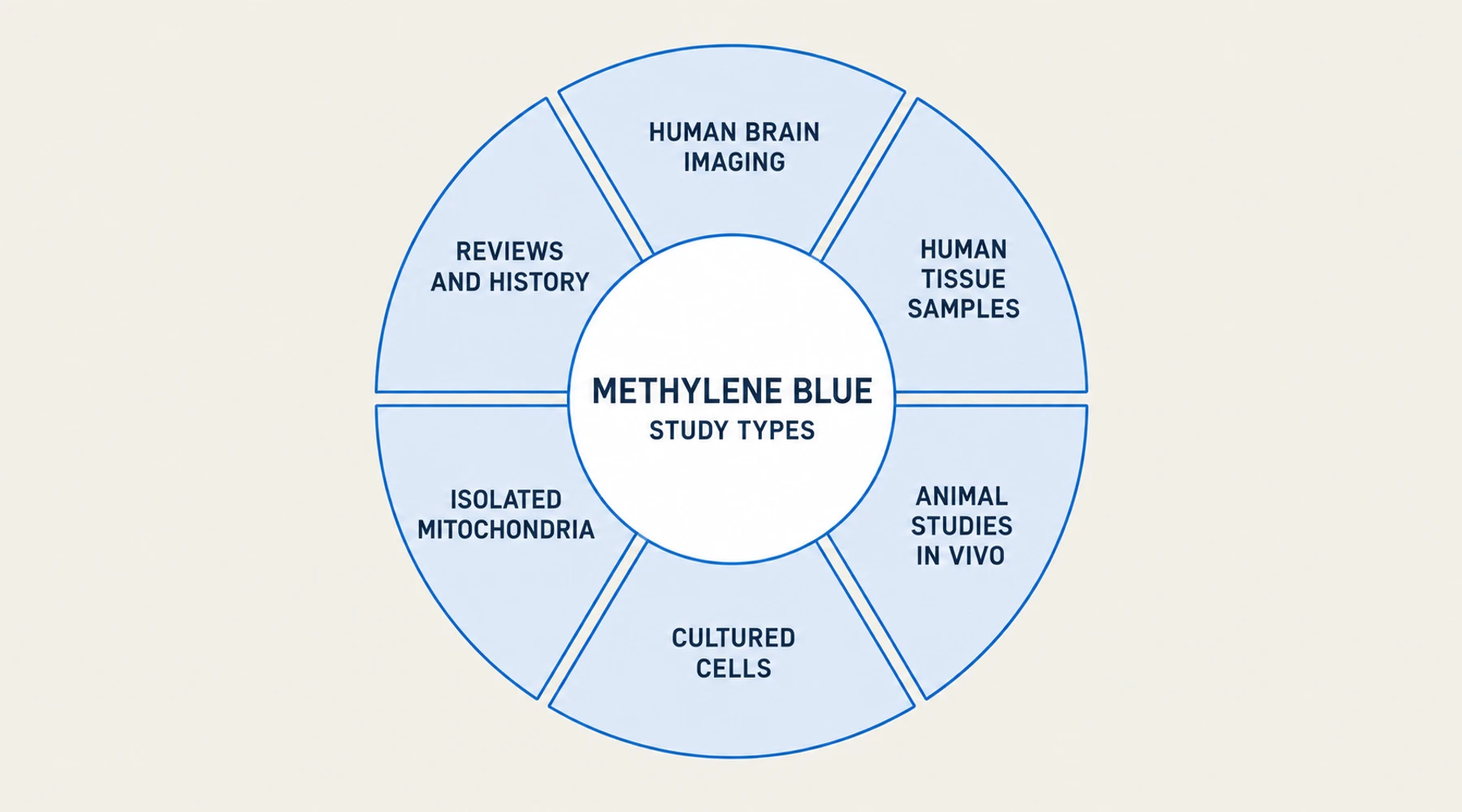
The shape of the collection matters more than its size. Fifty papers are whole-animal studies. Thirty-four study tissue, cells, or blood outside the body. Eight work on isolated mitochondria, five are molecular or biochemical assays, and twenty-nine are reviews, commentary, or history. Four administer methylene blue to people. Every one of those four studies methylene blue in healthy volunteers or healthy adults.
That figure is not an argument that methylene blue has never been tested in patients; approved treatment of methemoglobinemia and of ifosfamide-related encephalopathy rests on clinical use that this library only partly covers. It is a statement about what a reader will find here, and it changes how the rest of the collection should be read. A large body of animal and cell work is good evidence about mechanism. It is not evidence about what happens in a person who swallows a capsule.
The four human studies, including the ones that went the wrong way
The strongest human work in the library comes from one research group working on brain imaging.
A prospective, randomised, double-blind, placebo-controlled trial enrolled twenty-six subjects aged 22 to 62 and gave a single low oral dose of methylene blue or a placebo. Functional MRI response increased in the bilateral insular cortex during a sustained-attention task, and in prefrontal, parietal, and occipital cortex during a short-term memory task. Correct responses during memory retrieval rose by seven percent, with a reported probability of .01. The same group then showed in a second randomised, double-blind, placebo-controlled study that a single low oral dose reduced cerebral blood flow in a task-related network during a visuomotor task while strengthening resting-state connectivity in regions linking perception and memory. The published reports are PubMed 27351678 and PubMed 26961091.
The third study is the one a summary page would quietly leave out. Investigators at King's College London gave two intravenous doses, 0.5 and 1 mg per kilogram in humans and 2 and 4 mg per kilogram in rats. Methylene blue reduced global cerebral blood flow in both species, reduced the cerebral metabolic rate of oxygen in humans, and reduced the cerebral metabolic rate of glucose in rats. The authors had predicted the opposite. Their published explanation is that the doses, although clinically relevant, may sit on the descending arm of a hormetic dose-response curve, and that healthy volunteers with normal cerebral metabolism leave little room for improvement. The record is at PubMed 36803299.
The fourth study is a clean species split. In rat hepatocytes and in intact rats, methylene blue increased the oxidation of labelled ethanol to carbon dioxide by 75 percent and 30 percent respectively. In healthy volunteers, given a dose modelled on the regimen used for ifosfamide encephalopathy, it changed nothing measurable: the pharmacokinetics of ethanol were unaffected, and the change in the lactate to pyruvate ratio that would signal a shift in cellular redox state did not appear. The rat experiment and the human experiment disagree, and the human one is the null. See PubMed 11022014.
Half of the human dosing studies in this library report results that do not support the popular account. The memory and focus trials are worth reading in full for that reason, and why these trials are difficult to blind is a separate problem in its own right.
"Human" covers two different things
Beyond the four dosing studies, ten papers work on human material outside the body, and summaries tend to fold them into the same category.
One group incubated cardiovascular adipose tissue taken from twenty-five patients during cardiac surgery with methylene blue at 0.1 micromolar for twenty-four hours. Expression of the monoamine oxidase enzymes fell, as did markers of oxidative stress (PubMed 39167271). This is good evidence that human tissue responds to methylene blue. It is not evidence about what a dose does in a living person, because nothing was circulated, metabolised, or excreted in that experiment.
The same distinction applies to skin. Human skin fibroblasts taken from healthy donors and from patients with progeria responded better to methylene blue than to several other antioxidants, in both proliferation and delay of cellular senescence, and a reconstructed three-dimensional human skin model showed no irritation even at high concentrations (PubMed 28559565). That is genuinely strong evidence for a topical formulation, and it is still not a trial in people. Where the skin evidence stops is worth reading alongside it.
Where the papers in this library contradict each other
Two careful experiments disagree about a mechanism that has been repeated in a lot of secondary writing.
The first reports that methylene blue can still reduce cytochrome c and improve respiration in mitochondria treated with complex III inhibitors, tested across rat, mouse, and guinea pig mitochondria (PubMed 33669457). The second reports that methylene blue does not bypass a complex III antimycin block in mouse brain mitochondria (PubMed 30734287). Both are published, both are methodologically serious, and this library does not resolve them. Any account that presents the bypass mechanism as settled has flattened a live disagreement. The cell biology target map is where the mechanistic detail belongs.
Compound, and the detail the papers omit
Methylene blue is not one thing in this literature. Papers report methylene blue, methylthioninium chloride, reduced methylthioninium, and phenothiazinium analogues such as toluidine blue, and the four are not interchangeable in the body. The Alzheimer's disease trials are the sharpest example of this, since some of that programme used a reduced form with different absorption behaviour rather than the oxidised dye.
Almost none of the 130 papers state the grade of the material they used. Methods sections name a supplier and stop. A histological stain, a laboratory reagent, and a pharmaceutical-grade active ingredient can all be labelled methylene blue on a purchase order, and they differ precisely in the impurities that follow them. Azure B, heavy metals, and residual solvents are the usual ones, and a reader who wants to compare a paper with a product cannot make that comparison without a certificate of analysis. That is the reader-facing reason grades matter, before any question of taste or dose. Most sellers who claim conformance to the USP monograph test only for heavy metals and treat that as the whole specification. Blupreme tests the full specification, covering identity, assay, organic impurities, residual solvents, elemental impurities, residue on ignition, microbial limits, and bacterial endotoxins, and publishes the results.
Using the table
The evidence table lists all 130 papers with their year, journal, study type, and the material actually used. Study type records the level at which the experiment ran, which is the axis that changes fastest as you scroll. The material column is there so you can check the classification, because papers that mix levels, such as one that runs an in vitro assay before an in vivo confirmation, get the dominant level and nothing more. You can filter by study type, search titles, journals, and species, and sort by year or title. A CSV of the same data is in the same folder.
Once you have picked a paper, the harder skill is reading it: identifying the model, the comparator, the endpoint, the timing, and the uncertainty the authors admit to. How to read a single methylene blue paper covers that, and this index deliberately stops short of it.
For the outcome-by-outcome view of what human research supports, the human evidence overview is the better starting point. This page answers a narrower question: which kinds of study exist, and how many of each.