
Article
Methylene blue in cell biology: targets, models, and measured effects
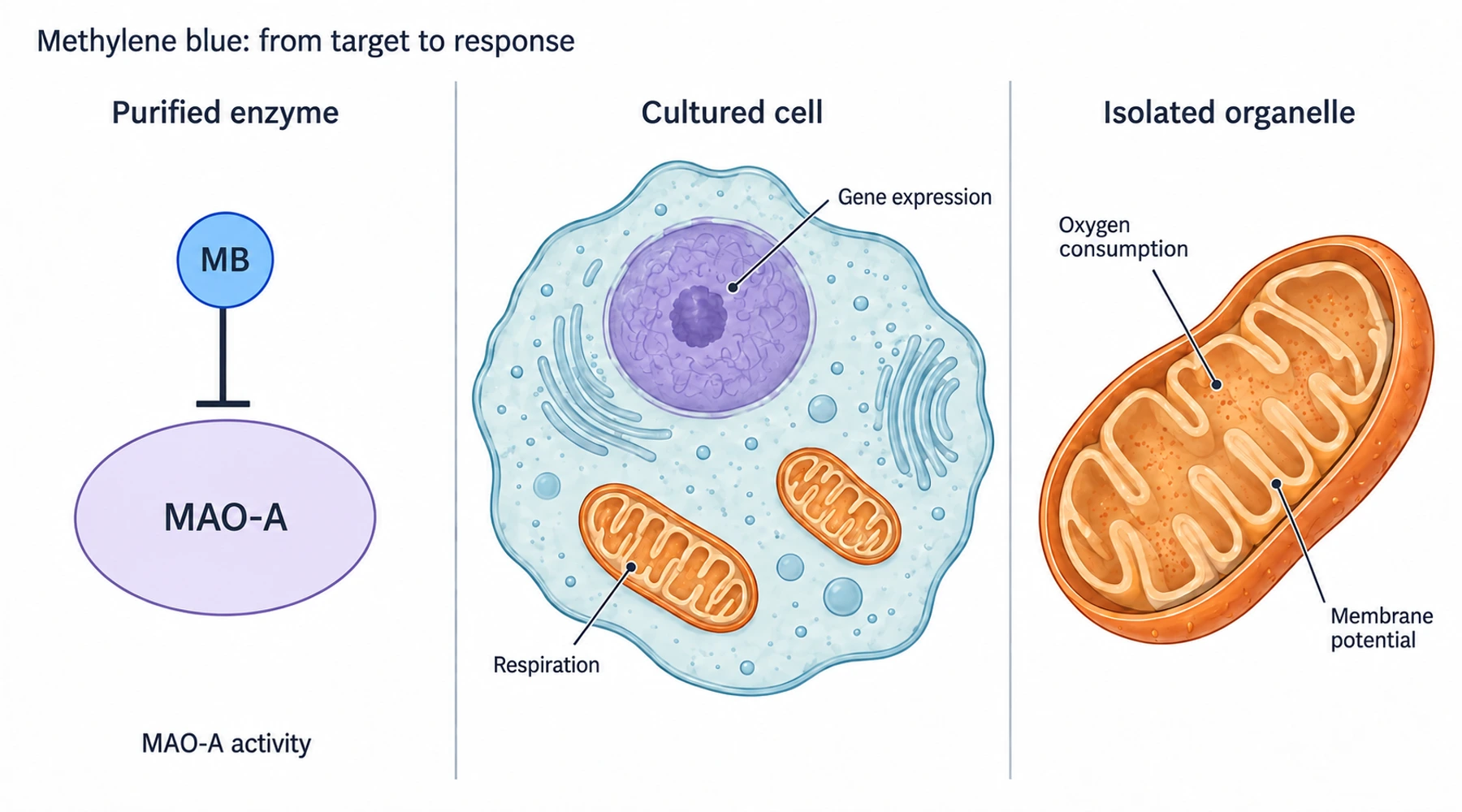
Methylene blue has several experimentally supported molecular actions, but a list of pathway names obscures what each experiment actually established. Inhibiting a purified enzyme, changing oxygen consumption in cultured cells, and reducing a protein signal in mouse brain are different observations. They require different controls and support different conclusions.
This research index organizes those observations by process, model, and endpoint. The accompanying cover is a conceptual illustration of experimental systems, not a molecular structure determination or microscopy image. For the underlying chemistry, start with redox chemistry and biological mechanisms.
Read the evidence labels first
Biochemical evidence tests a defined protein or reaction outside an intact cell. It can establish inhibition or electron transfer under specified conditions. Cellular evidence adds uptake, metabolism, compartmentalization, and interacting pathways. Dependency evidence asks whether removing a proposed pathway component abolishes the response. Organism evidence measures effects in an animal with circulation, metabolism, and multiple tissues.
These labels describe the question answered, rather than a single ranking. A knockout experiment can identify a necessary signaling component without showing that methylene blue binds that component directly. An animal behavioral result can establish a phenotype without identifying its molecular cause.
Linked molecular-target map
Read each row horizontally. The first column links to the pathway discussion; the study link identifies the experimental basis. This is a selected map of mechanistic anchors, not an exhaustive catalog of every reported cellular effect.
| Process or target | Experimental system and evidence type | Measured endpoint and interpretation |
|---|---|---|
| MAO and neurotransmitter metabolism | Purified recombinant human MAO-A and MAO-B; biochemical kinetics | Ramsay and colleagues measured enzyme inhibition. MAO-A was much more sensitive; a mood or brain-serotonin endpoint was not measured. |
| NOS and cGMP signaling | Purified NO synthase, endothelial cells, isolated vessels; biochemical and functional assays | Mayer and colleagues separated citrulline formation, cGMP production, and relaxation. NOS inhibition cannot be relabeled as selective soluble guanylyl cyclase inhibition. |
| Mitochondrial electron transport | Transformed mouse hippocampal HT-22 cells and biochemical reactions; cellular and biochemical evidence | Wen and colleagues measured oxygen consumption, acidification, ATP, and redox-dependent electron transfer. These endpoints were assayed separately. |
| Complex III bypass | Isolated mouse brain mitochondria with respiratory inhibitors; organelle experiment | A complex III antimycin study found failure to restore respiration and membrane potential after that block, despite partial rescue after complex I inhibition. |
| Nrf2 and mitochondrial biogenesis | Wild-type and Nrf2-knockout mouse embryonic fibroblasts; genetic dependency | Stack and colleagues measured antioxidant-response transcripts. Loss of induction in knockout cells supports Nrf2 dependence, not direct binding to Nrf2. |
| Autophagy and mTOR signaling | Human-tau-expressing Chinese hamster ovary cells; reporter and knockdown experiments | Congdon and colleagues examined LC3 reporters, kinase phosphorylation, and tau. BECN1 knockdown removed the observed tau-lowering response. |
| Tau handling and protein clearance | Purified Hsp70 assay and human-tau-expressing HeLa cells; biochemical and cellular evidence | Jinwal and colleagues connected ATPase inhibition with proteasome-dependent tau reduction. This differs from preventing purified tau fibrils from assembling. |
| Tau condensate formation | Reconstituted recombinant-tau droplets; separate SH-SY5Y cytotoxicity assay | A 2023 phase-separation study measured droplet formation and gelation in vitro, then assessed cell viability by MTT after exposure to incubated tau species. The cell assay did not measure intracellular condensate formation. |
The downloadable molecular-target map preserves the primary-study links, evidence labels, and key experimental conditions in a reusable text document.
What the primary experiments distinguish
Enzyme inhibition has an assay context
The purified-human-enzyme study reported a MAO-A inhibition constant, Ki = 27 ± 3 nM, using tight-binding analysis. Its MAO-A IC50 was 164 ± 8 nM under the stated assay conditions. Ki and IC50 are not interchangeable: the latter depends on the enzyme and substrate conditions used to measure half-inhibition. Neither number is a human dose or a predicted tissue concentration.
The NOS comparison is similarly informative. Purified NO synthase lost all measured citrulline-forming activity at 30 μM methylene blue. In the same paper, guanylyl cyclase stimulated by S-nitrosoglutathione required approximately 60 μM for half-inhibition. Thus, a fall in cellular cGMP does not by itself locate the effect at guanylyl cyclase. It can reflect reduced production of the NO that activates it.
Respiration is not a synonym for ATP production
In the HT-22 study, investigators used oligomycin, FCCP, and rotenone to probe respiratory behavior. They also measured ATP independently. Their comparator FCCP increased oxygen consumption while lowering cellular ATP, directly illustrating why an oxygen-consumption trace cannot answer the ATP question alone. The dedicated guide to oxygen consumption versus ATP follows that distinction.
Later work in isolated mouse brain mitochondria used substrates including pyruvate and malate. At 1 μM, methylene blue partly restored rotenone-inhibited respiration but did little after antimycin. That result limits a universal claim that the dye always bypasses both complexes I and III. Species, mitochondrial preparation, substrates, inhibitors, and assay conditions belong beside any proposed electron-transfer diagram.
A gene response is not proof of direct target engagement
In the Nrf2 experiment, 0.1, 1, and 10 μM methylene blue increased HO1 transcript in wild-type mouse embryonic fibroblasts, while the response was absent in Nrf2-knockout cells. This genetic comparison is more informative about pathway dependence than measuring expression in treated cells alone.
It still leaves the initiating molecular event unresolved. Nrf2-dependent transcription, mitochondrial biogenesis, altered NAD+/NADH balance, and AMPK signaling should remain separate entries until an experiment connects them. Increased expression of one mitochondrial gene does not establish that cells produced more functional mitochondria.
Protein disposal has several routes
The autophagy study exposed tau-expressing CHO cells to 0.01 μM methylene blue for six hours and compared them with vehicle. A tandem red/green LC3 reporter helped distinguish earlier vesicles from acidified autolysosomes; bafilomycin supplied a contrasting condition that impaired flux. BECN1 knockdown tested whether the autophagy machinery contributed to tau reduction. These experiments go beyond simply counting LC3-positive spots, which can accumulate when either formation increases or disposal slows.
By contrast, the Hsp70 study examined ATPase activity and proteasome-dependent tau clearance in a different cell system. The 2023 condensate experiments asked another question: how tau molecules form droplets and change their material properties. Total tau, phosphorylated tau, insoluble fibrils, and gel-like condensates are distinct endpoints. Combining them into one “anti-tau” claim erases the mechanism being tested.
Choose the next experiment by the missing distinction
For a new paper, extract the exact chemical identity, concentration, exposure duration, solvent, illumination conditions, model, comparator, and endpoint before interpreting its pathway diagram. Match the assay to the claim: respiration to respiratory flux, ATP to energy availability, enzyme kinetics to inhibition, and genetic perturbation to pathway dependence.
The dose-response guide addresses responses that change direction across concentrations. The antioxidant and pro-oxidant guide separates redox cycling from a universal antioxidant label. Cell entry and membrane partitioning explains why nominal medium concentration is not automatically intracellular exposure; Azure B research explains why related dye species should not be treated as interchangeable.
The broader literature also covers caspase activity, ferroptosis, inflammatory signaling, and cellular senescence. Those are useful routes when the endpoint is cell death, cytokine signaling, or persistent growth arrest. They are not additional proof that every molecular action occurs in the same cell at the same concentration. This map establishes routes through experimental evidence; it does not convert those experiments into clinical benefits.