
Article
Azure B: methylene blue impurity, metabolite, and research compound
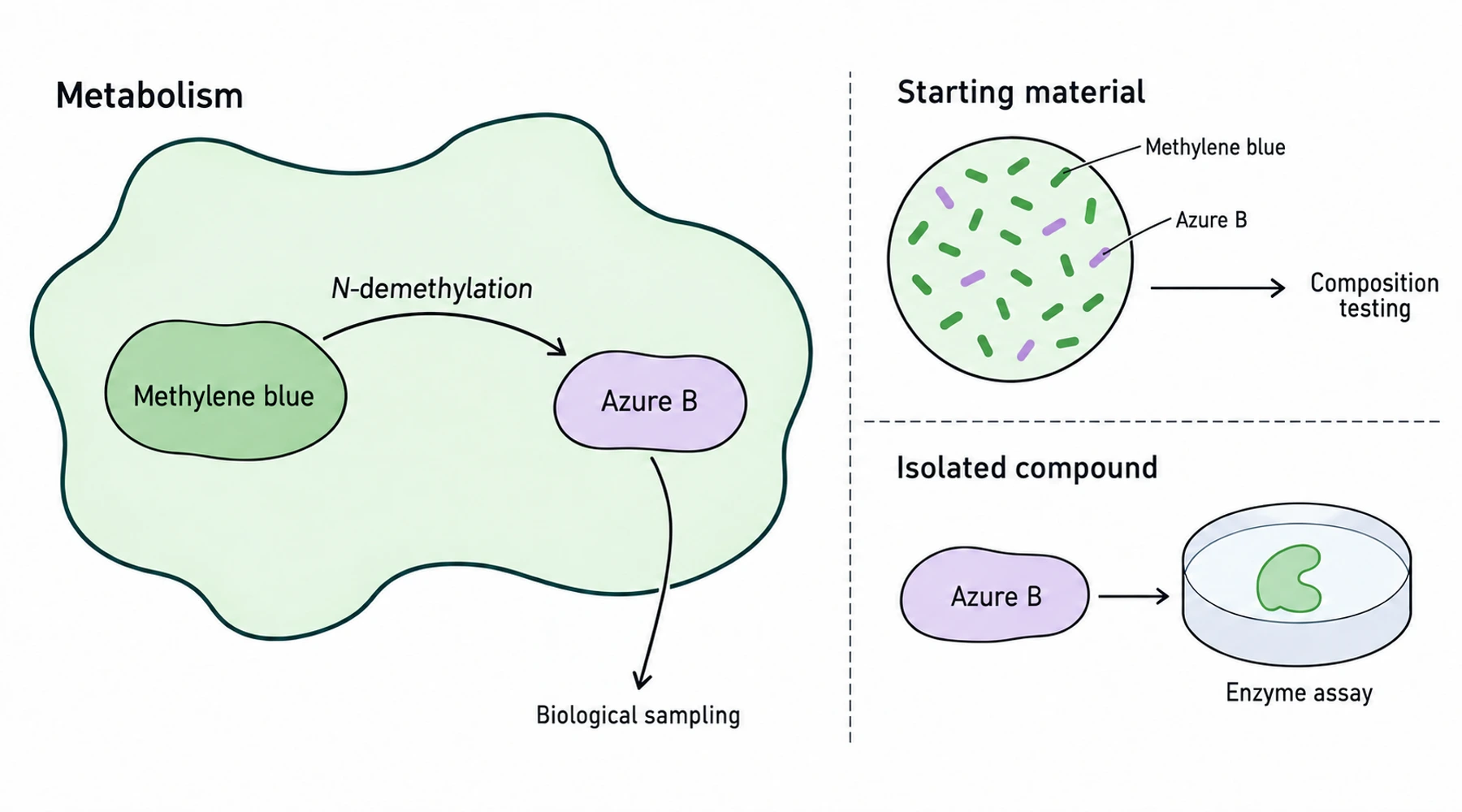
Azure B is a chemically distinct relative of methylene blue. It can already be present in a methylene blue sample, appear after the body processes methylene blue, or be supplied separately for an experiment. These descriptions are compatible. They describe where the compound came from and what a researcher is asking about it.
The distinction matters when interpreting a certificate of analysis or a claim about biological activity. Calling Azure B an active metabolite does not make an uncontrolled amount in a bottle desirable. Calling it an impurity does not mean it is biologically inactive.
What changes chemically?
Azure B is the monodemethylated derivative of methylene blue. One methyl group attached to nitrogen has been replaced by hydrogen. The relationship is described in the chemical discussion and Figure 1 of Schirmer and colleagues' review. This is a specific structural change, rather than a different name for methylene blue.
It also differs from reduction to leucomethylene blue. Reduction changes the oxidation state; N-demethylation changes a nitrogen substituent. Treating both processes as simply “methylene blue becoming colorless” loses the distinction needed to interpret metabolism. Related dye names require similar care: Azure A, Azure B, and methylene blue are not interchangeable labels. The guide to similarly named compounds addresses that naming problem.
Three origins, three different questions
The cover diagram separates three routes through an investigation. The table makes the evidence required at each route explicit.
| Where Azure B enters the investigation | Question being asked | Useful evidence | Conclusion that does not follow |
|---|---|---|---|
| Already present in the starting material | What does this batch contain? | A method that separates and quantifies Azure B, tied to the lot and applicable specification | The detected amount improves the product's effects |
| Detected after methylene blue exposure | What compounds are present over time? | Starting-material analysis plus serial, validated biological measurements | Every detected molecule must have formed in the body |
| Added as a separately characterized compound | What does Azure B itself do? | Identity, purity, concentration, comparator, and a defined experimental endpoint | The same effect occurs in patients taking methylene blue |
The middle row is easily overlooked. If Azure B was present in the administered material, a subsequent biological sample can contain both pre-existing and newly formed compound. Establishing formation requires more than detecting a peak after exposure.
Azure B in starting material
A historical analytical study provides a useful example of why a minor constituent can matter. Researchers investigating methylene blue iodination with HPLC–mass spectrometry found that the main iodinated product arose from Azure B impurity. The methylene blue samples studied contained approximately 7–8% Azure B. Under their reaction conditions, iodinated Azure B was much more abundant than iodinated methylene blue.
Those percentages describe the material in that 1999 study. They do not establish today's acceptable impurity limit or the composition of another supplier's product. The experiment demonstrates a narrower point: the predominant starting compound need not produce the predominant reaction product.
For a certificate of analysis, inspect the specific Azure B result, units, test method, reporting limit, and lot identity. A total dye assay and a related-substances test answer different questions. An “undetected” result also requires a detection or reporting limit to be interpretable. See how to read a methylene blue certificate of analysis for the broader document checks.
Azure B formed during metabolism
Studying metabolism requires analytical separation of the parent and its metabolite. Kim and colleagues developed an LC–MS/MS method measuring both compounds in rat plasma. Their calibration range was 1–1,000 ng/mL for each compound, with a lower quantification limit of 1 ng/mL using 20 microlitres of rat plasma. They then applied the method in a rat pharmacokinetic study.
The detail matters because a measurement method has a sample context. Validation in rat plasma does not automatically establish accuracy in human plasma, urine, or a concentrated commercial solution. The method demonstrates how researchers can follow two compounds separately; it does not provide a human dosing rule.
Human exposure data also show why one fixed metabolite percentage is inadequate. The clinical pharmacology section of a methylene blue injection label reports increased Azure B exposure in participants with renal impairment. Exposure over time reflects formation, distribution, and elimination, rather than bottle composition alone. Route, sampling time, and the measured compartment all matter when comparing these results.
What direct experiments show
Azure B has measurable pharmacological activity. The more useful question is which target, under which conditions.
In a 2012 study using recombinant human monoamine oxidase, Azure B inhibited MAO-A with an IC50 of 11 nM, compared with 70 nM for methylene blue under identical conditions. An IC50 is the concentration associated with 50% inhibition in that assay. Azure B also inhibited MAO-B, but at a substantially higher concentration: 968 nM. The investigators reported reversible inhibition.
These results support possible contributions to biological effects and interactions, including questions about methylene blue and neurotransmitters. They do not mean that Azure B is six times better as a medicine. The ratio describes inhibition of one enzyme in one experimental comparison.
A separate human cholinesterase experiment illustrates the limitation of that generalization. Azure B's IC50 values were 0.486 micromolar for acetylcholinesterase and 1.99 micromolar for butyrylcholinesterase. Methylene blue was more potent in those same assays, with respective values of 0.214 and 0.389 micromolar. The ordering reversed with the biological target. Neither result independently establishes improved cognition or treatment of Alzheimer's disease.
From experimental activity to clinical interpretation
Experiments in whole animals add another level of evidence without resolving clinical efficacy. In Delport and colleagues' rat study, Azure B reduced immobility in an acute forced-swim test, with methylene blue and imipramine among the comparators. The paper calls this an antidepressant-like effect. It was a behavioral experiment in rats, not a trial measuring recovery from depression in patients.
For any claim about Azure B, first identify the material tested. Then identify the organism or assay, the exposure, and the endpoint. Finally, check whether the conclusion concerns composition, metabolism, enzyme activity, animal behavior, or clinical benefit. These steps keep a batch-quality result from being mistaken for a treatment claim, and an experimental mechanism from being mistaken for an established patient outcome.