
Article
Methylene blue in skincare: formulations and human evidence
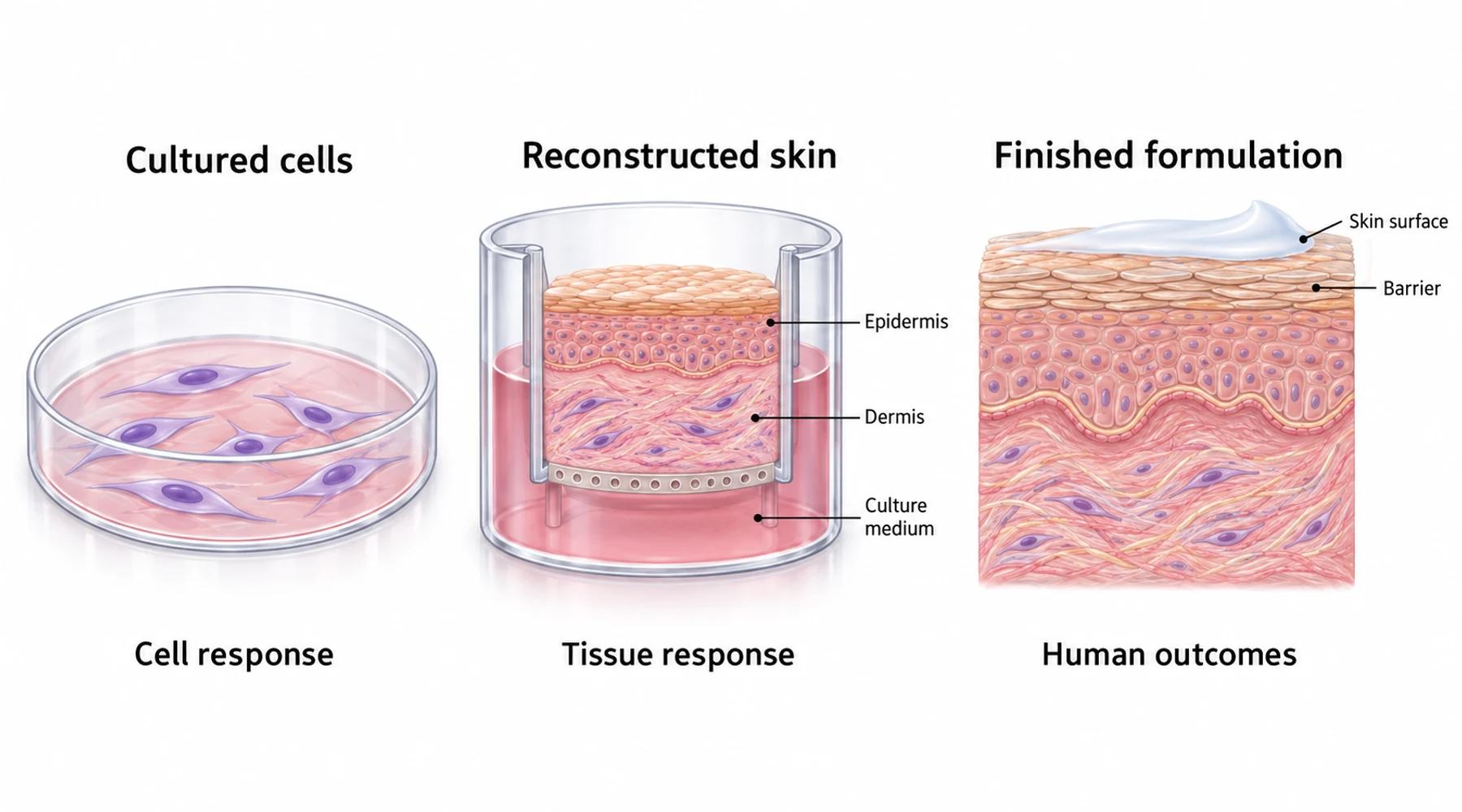
Methylene blue has promising laboratory evidence for skin aging, and manufacturers report human testing of some finished cosmetics. These findings answer different questions. Neither makes a bottle of raw methylene blue equivalent to a tested face cream, and neither establishes a treatment for eczema, psoriasis, or rosacea.
For any skincare claim, identify three things: what was applied, what it was applied to, and what changed. A concentration in cell-culture medium, a skin-model response, and a person reporting smoother skin are not interchangeable measurements.
What the frequently cited skin study tested
The 2017 study by Xiong and colleagues tested human dermal fibroblasts and reconstructed skin. Fibroblasts are connective-tissue cells; growing them in a dish removes the outer barrier that a face cream must encounter.
Cultured fibroblasts exposed to 100 nM methylene blue for four weeks showed changes in oxidative-stress and senescence measures. In full-thickness reconstructed skin, two weeks of methylene blue in culture medium increased measured hydration and dermal thickness. The greatest thickness response occurred at 0.5 µM among the tested concentrations. These are experimental exposures, not instructions for preparing a cream.
One detail matters for collagen claims: the authors reported increased COL2A1 expression but did not observe a change in type I collagen. Their wound-related experiment measured closure of a scratch in a fibroblast monolayer. It did not test healing of wounds on people.
Reconstructed skin provides more tissue organization than isolated cells. It still cannot establish how much a particular cosmetic reaches living facial skin, whether wrinkles visibly improve, or how repeated use affects a diverse population.
Comparison: formulation and study model
Use this comparison to locate the evidence behind a label or social-media claim. The rightmost column identifies the missing measurement, rather than assuming that every experiment answers the same question.
| Material or intervention | Model and exposure | What the evidence can address | What still needs direct testing |
|---|---|---|---|
| Methylene blue added to laboratory medium | Cultured human fibroblasts; repeated exposure | Cellular responses under controlled conditions | Delivery through an intact skin barrier and visible cosmetic outcomes |
| Methylene blue in medium supporting reconstructed skin | Engineered epidermis and dermis | Tissue-level responses in that model | Performance of a finished cream applied to people |
| Finished commercial cream or serum | Product-specific human testing | Tolerability and the outcomes actually measured for that formula | The contribution of methylene blue versus its vehicle and other ingredients |
| Raw aqueous dye mixed into moisturizer, tallow, or coconut oil | A newly altered formulation | Ingredient identity alone establishes no product outcome | Uniformity, stability, preservation, delivery, tolerability, and benefit |
| Methylene blue plus an enhancer or light device | A combined intervention | Only results obtained with that specific combination | Whether another solvent, device, exposure, or skin condition produces the same result |
Human testing exists, but read its endpoint
It would be inaccurate to say that no human skincare testing exists. Bluelene's EyePlus+ study summary reports no irritation or allergic contact dermatitis in its tested group. That is a manufacturer-published tolerability claim about a finished product containing several ingredients. It does not mean that every user will tolerate it or that methylene blue alone reduced wrinkles.
The manufacturer's Fit+Firm report also describes participant ratings for hydration, firmness, and texture. Its skin-thickness illustration is explicitly described as a three-dimensional skin model, even though it appears beside human product-test results. The two should remain separate when interpreting the page.
The public summaries inspected do not establish a randomized comparison of otherwise identical formulations with and without methylene blue for wrinkle improvement. A controlled comparison of that kind would help isolate the ingredient's contribution. Participant satisfaction can support acceptability; objective measurements and a suitable control answer a different question.
A finished product is more than its dye
For a concrete example, the Bluelene Night Cream ingredient list includes water, rice-bran oil, glycerin, fatty ingredients, an emulsifier, preservatives, and methylene blue. Its complete formulation is the material a customer applies. The manufacturer's FAQ states that its methylene blue concentration is proprietary, so the label cannot be used to reconstruct it.
A moisturizer's vehicle is its carrier system. It influences spreading, water retention, release of the ingredient, and contact with skin. If a multi-ingredient cream improves dryness, attributing the entire change to one ingredient requires more than that ingredient's presence on the label.
The same applies to product color. A pale cream does not reveal a precise methylene blue concentration. Appearance cannot substitute for an assay of concentration, chemical state, or stability. Our guide to methylene blue solution ingredients explains why a solution's full contents matter.
Does methylene blue penetrate skin?
The answer depends on what “penetrate” means. A substance can enter the outer stratum corneum without reaching the dermis in an effective concentration or passing into the circulation.
In a human solvent study involving ten healthy volunteers, researchers pretreated forearm sites with different vehicles and then applied methylene blue. Surface biopsies showed that some pretreatments increased dye retention in the stratum corneum while others reduced it. This was a delivery experiment, not an anti-aging trial. The method did not measure systemic absorption.
That finding also shows why “it dissolves in this solvent” is insufficient. Solubility describes behavior in the container. Skin delivery additionally requires release from the vehicle and movement through tissue. Greater solubility does not automatically mean greater useful delivery, and greater delivery does not automatically mean a better outcome.
Tallow, coconut oil, and homemade serums
Tallow and coconut oil are lipid-rich bases. Simply stirring aqueous methylene blue into either does not establish a uniform, stable emulsion. A mixture can look evenly colored immediately after stirring while leaving unanswered questions about separation during storage and the amount delivered in each application.
Adding a solution to an existing cream also changes the formula the manufacturer tested. FDA guidance on cosmetic contamination identifies added water, contaminated ingredients, ineffective preservation, and consumer handling as relevant risks. Methylene blue's antimicrobial research is not a substitute for preservation testing of a jar of cream.
The supplied discussion of homemade creams and penetration enhancers raises DMSO and Transcutol as possible carriers. These suggestions do not supply measurements of the finished mixture's safety or delivery. An enhancer can change exposure to other ingredients as well as the intended active. A solvent's laboratory compatibility does not establish that a multi-ingredient serum is suitable for facial use.
There is also a real research question behind vitamin C combinations. A 2021 laboratory study reported favorable combined effects in cultured skin cells. It did not validate arbitrary mixtures of vitamin C, methylene blue, peptides, oils, and solvents. Every added component introduces another variable; a better cell response is not a finished-product stability test. The sunscreen research overview examines the separate UV-protection question.
Cosmetic aging, inflammatory disease, and light
Improved hydration is not equivalent to control of eczema, psoriasis, or rosacea. These conditions require disease-specific outcomes, such as symptoms, lesion severity, and recurrence. The aging experiments and cosmetic summaries above do not establish methylene blue cream as an effective treatment for them. Persistent redness, scaling, or itch should be assessed on its own terms rather than treated as cosmetic aging.
Light changes the intervention too. In photodynamic experiments with methylene blue, light and oxygen participate in generating reactive species. This chemistry differs from the antioxidant rationale commonly used to market skincare. Adding a red-light panel to a homemade mixture cannot be assumed to amplify a cosmetic benefit safely. The methylene blue and red-light evidence guide separates those settings.
When assessing a product, ask for the study of that formulation, the comparator, the duration, and the measured outcome. Those details are more informative than a blue color, an ingredient mechanism, or the word “clinical” on its own.