
Article
Methylene blue and thyroid conditions: evidence and medication questions
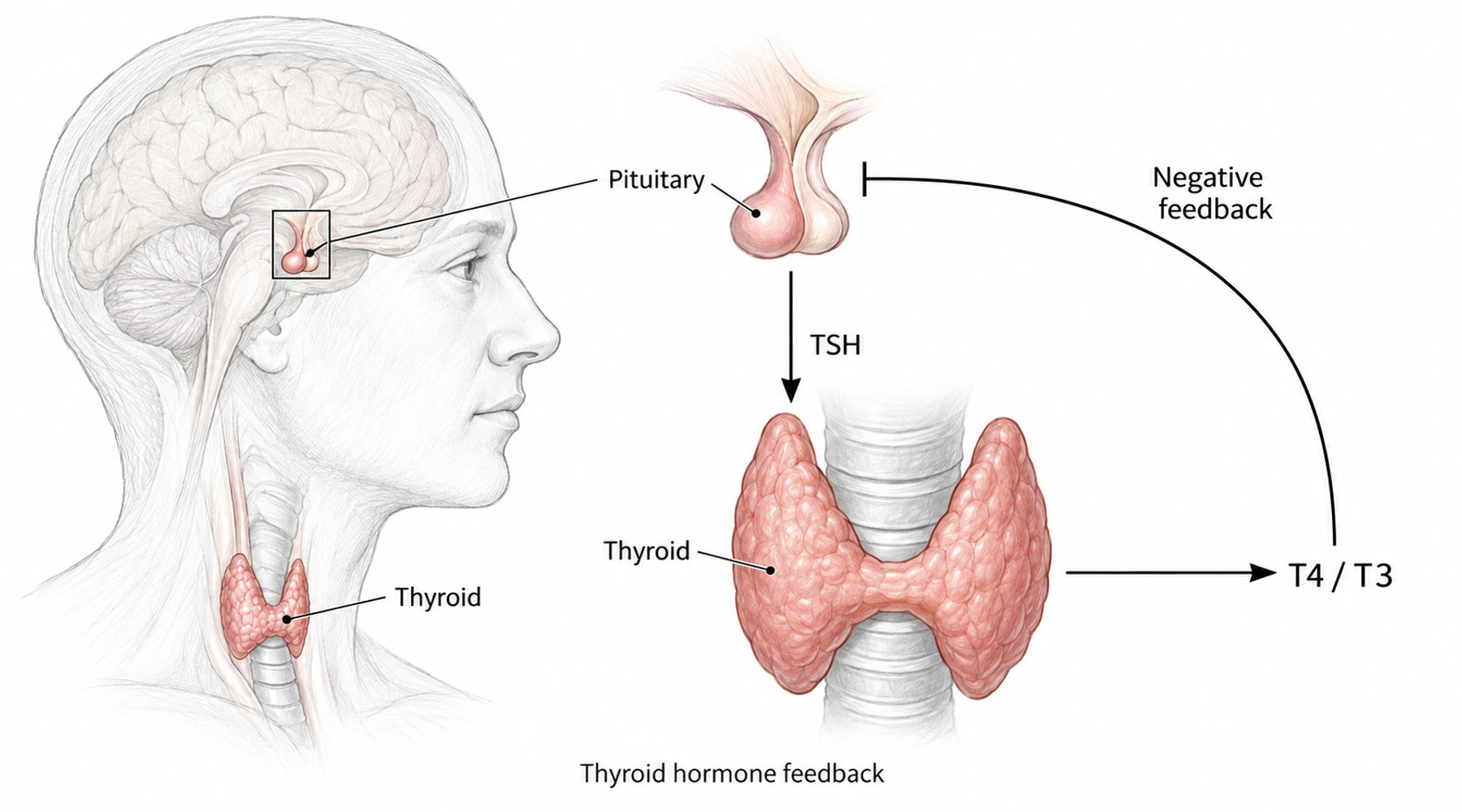
Methylene blue has measurable effects on thyroid-related biology in experimental systems. That does not establish it as a treatment for hypothyroidism, Hashimoto's disease, or hyperthyroidism. The research examined here did not identify a controlled human treatment trial showing that methylene blue safely corrects these conditions or reduces the need for thyroid medication.
The practical question is therefore broader than whether it can influence metabolism. Which thyroid process changes, in which experimental system, and does the change help a person with a particular diagnosis? Existing studies give different answers at different biological levels. They do not justify replacing prescribed thyroid medicines.
Thyroid function has several distinct measurements
The thyroid produces mainly thyroxine, or T4, and a smaller amount of triiodothyronine, or T3. Tissues also convert T4 into T3. The pituitary releases thyroid-stimulating hormone, or TSH, which signals the gland to produce hormone. Circulating thyroid hormones feed back to reduce that signal.
As the American Thyroid Association explains thyroid testing, total hormone measurements include protein-bound hormone, while free hormone measurements assess the unbound fraction. TSH and free T4 together help interpret thyroid status; pituitary disease can change the usual relationship between them. A lower TSH alone therefore does not prove better thyroid function.
The cover illustrates this normal feedback relationship. It does not depict a demonstrated methylene blue treatment pathway.
What the thyroid-specific experiments measured
A 1995 study of methylene blue and carbimazole in rats compared control animals, animals receiving methylene blue in food, animals receiving the thyroid-blocking drug carbimazole, and animals receiving both. Investigators measured circulating T4 and TSH, thyroid and pituitary hormone content, organ weights, and the signaling molecule cAMP.
Methylene blue increased circulating T4 and partly counteracted the T4 reduction associated with carbimazole. It also prevented the large carbimazole-associated rise in circulating TSH. These were male Wistar rats, including a chemically induced thyroid-blockade model. The findings concern endocrine effects and a potential drug interaction, not symptom improvement in people with autoimmune thyroid disease. The indexed abstract does not provide enough exposure detail to translate the experiment into a human regimen.
A separate 1997 experiment in male rats tested methylene blue, estradiol benzoate, and acetylsalicylic acid, alone and in combinations. Methylene blue counteracted an aspirin-associated fall in serum T4, but the corresponding T3 effect appeared in only one of two experiments. The outcome depended on the hormone measured and the combination used. That is a poor basis for a general promise to “boost thyroid function.”
More recent work asks a different question. A 2021 chemical-screening study using recombinant human iodotyrosine deiodinase found methylene blue inhibited activity in an enzyme assay, with an IC50 of 3.4 micromolar. IC50 is the concentration producing half-maximal inhibition under the assay conditions. It is not a recommended blood concentration or oral dose.
Iodotyrosine deiodinase, abbreviated IYD, recycles iodide from hormone-production byproducts. It is distinct from the iodothyronine deiodinases involved in activating or inactivating thyroid hormones. An IYD inhibition result does not show improved T4-to-T3 conversion. Nor can this isolated assay predict the net hormone response of a person taking methylene blue.
Human observations do not establish a consistent direction
There is at least a preliminary clinical observation worth distinguishing from the animal results. In a 2025 American Thyroid Association meeting abstract, Poster 418, investigators described a 43-year-old man who received systemic methylene blue for refractory shock. A blue-black thyroid observed during tracheostomy prompted testing that found low TSH and thyroid hormones. Free T4 improved with levothyroxine.
The patient already had subclinical hypothyroidism and developed severe multiorgan illness. The authors considered non-thyroidal illness syndrome as well as a possible methylene blue effect. This single conference case cannot establish causation, incidence, or the response to consumer oral products. It also prevents an accurate account from claiming that all reported thyroid changes point toward higher hormone levels.
For other outcomes, the same distinction between models and patients applies in the assessment of human evidence for methylene blue benefits.
Condition and medication evidence matrix
Read each row for the specific diagnosis or medicine. “Not established” means the inspected evidence does not answer the clinical question, not that an interaction is impossible.
| Condition or medication | Relevant evidence | What it means for the decision |
|---|---|---|
| Primary hypothyroidism, including Hashimoto's | Rat hormone changes do not demonstrate correction of human hormone deficiency or autoimmune injury. | No established role for methylene blue as hormone replacement or a way to reduce replacement requirements. |
| Hypothyroidism after total thyroid removal | The animal studies involved thyroid tissue; they did not test replacement after complete thyroidectomy. | An effect on an existing gland cannot demonstrate replacement of a missing gland's hormone output. |
| Graves' disease or overactive nodules | No controlled treatment benefit identified; some rat experiments found higher circulating T4. | A possible hormone increase would not be an intended treatment outcome. Do not infer suitability from “metabolism support.” |
| Levothyroxine, or T3-containing replacement | No clinical interaction study identified that quantifies the effect of adding methylene blue. | There is no evidence-based spacing interval or thyroid-dose adjustment rule for this combination. |
| Carbimazole | Rat co-exposure partly opposed the drug-associated T4 fall and prevented the TSH rise. | A specific experimental interaction signal warrants attention; it does not quantify risk in patients. |
| Methimazole or propylthiouracil | The carbimazole experiment did not directly test either medicine. | Do not assign the same effect size or a safe combination regimen to other antithyroid drugs. |
| Thyroiditis or critical illness with abnormal tests | Disease course and severe illness can alter hormone patterns; the 2025 case had major competing explanations. | Interpretation needs the clinical setting, previous results, and exposure history. One laboratory change cannot identify the cause. |
The matrix combines the studies discussed above with NIDDK's explanation of hypothyroidism and hormone replacement and its description of hyperthyroidism causes and treatments. Levothyroxine supplies missing hormone. Antithyroid medicines reduce production. Thyroiditis can release stored hormone through inflammation, so its management differs from an actively overproducing gland. Beta-blockers can reduce symptoms such as tremor and rapid heartbeat without stopping hormone production.
Does use during thyroid surgery answer the medication question?
No. Methylene blue can also appear in research as a surgical dye. For example, a prospective study in 56 thyroidectomy patients sprayed dye onto the surgical field to help distinguish structures by their staining and washout patterns. Its question concerned anatomical identification during an operation.
Visualizing tissue is different from correcting thyroid hormone production. A surgical dye study cannot establish that swallowing methylene blue treats thyroid disease, and parathyroid identification concerns glands with a different hormonal function. The methylene blue research library organizes studies by their actual intervention and endpoint.
What to bring to a medication discussion
Bring the thyroid diagnosis, current medicine and formulation, recent laboratory results, and the exact methylene blue product, amount, route, and timing. A claim that two products can simply be taken several hours apart needs evidence about the interaction mechanism; separating ingestion does not automatically prevent a systemic pharmacological effect.
Include medicines unrelated to the thyroid. The PROVAYBLUE prescribing information warns of serious serotonin syndrome with serotonergic medicines and opioids and contraindicates use in G6PD deficiency because of hemolysis risk. That injectable-drug label does not establish a safe chronic oral thyroid regimen. The methylene blue safety overview explains these broader risks.
New palpitations, tremor, or heat intolerance require assessment rather than an assumption that metabolism has improved. Fever with confusion, marked agitation, muscle rigidity, or a rapidly worsening heartbeat after exposure requires urgent medical attention. These symptoms can overlap with serious drug reactions and endocrine illness. Do not change thyroid replacement, antithyroid treatment, or antidepressants to accommodate methylene blue without the prescribing clinician's direction.