
Article
Methylene blue for ADHD: what has actually been studied?
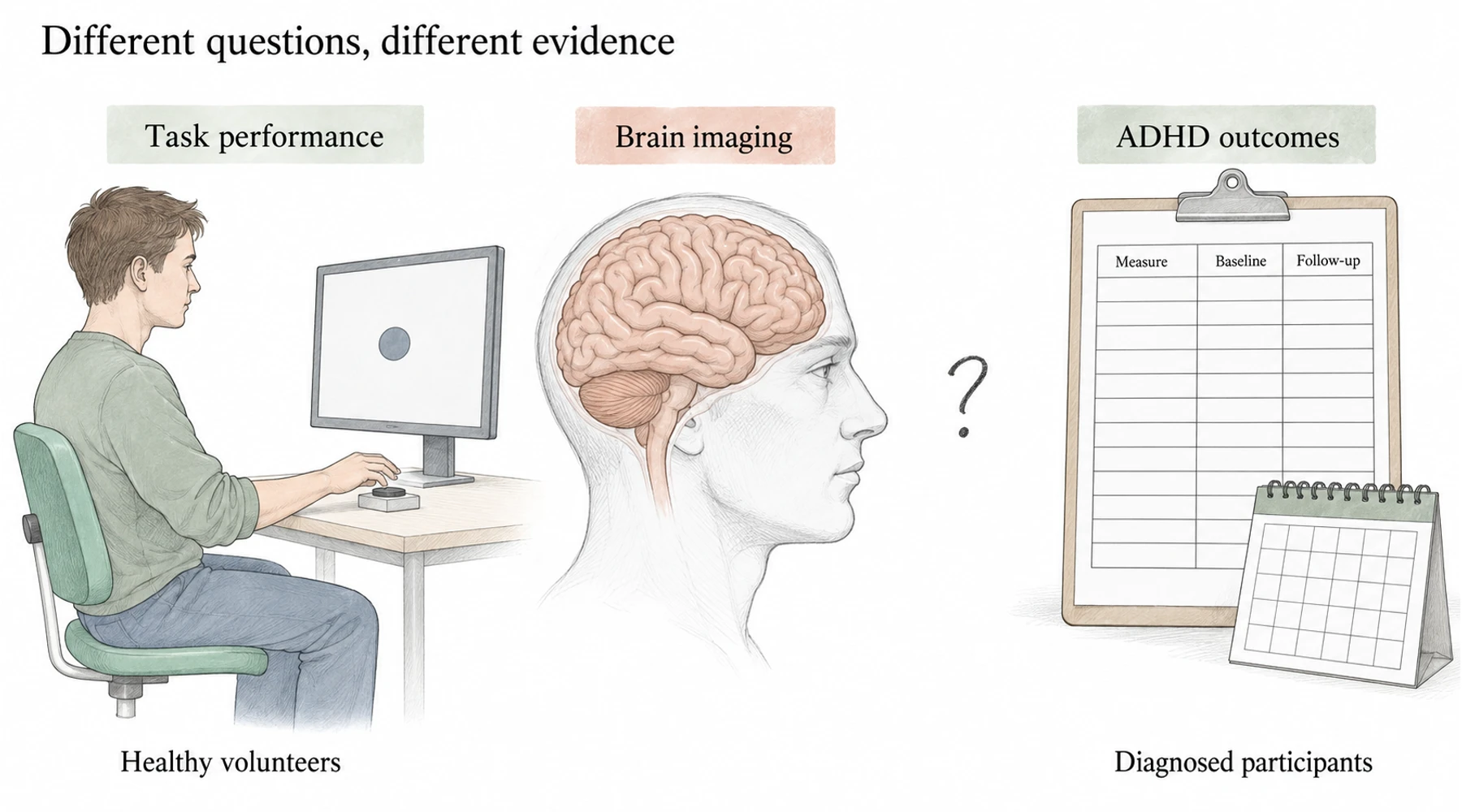
Methylene blue has not been established as an effective ADHD treatment. Searches for this review did not locate a trial testing whether it improves ADHD symptoms in people recruited with that diagnosis. The human experiments usually cited concern memory, laboratory attention tasks, or brain imaging in other populations. Those findings cannot establish that methylene blue helps someone manage impulsivity, sustain work, or function better with ADHD.
That distinction also matters for safety. Several ADHD medicines have contraindications involving monoamine oxidase inhibitors, the drug class relevant to methylene blue's interaction risk. An uncertain benefit does not make an experimental combination harmless.
An attention test is not an ADHD treatment trial
ADHD involves persistent symptoms and impairment across settings. The CDC's diagnostic explanation describes a clinical assessment that considers history, behavior in different environments, and other possible explanations. A slow reaction on a computer task cannot establish the diagnosis. A faster reaction after an intervention cannot, by itself, establish treatment success either.
An ADHD trial would need to recruit an appropriately diagnosed population and measure relevant outcomes. These could include validated symptom ratings and functioning at school, work, or home. It would also need to distinguish the intervention from changes in sleep, existing medication, expectations, and repeated practice.
Consider two questions: can a person recognize a recently presented image more accurately, and can that person consistently organize and finish daily tasks? Both involve cognition. They are not interchangeable outcomes. Our overview of human methylene blue evidence applies the same distinction across proposed benefits.
What the healthy-adult experiment actually found
The 2016 randomized imaging study by Rodriguez and colleagues analyzed 26 healthy adults, aged 22 to 62. It compared a single oral administration of USP-grade methylene blue with a blue-colored placebo. Testing before administration and about an hour afterward included a sustained-attention task, a short-term memory task, and functional MRI. Psychiatric disorders and recent psychiatric medication use were exclusion criteria.
Brain-imaging responses changed in several regions. Behavioral results require more care: the attention reaction-time comparison between groups over time was not significant, with P = .43. The paper reported an approximately 7% improvement in correct memory responses within the methylene blue group, but the corresponding between-group interaction was also not significant, with P = .09.
A significant before-and-after result in one group does not establish a significant treatment advantage over another group. These findings support further investigation, but do not demonstrate an ADHD benefit. The trial also cannot answer questions about repeated use, children, or combinations with ADHD medication.
A searchable inventory, including the missing evidence
Open the searchable study inventory to filter records by population, outcome, author, or evidence gap. It includes source links and distinguishes eligible background experiments from an irrelevant search hit.
| Record | What was examined | What it cannot establish |
|---|---|---|
| Rodriguez, 2016 | Attention, memory, and imaging in healthy adults | ADHD symptom improvement or long-term treatment safety |
| Telch, 2014 | Fear extinction and contextual memory after exposure training | Treatment of inattention, impulsivity, or hyperactivity |
| PubMed 27099330 | A methemoglobinemia case mentioning ADHD in medical history | Any methylene blue treatment benefit: the drug was avoided |
| Diagnosed ADHD trials | None located by this review's targeted searches | Efficacy, an ADHD dose, or a comparison with established treatments |
| Repeated use with ADHD medicines | No relevant controlled combination trial located | Safety or additional benefit from combining treatments |
The Telch trial randomized 42 adults with marked claustrophobic fear to methylene blue or placebo after exposure training. Memory assessments and a one-month fear assessment were relevant to learning and fear retention. Fear results depended on how successfully the exposure session ended. This was not an ADHD symptom trial, and it does not establish a general-purpose benefit for attention.
One search result illustrates why counting papers is insufficient. In the methemoglobinemia case report indexed as PMID 27099330, ADHD appeared in the patient's medical history. Methylene blue was avoided because of suspected, subsequently confirmed, G6PD deficiency. A search engine can match both terms even when the paper contains no treatment experiment connecting them.
The inventory records a targeted search on September 12, 2026, using “methylene blue” or “methylthioninium” with “ADHD” or “attention deficit hyperactivity disorder.” PubMed returned that case report; ClinicalTrials.gov returned no matching records. Broader searches supplied the background cognition studies. This is a dated evidence check, not proof that every unpublished or differently indexed study has been found. The research library provides the broader study context.
Medication interactions change the practical question
Methylene blue can inhibit monoamine oxidase. Its prescription injection labeling warns about serotonin syndrome with serotonergic medicines and opioids. For a person with ADHD, the entire medication list matters, including treatment for co-occurring depression or anxiety.
- Amphetamine products: the Adderall XR label contraindicates use with MAO inhibitors and explicitly names intravenous methylene blue. Hypertensive crisis is a stated concern.
- Methylphenidate: the Ritalin label also contraindicates concurrent MAO inhibitor treatment because of hypertensive-crisis risk.
- Atomoxetine: the Strattera label names intravenous methylene blue in its MAO inhibitor contraindication and describes potentially serious reactions.
These labels are not trials of every consumer oral formulation. They also do not establish an oral combination as safe. The Australian TGA's warning about unregistered oral methylene blue products specifically addresses dangerous medicine interactions. Bring the exact product, concentration, and complete medication list to the prescriber or pharmacist before considering use. Do not stop prescribed ADHD treatment to create a self-directed methylene blue experiment.
If exposure is followed by fever, marked agitation or confusion, muscle rigidity, or a rapidly worsening reaction, seek urgent medical care. The safety overview explains additional contraindications and exposure information worth recording.
What evidence would change the answer?
A useful next study would test a defined formulation in diagnosed participants, use a comparator, prespecify ADHD symptom and functioning outcomes, and follow adverse effects over a meaningful period. Adult and pediatric questions would need separate evidence. A mechanistic explanation about mitochondria cannot fill those gaps.
Established care already has structured assessment and monitoring pathways, such as those in NICE's ADHD recommendations. Unsatisfactory symptom control is a reason to reassess that care with the treating clinician. The studies reviewed here do not support substituting methylene blue. Claims about related developmental conditions need their own population and intervention checks, as explained in our review of methylene blue and autism research.