
Article
Methylene blue and autism: what the cited studies actually tested
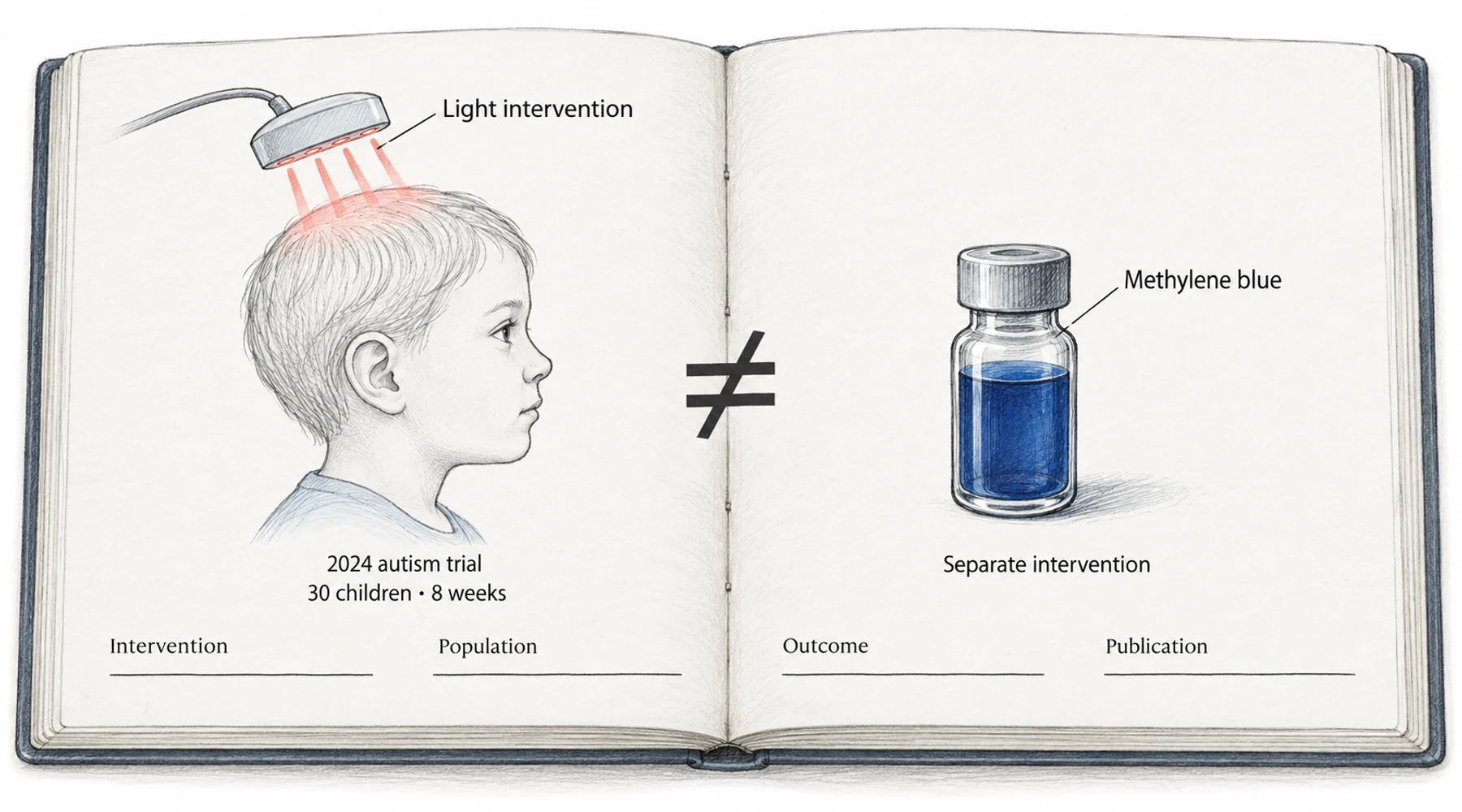
Methylene blue has not been established as a treatment for autism. The sources checked for this article do not include a controlled patient trial showing that methylene blue alone improves autistic people's daily functioning or autism-related outcomes. They include a light-device trial, laboratory and observational research, and a case report involving multiple treatments. Those records answer different questions.
The practical first step is to read the intervention section of the cited paper. A publication can mention methylene blue without giving it to any participant. A person can receive methylene blue for an unrelated medical problem without that becoming an autism treatment study.
The light trial did not test methylene blue
The 2024 randomized, sham-controlled study in children aged two to six tested transcranial photobiomodulation: near-infrared light delivered to the scalp using an investigational device. Thirty children participated in an eight-week course. The intervention did not include methylene blue.
The researchers reported a 7.23-point between-group difference in change on the Childhood Autism Rating Scale, with a 95% confidence interval of 2.357 to 12.107. This was a rating-scale result from a small trial. It does not establish a methylene blue effect, whether used alone or alongside light. The authors identified limitations including the small sample, withdrawal and replacement, and uncertainty about long-term effects.
Why might the paper appear in a methylene blue discussion? Its references include a review about the dye's neurometabolic mechanisms. A reference supports background discussion; it does not change what the participants received. The distinction between photobiomodulation and methylene blue photochemistry matters whenever a combined protocol borrows results from a light-only study.
Claim-to-study tracing table
Use this table to compare a claim with the record that might be cited to support it. “Published” describes availability, not proof of effectiveness.
| Claim being evaluated | Actual intervention or measurement | Population or model | Reported outcome | Publication status and interpretation |
|---|---|---|---|---|
| “An autism trial supports methylene blue.” | Near-infrared light versus sham; no methylene blue | 30 children aged 2–6 | Change in autism rating scale; exploratory EEG measurements | Published 2024 light-device trial; cannot establish a drug effect |
| “Methylene blue counters endotoxin-related autism symptoms.” | Methylene blue injected before an LPS challenge or behavioral testing | Male mice in a depression model | Most induced behavioral deficits reduced; serum heme oxygenase-1 assessed | Published animal experiment, online 2018 and in a 2019 issue; no autistic patient outcomes |
| “Endotoxin is the cause of autism.” | Serum endotoxin and immune-marker measurements; no treatment | 22 adults described as having severe autism; 28 matched controls | Higher endotoxin concentrations and associations with social measures | Published 2010 observational study; does not establish causation or treatment benefit |
| “Mitochondrial findings establish a methylene blue indication.” | Blood-cell mitochondrial measurements; no methylene blue treatment | 10 autistic children aged 2–5 and 10 controls | Differences in mitochondrial function and DNA measures | Published 2010 exploratory study; no drug efficacy endpoint |
| “A case report proves methylene blue works.” | Changing antimicrobial regimens including methylene blue, plus supportive measures | One adolescent with several diagnoses | Parent-recorded symptom changes and improved educational assessments | Published 2023 case report; cannot isolate methylene blue's contribution |
| “A study has been announced, so benefit is demonstrated.” | Proposed intervention must be checked in the actual protocol | Eligibility criteria describe intended participants | Planned endpoints are not observed results | Announcement or registration alone supplies no patient outcome data |
What the endotoxin experiment actually shows
The forum discussion linking methylene blue, autism, and endotoxin illustrates how several claims can become joined together. It is a source of reader questions, not clinical evidence.
One relevant paper is Yin and colleagues' mouse experiment on LPS-induced behavioral deficits. LPS, or lipopolysaccharide, was used to create an inflammatory challenge in a depression model. The researchers gave methylene blue by intraperitoneal injection before the challenge or behavioral testing. They measured forced-swim and tail-suspension behavior, sucrose preference, object recognition, and a blood marker.
That design asks whether pretreatment changes responses to an experimentally imposed insult. It does not ask whether oral methylene blue helps an autistic adult with fatigue, reduces children's gastrointestinal symptoms, or alters autism. It also does not test an “endotoxin-free” diet or prove that the dye eliminates endotoxin-producing gut bacteria.
The human association is a separate finding. Emanuele and colleagues measured endotoxin in 22 autistic adults and 28 controls, finding higher levels in the autistic group and relationships with social measures. No endotoxin-lowering treatment was tested. A group difference leaves open direction of causation, other contributing factors, and whether changing that measurement would help anyone. Research on methylene blue and the gut microbiome requires the same separation between biological measurements and patient benefit.
Mitochondrial hypotheses and the multi-treatment case report
Mitochondria participate in cellular energy production. That makes them a plausible research target, but a plausible target is not a treatment indication. In Giulivi and colleagues' exploratory study, researchers compared lymphocyte mitochondria from 10 autistic children with those from 10 controls. They found differences in several functional and mitochondrial DNA measures. They did not administer methylene blue or establish a single mitochondrial defect shared by all autistic people.
A different kind of evidence comes from a 2023 adolescent case report involving antimicrobial treatment. Methylene blue was one of several agents introduced within changing regimens for suspected vector-borne infections. The authors described improvements in parent-recorded symptoms and educational assessments. There was no untreated comparison group, and several interventions changed over time. The report cannot tell us what would have happened without treatment or which component contributed. It does not establish infection as the explanation for autism generally.
Define the outcome before considering a treatment
An autistic person seeking relief from fatigue, insomnia, pain, anxiety, or gastrointestinal symptoms deserves assessment of that specific problem. Improvement in sleep can matter considerably without demonstrating a change in autism itself. Conversely, a changed laboratory value may have no noticeable effect on the person's life.
For any new claim, record the intended outcome, who measured it, the comparator, and how long improvement lasted. Distinguish the person's own goals and quality of life from an observer's impression that they behave more typically. Checking an online methylene blue protocol also means verifying that its complete combination was studied.
An announcement describes intended research. A registry record can describe planned enrollment and outcomes. Neither substitutes for results showing how many people were treated, what happened in each group, and what adverse events occurred. Even a study marked completed may lack publicly reported results.
The current US prescribing information for intravenous ProvayBlue concerns acquired methemoglobinemia, including pediatric use. It does not provide an autism regimen. It warns about serious serotonin syndrome with serotonergic drugs and opioids and contraindicates use in G6PD deficiency because of hemolytic anemia risk. These issues require medication and medical-history assessment, not an online dose calculation.
Do not scale an adult wellness regimen down for a child. Evidence about methylene blue in children must match the diagnosis, formulation, route, and age group. The studies traced here do not establish a child-specific autism dose or a methylene blue treatment for co-occurring fatigue.