
Article
How to check a methylene blue protocol found online
Start with one claim and locate the publication supposed to support it. A detailed schedule, scientific vocabulary, and a long reference list do not establish that anyone tested the proposed protocol.
An online protocol often combines several different assertions: methylene blue changes a biological process; that change improves a disease; another intervention strengthens the effect; and a particular product reproduces the research. Each assertion needs its own evidence. Confirming the first does not confirm the remaining three.
The useful question is specific: Did this study test this intervention, in this population, and measure the benefit being promised?
Find the record behind the reference
Copy the title, authors, journal, year, and DOI or PubMed identifier into a note. Open the identifier independently and compare every field. A genuine identifier attached to the wrong title is a failed citation, even when the destination concerns methylene blue.
If there is no identifier, search the exact title, then distinctive title words with the author's surname. Check the journal's website as well as PubMed. One unsuccessful search is not proof of fabrication: titles change, citations contain errors, and PubMed does not cover every publication. Record the result as unverified until a matching record is found.
For an AI-generated summary, use exactly the same procedure. Ask for a recoverable reference, then inspect the publication independently. Asking the same system whether its citation is correct does not provide independent verification.
Check authorship of the page too. A patient discussion hosted by a hospital is still a patient discussion unless it is explicitly authored or reviewed as clinical guidance. NCCIH's guide to evaluating online health information separates questions about source, accuracy, expert review, currency, and funding. A familiar domain answers only part of that assessment.
Match the experiment to the promise
Make a short record of the study's substance, formulation, population, route, duration, comparator, and measured outcome. Read these from the paper, not from the post that cites it. The guide to reading a methylene blue research paper explains the closer examination of study design.
Consider a real example. A 2016 randomized study in 26 healthy participants examined brain imaging, sustained attention, and short-term memory before and one hour after oral methylene blue or placebo. It reported changes in imaging responses and improved correct responses during memory retrieval.
That is relevant evidence about the measured tasks under those conditions. It does not establish treatment of a chronic lung disease, benefits over months, or effects of adding oxygen or light. These are different questions, even if a promotional paragraph links them through mitochondrial terminology.
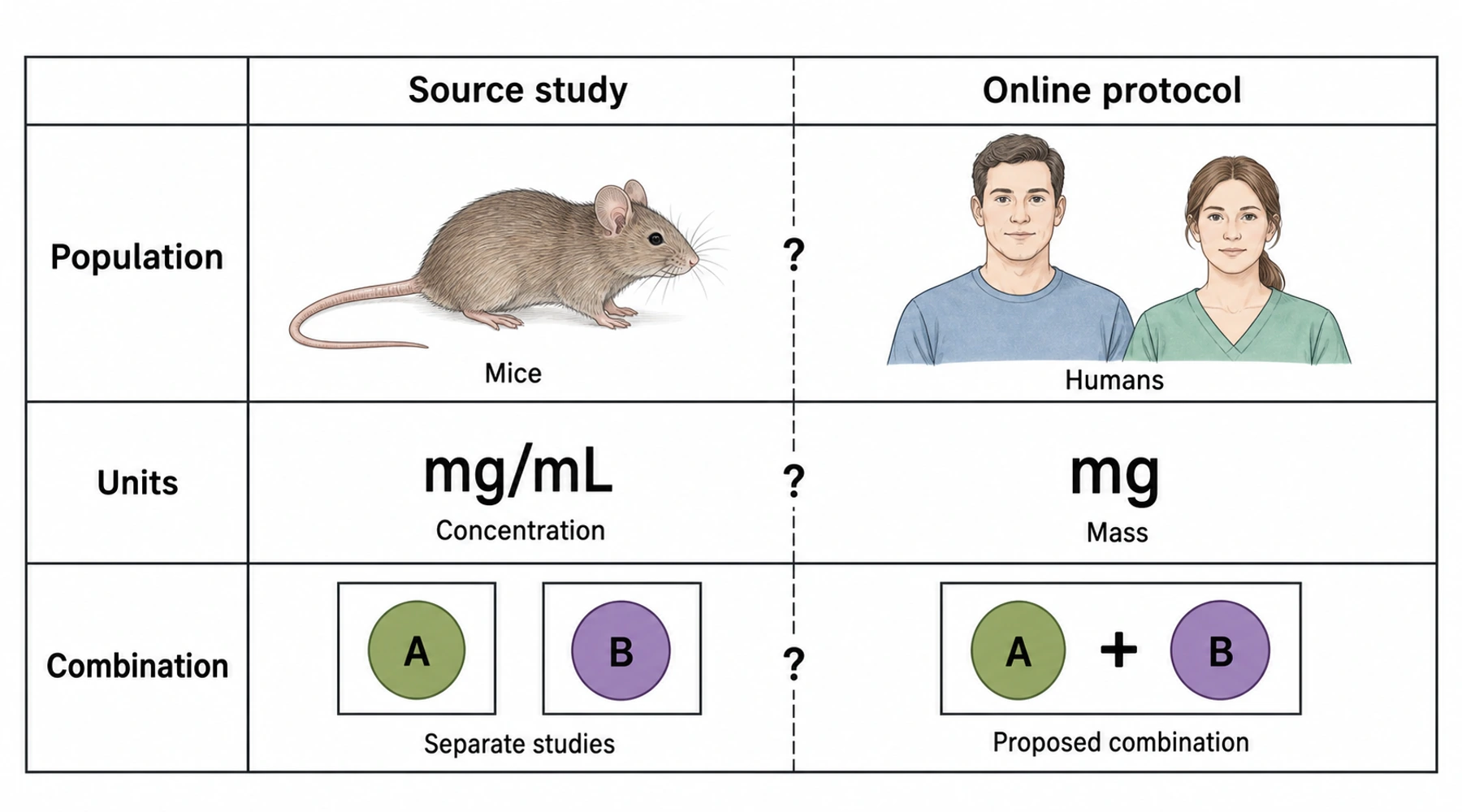
Also distinguish an animal disease model from patients with the disease. A shared diagnostic word does not make the populations interchangeable. Record any proposed transfer between species, routes, or outcomes as an extrapolation, then look for the evidence supporting that transfer.
Keep units attached to the quantity
Units describe what a number measures. Milligrams describe mass; milliliters describe volume; milligrams per milliliter describe concentration; milligrams per kilogram describe mass relative to body weight. Copying a number while dropping its denominator changes its meaning.
For a nonclinical arithmetic example, a reference to 4 mg/mL does not describe 4 mg without an associated volume. Likewise, 4 micrograms and 4 milligrams differ by a factor of 1,000. These examples illustrate transcription checks, not amounts to use.
Do not repair a questionable protocol by calculating a new regimen. Flag the mismatch and return to the source. Even flawless arithmetic cannot establish that an animal exposure, laboratory concentration, or injectable formulation is appropriate for a person using an oral product.
Worked claim-verification worksheet
The claims below are deliberately constructed teaching examples, not actual treatment recommendations. The PubMed record is real; the invented claim attached to it is not. Copy the table structure when checking a post.
| Illustrative claim or defect | Verification step | Finding and defensible conclusion |
|---|---|---|
| Fabricated citation: a made-up title about curing chronic lung disease with a combination is attached to PMID 27351678. | Open the PMID and compare the title, participants, and intervention. | The record is the healthy-participant brain-imaging study described above. The identifier is real, but it does not verify the invented citation or claim. |
| Population mismatch: a result from a mouse experiment is described as a demonstrated patient benefit. | Identify the species and look for a separate human study of the claimed benefit. | The animal paper establishes what was studied in that model. The patient claim needs additional evidence. |
| Unit mismatch: a summary copies a concentration value as if it were a mass. | Write out both quantities, including denominators and the associated volume. | The two entries describe different quantities. The summary cannot be relied on as written. |
| Combination gap: one paper studies methylene blue and a different paper studies another intervention. | Inspect whether either study includes the proposed combined treatment and relevant comparator. | Separate studies do not demonstrate the combination's benefit, added benefit, or safety. |
| Outcome substitution: a change in a laboratory marker becomes a promise of better daily functioning. | Find the exact endpoint, measurement method, and follow-up period. | A marker result supports a marker claim. Functional benefit requires a relevant measurement. |
Check the combination as a separate intervention
For a claim that adding B improves treatment A, look for an A-plus-B group compared with an A group. A combination compared only with placebo may show an overall difference without identifying what B adds. A stronger claim of synergy needs a design and analysis that can distinguish interaction from the effects of the individual components.
Write down each component rather than using a package name. For oxygen and light claims, this includes the actual oxygen delivery and light exposure used in the study. The article on methylene blue with hyperbaric oxygen examines this combination-specific evidence question.
Safety also requires its own check. The current PROVAYBLUE prescribing information concerns an intravenous product for acquired methemoglobinemia. It warns about serious or fatal serotonin syndrome with serotonergic drugs and opioids and contraindicates use in G6PD deficiency because of hemolytic anemia risk. A forum schedule is not a medication-interaction assessment. Bring the claim and your medication list to a qualified clinician; do not change prescribed treatment to fit an online protocol.
Record the conclusion before considering the seller
Check whether the author sells the product, earns referral fees, or offers the proposed clinic package. NCCIH's guidance on advertising presented as news explains why editorial appearance alone is unreliable. A commercial interest is relevant context, not automatic proof that a claim is false. Product documentation belongs in a separate assessment of quality evidence.
Finish your note with three entries: what the source supports, what the protocol adds, and what remains unresolved. Preserve the original claim, source URL, and date. This gives a clinician or researcher a specific discrepancy to assess, rather than a long protocol whose assumptions are hidden inside its instructions.