
Article
Methylene blue with hyperbaric oxygen: evaluating combination-treatment claims
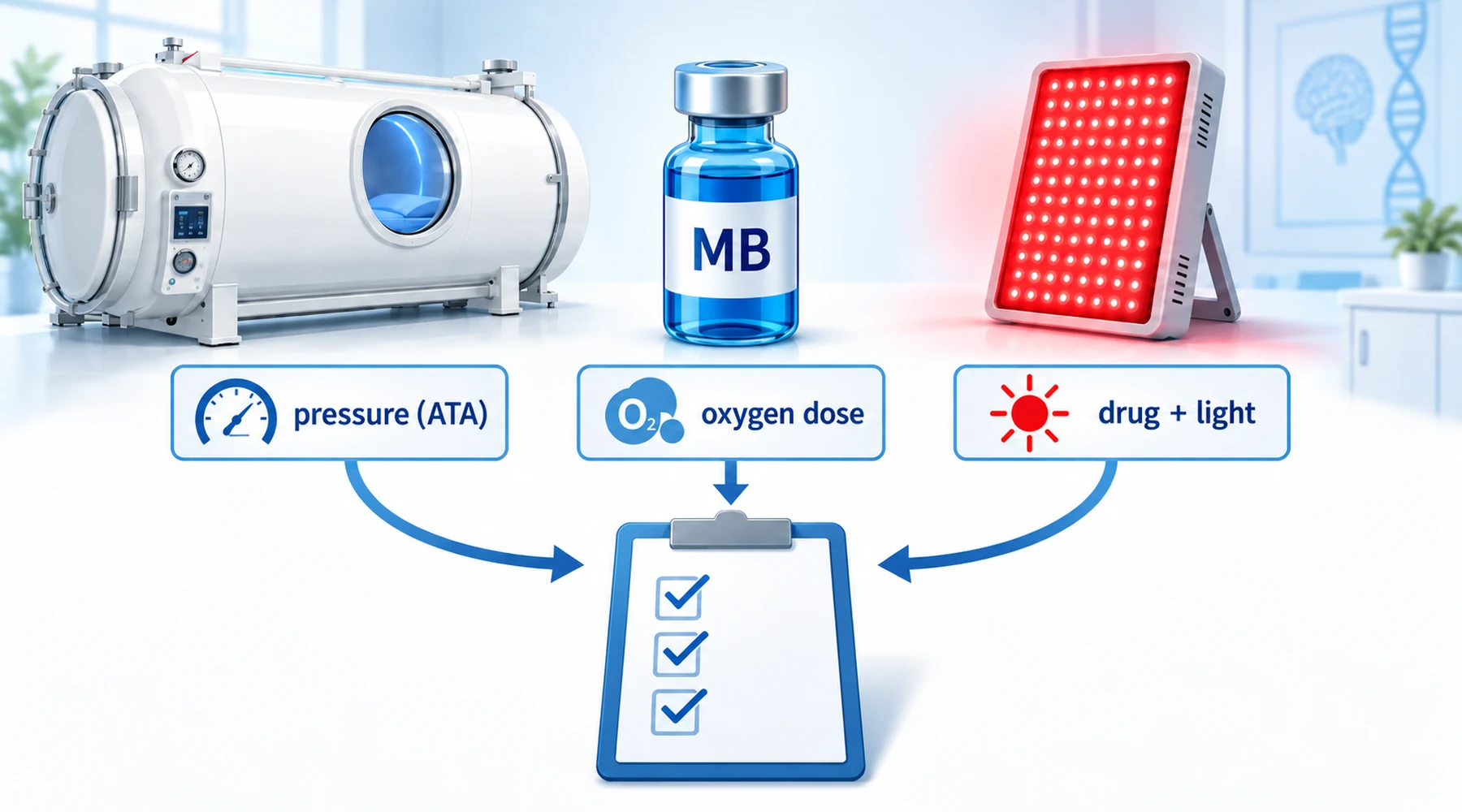
A clinic page offers methylene blue HBOT for energy, cognition, or recovery. Sometimes a red light panel is added and the package is called methylene blue red light hyperbaric oxygen. The page cites mitochondria, oxygen delivery, and a handful of papers. The price is per session. The question a reader needs is narrower than whether each part sounds plausible. It is whether anyone tested this exact combination and measured added benefit over each part alone.
That question is the subject of this review. The package holds up to four independently variable interventions: chamber pressure, oxygen dose, drug formulation and timing, and light exposure. Evidence for one part is not evidence for the package, and the best direct combination result points toward amplified photodynamic killing rather than a general mitochondrial boost.
Four interventions travel under one name
Pressure is the first concept. Clinical hyperbaric oxygen therapy, usually called HBOT, means breathing high concentration oxygen above ambient pressure, commonly around 1.9 to 3.0 atmospheres absolute with oxygen breathing periods of roughly 90 to 120 minutes including air breaks. In a monoplace chamber the vessel is pressurized with oxygen; in a multiplace chamber it is pressurized with air while the patient breathes oxygen through a hood or mask. Pressure and oxygen fraction vary separately, so mild hyperbaric without both numbers specifies neither.
Oxygen delivery is the second concept. At 2 atmospheres on pure oxygen, dissolved plasma oxygen rises far above normal in addition to hemoglobin bound oxygen. That dissolved fraction drives accepted uses such as gas embolism and compromised grafts on the Undersea and Hyperbaric Medical Society indication list. It also drives the toxicities: ear and sinus barotrauma, pulmonary oxygen toxicity, transient myopia, and seizures at higher oxygen pressures.
Drug formulation is the third concept. In the dark the dye acts as a redox cycler and alternative electron carrier, accepting electrons to form leucomethylene blue and passing them onward while recycling, as explained in how methylene blue works as an electron relay. Product, route, dose in mg per kg, and timing relative to the chamber session all belong here. The US injection label covers acquired methemoglobinemia at 1 mg per kg per the ProvayBlue prescribing information, which is not a validated dose for elective combination sessions.
Light exposure is the fourth concept, present only in some offers. Red light at 630 to 680 nm overlaps the dye absorption band near 664 nm and can drive photosensitizer chemistry; 810 nm near infrared is a poor direct activator of the dye, as reviewed in methylene blue and red light therapy. Wavelength, irradiance, fluence, and the drug to light interval decide the regime, per the guide to wavelength, irradiance, and geometry. Red light without those numbers is the optical equivalent of hyperbaric without the pressure.
What the combination literature actually tested
No controlled human trial located for this review demonstrates incremental systemic benefit of methylene blue plus true HBOT over both parts separately. What exists falls into three groups, and each answers a different question.
The most direct combination experiment is in vitro. Bisland and colleagues exposed S. aureus and P. aeruginosa, planktonic and biofilm, to dye plus red filtered light at 600 to 800 nm with and without 2 atmospheres of pure oxygen, as reported in this photodynamic oxygen study. Added pressure oxygen increased killing by more than one log at 5 J per square cm and more than two logs at 10 J per square cm. That is genuine added benefit of oxygen to photodynamic therapy in a dish, not evidence that pressurized oxygen plus dye improves cognition or energy in people.
The closest factorial animal experiment used normobaric hyperoxia, not HBOT. Rodriguez and colleagues assigned rats with 60 minute artery occlusion to air or oxygen crossed with vehicle or 1 mg per kg dye, in this stroke recovery study. The combination improved functional recovery over either part alone, though infarct volumes resembled dye alone. Because nothing was pressurized, this supports an oxygen and dye interaction without saying whether 2 to 3 atmospheres adds anything beyond oxygen.
Human reports are case level. A 52 year old with severe acquired methemoglobinemia received oxygen plus 1 mg per kg intravenous dye followed by HBOT at about 2.2 atmospheres for 90 minutes, described in this emergency case report. Sequential rescue cannot separate natural course, dye, oxygen, and pressure effects. A counterpoint dapsone case found 2.5 atmospheres for 2 hours did little before 1.5 mg per kg dye rapidly worked, reported in this sequential treatment case. That argues against HBOT substituting for the dye, without testing simultaneous therapy. Frequently cited 810 nm mouse papers test dye plus light with no chamber at all, indexed at PMID 35059872 and PMID 31372913, so they cannot validate a chamber protocol.
Why more oxygen plus a redox dye is not automatically synergy
Dye redox cycling itself consumes oxygen: micromolar intravenous dye raised whole body oxygen use by roughly half in rats, with reduced dye passing electrons directly to oxygen, in this metabolic study. Its effect on reactive oxygen is substrate dependent, rising with complex I substrates and falling with succinate in isolated heart mitochondria (substrate study). Without light there are two live hypotheses: extra oxygen supports dye reoxidation where transport is impaired, or it increases oxidative flux from dye cycling. No rule says the dye grows more antioxidant as pressure rises.
Adding red light changes the mechanism. Photoactivated dye transfers energy or electrons to oxygen and makes oxidizing species including singlet oxygen, which is why added oxygen amplified bacterial killing in the dish result. The same chemistry injures the wrong target: illuminated dye in isolated rat liver mitochondria caused oxidant formation, glutathione depletion, uncoupling, and reduced ATP output, in this mitochondrial phototoxicity study. The demonstrated synergy is photodynamic cytotoxicity, suited to killing microbes rather than energizing healthy tissue.
Safety is service specific, not dye general
Each concept brings its own screening, and the combination adds interaction points that a generic dye safety page cannot cover.
Chamber screening starts with pressure and oxygen hazards: untreated pneumothorax, obstructive or bullous lung disease, ear equalization failure, seizure history, recent thoracic or ocular surgery, and implanted devices. Fire control is structural. The FDA letter on safe use of hyperbaric devices requires following manufacturer instructions, grounding, staff training, continuous supervision, device maintenance, exclusion of prohibited electrical items, and compatible garments under NFPA 99 and ASME PVHO-1. A light panel must never simply be brought inside an oxygen rich chamber; compatibility must be documented in the chamber instructions and fire safety program.
Drug screening follows the dye label. G6PD deficiency is a labeled contraindication; the dye is a monoamine oxidase inhibitor with a boxed warning for serotonin syndrome with serotonergic drugs and some opioids. The prescribing clinician should direct any medication change, and pregnancy plus renal and hepatic function need review. The dye also interferes with pulse oximetry, so saturation needs an alternative method when accuracy matters. These distinctions matter for readers arriving with low oxygen readings in lung disease or fatigue states such as ME/CFS.
An FDA cleared chamber does not mean the agency evaluated methylene blue HBOT or any mitochondrial, cognitive, or longevity protocol. Chambers are generally Class II devices cleared through the 510(k) route for indications named in their own labeling. The FDA letter above is a safety communication, not an efficacy endorsement.
Combination-evidence checklist: the original asset for this article
Use this checklist against a paper or a clinic page. A credible protocol states every line in writing. If any line is missing, the claim is underspecified rather than promising.
Components: chamber model with clearance status; monoplace or multiplace; exact atmospheres absolute; patient oxygen fraction; oxygen time with air breaks; total chamber time; session count and frequency. Drug product and formulation; route; dose in mg per kg; maximum cumulative dose; dosing to chamber interval. If light is included: wavelength; irradiance; fluence; duration; timing relative to dye; and whether the source sits inside or outside the chamber with documented hyperbaric compatibility.
Comparators: for a study, the arms must include the combination, each part alone, and ideally a sham or standard care arm, with randomization and prespecified primary outcome. A before and after series on the full package cannot attribute benefit to the combination. For a clinic page, ask which of those arms the cited papers actually ran. Citing dye alone trials plus HBOT alone trials is composition by bibliography, not evidence of synergy.
Outcomes: name the endpoint, the measurement method, and the time point. Functional scales, lesion volumes, microbial counts, and symptom scores are different claims with different instruments. Surrogate changes during the session, such as a higher monitor reading while breathing oxygen, do not establish lasting benefit.
Safety controls: written screening for lung disease, ear equalization, seizure history, G6PD status, serotonergic and opioid medications, pregnancy, and renal and hepatic function; continuous supervision by trained hyperbaric personnel; barotrauma and oxygen toxicity procedures; emergency decompression plan; fire controls and prohibited item list; adverse event recording; and a stated plan for oxygen monitoring given dye interference with pulse oximetry.
When a page cannot supply these lines, apply the same verification routine you would use to check a protocol found online. Ask for the publication that tested the exact package, read which arms it ran, and decline to treat plausible mechanism as measured outcome. A combination that sounds coherent can still be untested, and in this case the one tested interaction amplifies the chemistry you would least want aimed at healthy tissue.