
Article
Methylene blue and children: clinical uses and evidence gaps
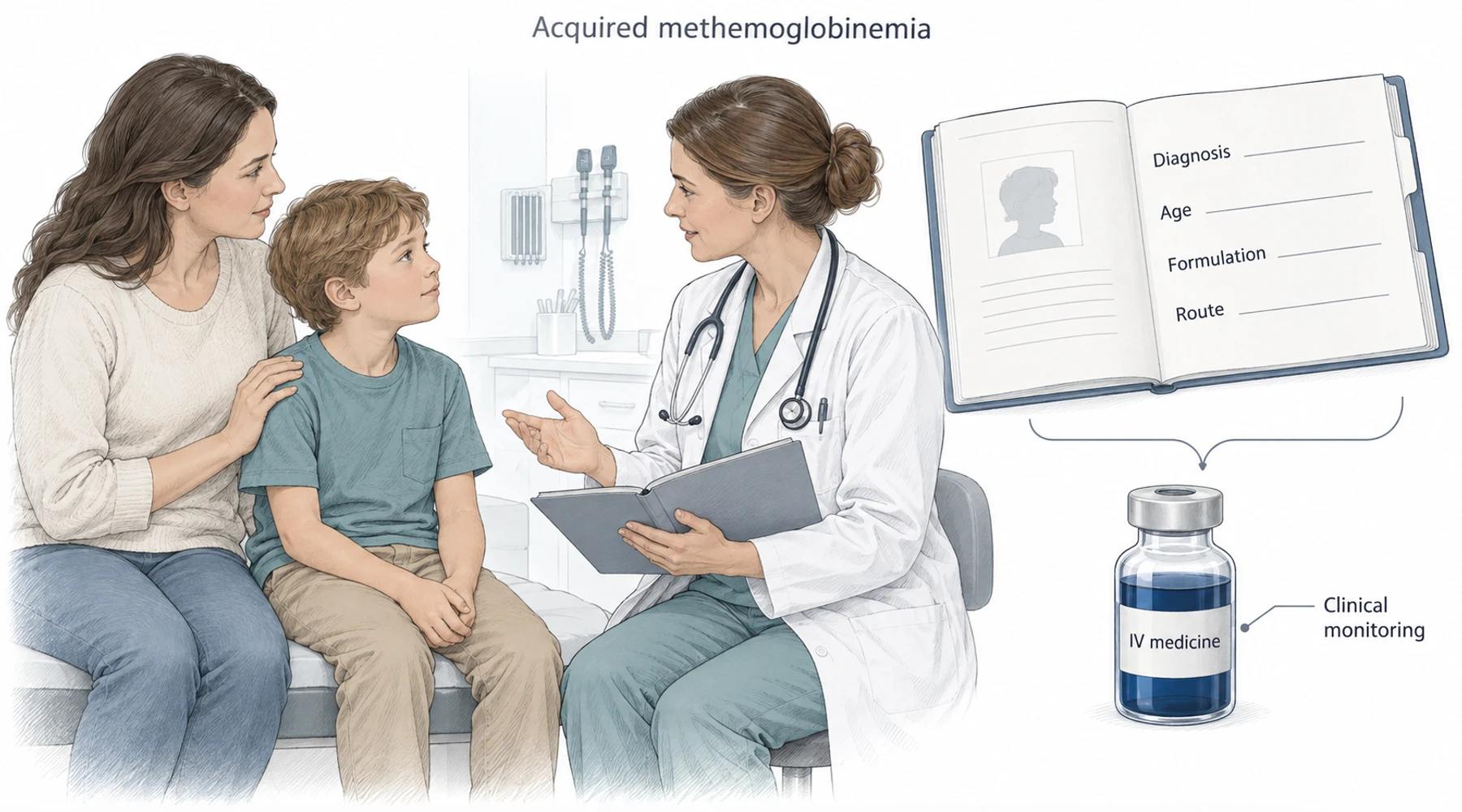
Methylene blue has an established pediatric medical use, but that does not make every product containing it suitable for children. The U.S. PROVAYBLUE prescribing information covers intravenous treatment of acquired methemoglobinemia. It does not establish an oral wellness regimen, an infant mouth paint, or a diaper-rash treatment.
“Is methylene blue safe for children?” therefore needs four additional details: the diagnosis, the child's age, the exact formulation, and the route of administration. Without those details, the question combines several different clinical decisions.
What pediatric clinical use means
Methemoglobinemia is a blood disorder in which altered hemoglobin cannot carry oxygen normally. Certain medicines and chemicals can cause it. Treatment concerns oxygen delivery, not the appearance of a mouth lesion or a skin rash. Our explanation of hospital treatment for methemoglobinemia describes that specific clinical problem.
The European Proveblue product information specifies administration by a healthcare professional and includes patients aged 0 to 17 years. It separates newborns and infants up to three months from older children in its prescribing instructions. It also describes particular susceptibility in very young infants and monitoring during treatment. These distinctions matter even before considering a different disease or route.
A hospital decision weighs the benefit of treating an identified disorder against the risks for that patient. A consumer claim about improving a healthy child's attention or energy starts with a different proposed benefit and requires its own evidence. The existence of the first decision does not supply the missing evidence for the second.
Age-and-setting evidence summary
The following summary links age groups to the setting actually supported by the sources. The U.S. counts come from section 8.4 of the current DailyMed label, checked September 12, 2026. They describe two retrospective case series, with two children receiving PROVAYBLUE and twelve receiving another methylene blue product.
| Age or population | Evidence and setting | What a parent can conclude |
|---|---|---|
| Newborns under 1 month | 3 patients in the U.S. pediatric case series; acquired methemoglobinemia | Neonatal clinical use exists for this indication. |
| Infants, 1 month to under 2 years | 4 patients in those series | Inclusion of infants is not evidence for treating infant mouth lesions. |
| Children, 2 to under 12 years | 4 patients in those series | These observations concern a blood disorder, not daily supplementation. |
| Adolescents, 12 to under 17 years | 3 patients in those series | Adolescent observations do not establish a wellness regimen. |
| Adults receiving cancer treatment | A randomized mouth-rinse trial studied mucositis pain | The patients, disease, route, and outcome differ from infant throat complaints. |
| Adults with oral candidiasis | An exploratory trial compared light-activated treatment with nystatin | A dental procedure cannot be reduced to painting dye onto a child's mouth. |
| Infants with diaper-area redness | Parent accounts describe improvement without establishing cause | A rash anecdote cannot confirm Candida or identify the effective treatment. |
These are evidence categories, not a dosage chart. A retrospective series records what happened in clinical care; it does not randomly assign children to compare alternative treatments. Its relevance can be strong for a narrowly defined emergency and weak for an unrelated proposed use. The adult studies in the table are described below.
Mouth sores, sore throat, and infant thrush are different questions
Parents encounter methylene blue advice for “stomatitis,” throat spots, teething discomfort, and thrush. Those terms are not interchangeable. Stomatitis describes mouth inflammation; it does not identify the cause. An oral lesion can require a different assessment from an inflamed throat, and suspected Candida requires more than recognizing a white or red area.
A parent question about a four-month-old's mouth treatment illustrates the uncertainty: the reported concerns included throat findings and episodes of difficult breathing. Such discussions establish what families are being told. They do not establish the diagnosis or verify that a proposed treatment works.
The 2022 randomized phase 2 cancer-mucositis trial had 60 adult completers. It compared methylene blue rinses added to conventional therapy with conventional therapy alone. The main endpoint was pain change over two days, with safety follow-up to 30 days. It reported pain improvement; some participants experienced oral burning. This was a study of painful tissue injury during cancer treatment, not a demonstration that methylene blue cures a child's infection.
The distinction also applies to antifungal research. A 2026 exploratory oral-candidiasis trial enrolled 18 participants and compared chairside methylene blue photodynamic therapy with nystatin over 14 days. The publication is indexed for adults and middle-aged people. It assessed both clinical response and fungal clearance and called for larger studies. Light activation was part of the intervention. Removing that component, changing the age group, and changing the application method creates a new treatment question.
An infant also cannot follow an adult rinse-and-spit procedure. The amount retained, swallowed, or spread to another site would differ. Our discussion of methylene blue for mouth sores and sore throat examines those diagnosis and route distinctions in more detail. The studies above do not provide a home-swabbing regimen for children.
What about the diaper area?
Diaper rash is a location-based description, not a fungal diagnosis. The American Academy of Pediatrics' guide to common diaper rashes distinguishes irritation from yeast, bacterial infection, and other causes. Moisture, friction, and contact with stool can injure the skin without Candida being the initial cause. Yeast can complicate an existing rash.
If redness improves after someone applies a dye, several explanations remain possible: the skin was cleaned more often, diaper contact changed, another product was used, or the rash improved over time. Without a diagnosis and a meaningful comparison, improvement cannot identify which explanation is correct.
The reviewed injection labels and adult oral studies do not establish methylene blue treatment for infant diaper dermatitis. That is a limit of these sources, not proof that no topical report exists anywhere. For persistent or worsening redness, the useful next step is an assessment of the cause. Fever, spreading painful redness, pus, or blisters warrant prompt medical advice.
Why concentration arithmetic cannot produce a child regimen
A concentration calculation answers how much material is present in a volume. It cannot determine whether the substance should be used, which exposure is appropriate, or whether that product is suitable for the intended tissue. Converting a percentage to milligrams does not solve those problems. Neither does multiplying an adult wellness amount by a child's share of adult body weight.
The guide to methylene blue dosage units explains the measurement issue. The separate discussion of injection formulations and IV use explains why a retail solution and a medicine intended for injection cannot be treated as interchangeable.
Before using a prescribed preparation, establish:
- The diagnosis being treated and the expected benefit.
- The exact product, route, and age group covered by the instructions.
- Whether the use is labeled or an individualized off-label decision.
- Which medicines and medical conditions affect the decision.
- How response and unwanted effects will be assessed.
The European product information's contraindications and interaction sections identify G6PD deficiency and potentially serious serotonergic drug interactions. Bring the child's complete medicine list, including nonprescription products, to the prescribing clinician. The broader methylene blue safety guide explains these concerns.
If a child develops blue or gray lips, difficulty breathing, collapse, or marked unresponsiveness, seek emergency help rather than trying methylene blue at home. The FDA's guidance on infant teething products explains that benzocaine can cause methemoglobinemia. Suspected exposure needs urgent assessment; it does not create a home antidote instruction.