
Article
Methylene blue dosage: understanding mg, mL, percentages, and drops
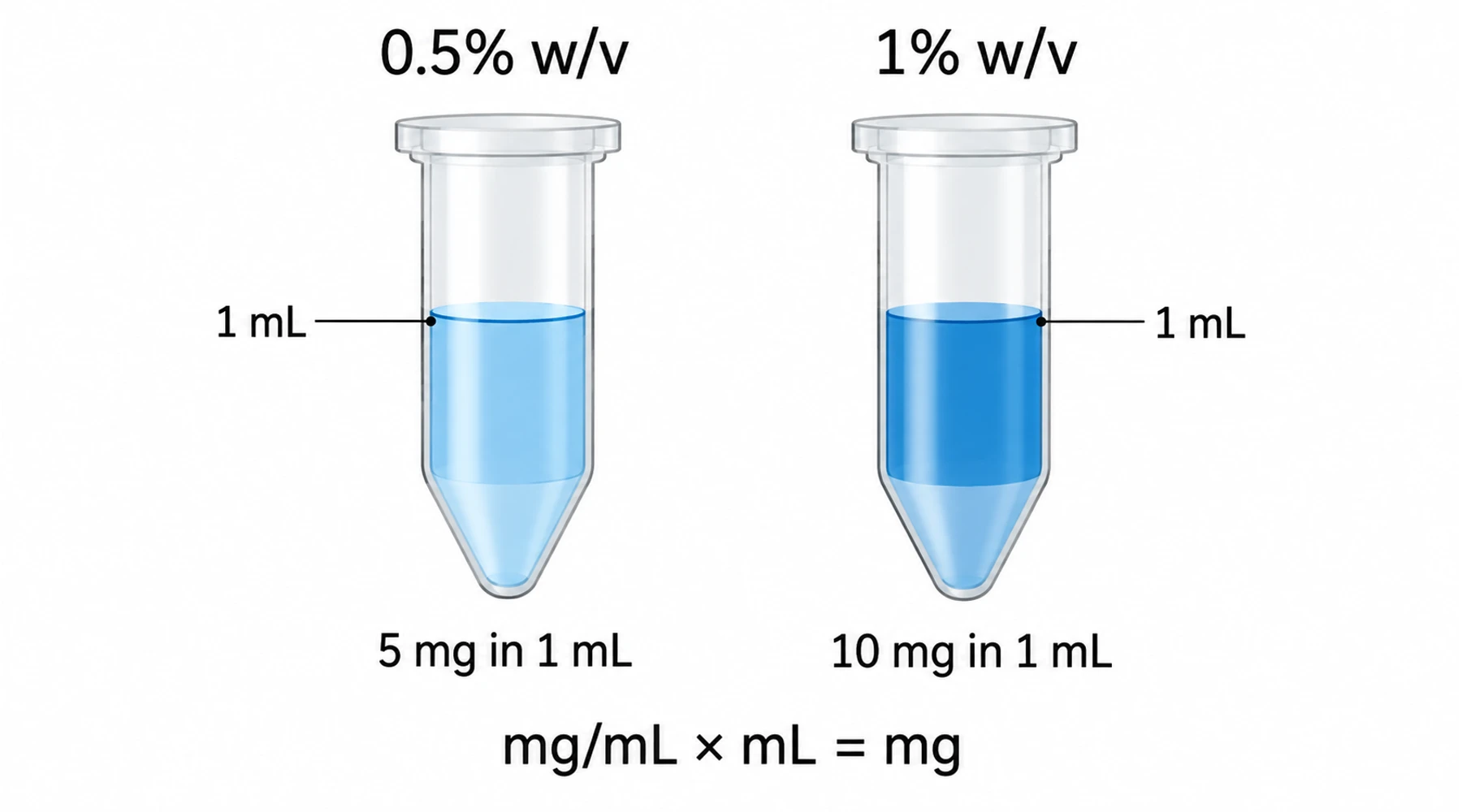
There is no universal number of methylene blue drops to take. A dosage decision requires an indication, formulation, route, patient assessment, and treatment instructions. A concentration label answers a narrower question: how much methylene blue is present in a specified quantity of solution.
A 1% w/v solution contains 10 mg in each milliliter. That conversion does not establish whether someone should use it, how much they should receive, or how often. This guide explains the measurement part so a label or instruction can be checked without turning arithmetic into a treatment recommendation.
Four quantities that are easy to confuse
| Expression | What it describes | What it does not tell you |
|---|---|---|
| mg | Mass of the named substance | The liquid volume containing it |
| mL | Volume of solution | The methylene blue mass without its concentration |
| mg/mL | Mass per milliliter | An appropriate amount to administer |
| mg/kg | Mass relative to body weight | Route, frequency, duration, or suitability |
One gram equals 1,000 milligrams. One milliliter equals 1,000 microliters. These conversions connect units of the same quantity. Milligrams and milliliters are different quantities, connected by the solution's concentration.
For a homogeneous solution:
Amount in mg = concentration in mg/mL × measured volume in mL
The volume units cancel. The result is the mass contained in that measured portion, sometimes called an aliquot. The formula does not depend on whether the portion is intended for analysis, staining, or a prescribed medicine; the permitted use requires separate information.
Read what the percentage is based on
The letters after a percentage identify its denominator. Avantor's reference tools distinguish mass, volume, and mass-per-volume composition.
1% w/v means 1 g of the named solute in 100 mL of final solution. Converting grams to milligrams gives 1,000 mg ÷ 100 mL, or 10 mg/mL. “Final solution” is the entire mixture after dissolution, not the volume of water before a solute is added.
1% w/w means 1 g of solute in 100 g of total solution. It describes mass relative to mass. To calculate what is present in a measured volume, you also need the density of the finished solution in g/mL. The density of dry powder does not supply that information.
If a label only says “1%,” check its accompanying specification for the basis or an explicit mg/mL value. Do not silently choose a basis because the number resembles another product's label.
Concentration-to-amount examples
This original comparison table uses hypothetical homogeneous samples. The measured volumes are selected to demonstrate the arithmetic. These are contained amounts, not suggested doses or a dosing schedule.
| Stated concentration and basis | Measured volume | Additional information | Calculation | Contained amount |
|---|---|---|---|---|
| 0.1% w/v = 1 mg/mL | 0.5 mL | None needed | 1 mg/mL × 0.5 mL | 0.5 mg |
| 0.5% w/v = 5 mg/mL | 1 mL | None needed | 5 mg/mL × 1 mL | 5 mg |
| 1% w/v = 10 mg/mL | 1 mL | None needed | 10 mg/mL × 1 mL | 10 mg |
| 1% w/v = 10 mg/mL | 0.5 mL | None needed | 10 mg/mL × 0.5 mL | 5 mg |
| 1% w/w | 0.5 mL | Hypothetical solution density: 1.04 g/mL | 0.5 mL × 1.04 g/mL × 0.01 × 1,000 mg/g | 5.2 mg |
| 1% w/w | 0.5 mL | Density unavailable | Volume cannot yet be converted to solution mass | Cannot determine |
The second and third rows explain the cover illustration: equal volumes can contain different amounts. The second and fourth rows demonstrate the reverse: different volumes can contain the same amount. A volume instruction cannot be carried over to a different concentration without checking the calculation.
The w/w example uses an invented density for teaching, not a measured property of a Blupreme product. Its 0.5 mL sample weighs 0.52 g; one percent of that mass is 0.0052 g, or 5.2 mg. When density is unknown, a precise-looking mg result would hide an unsupported assumption.
Use the methylene blue concentration converter to check these relationships with your own documented inputs. It calculates contained mass; it does not select a human dose.
Why counting drops leaves a missing measurement
A drop is produced by a liquid and dispenser under particular operating conditions. It is not automatically 0.05 mL, and a full dropper is not automatically 1 mL.
In Brown and colleagues' 2004 study of pediatric oral droppers, investigators tested pharmaceutical products and prepared fluids under laboratory conditions and with volunteers. Moving the dropper toward 45 degrees from vertical reduced delivered volume and increased variability. This was a device study, not validation of any methylene blue bottle or a clinical dosing trial.
To calculate a mean mass per drop, both concentration and a measured mean drop volume are required. Calibration must apply to that dispenser and liquid. A drop count copied from a different bottle loses this connection, even when both bottles display the same percentage.
Where an oral liquid medicine has been prescribed, ask the pharmacist to confirm a suitable graduated measuring device and the volume corresponding to the prescription. FDA's liquid-medication safety recommendations use milliliters and matching device graduations. Write 0.5 mL, with a leading zero, so a missed decimal is less likely to turn it into 5 mL. The guide to reading a graduated dropper explains how to interpret its markings. Do not estimate a volume below the device's readable graduations.
Clinical dosing has a specific context
The US PROVAYBLUE prescribing information describes a 5 mg/mL intravenous medicine for acquired methemoglobinemia in adults and children. Its labeled initial dose is 1 mg/kg, administered by clinical staff over 5 to 30 minutes. Further treatment depends on clinical response, laboratory assessment, and kidney function.
That indication, route, and monitoring are part of the regimen. The label does not establish an oral daily dose for energy, cognition, or longevity. Converting its mg/kg figure into drops would preserve arithmetic while discarding the clinical basis for using the medicine. The guide to methylene blue injections and IV infusions explains why formulation also matters.
The same label contraindicates use in G6PD deficiency because of hemolytic anemia risk, warns about serious serotonin syndrome with serotonergic drugs and opioids, and identifies pregnancy-related risks. A smaller measured amount does not establish suitability. The methylene blue safety guide explains the relevant conditions and interactions in more detail.
Make the instruction checkable
Before interpreting any instruction, record these items together:
- Product identity: formulation, labeled route, and full strength statement.
- Concentration basis: mg/mL, w/v, or w/w, with solution density if needed.
- Measurement: intended mL and a device that can resolve that volume.
- Clinical instructions, if prescribed: the amount, route, frequency, duration, and prescriber.
If the concentration or measurement basis is missing, resolve it before using the calculation. If the clinical instructions are missing, a conversion table cannot supply them.