
Article
Methylene blue concentration converter: percent, mg/mL, and measured volume
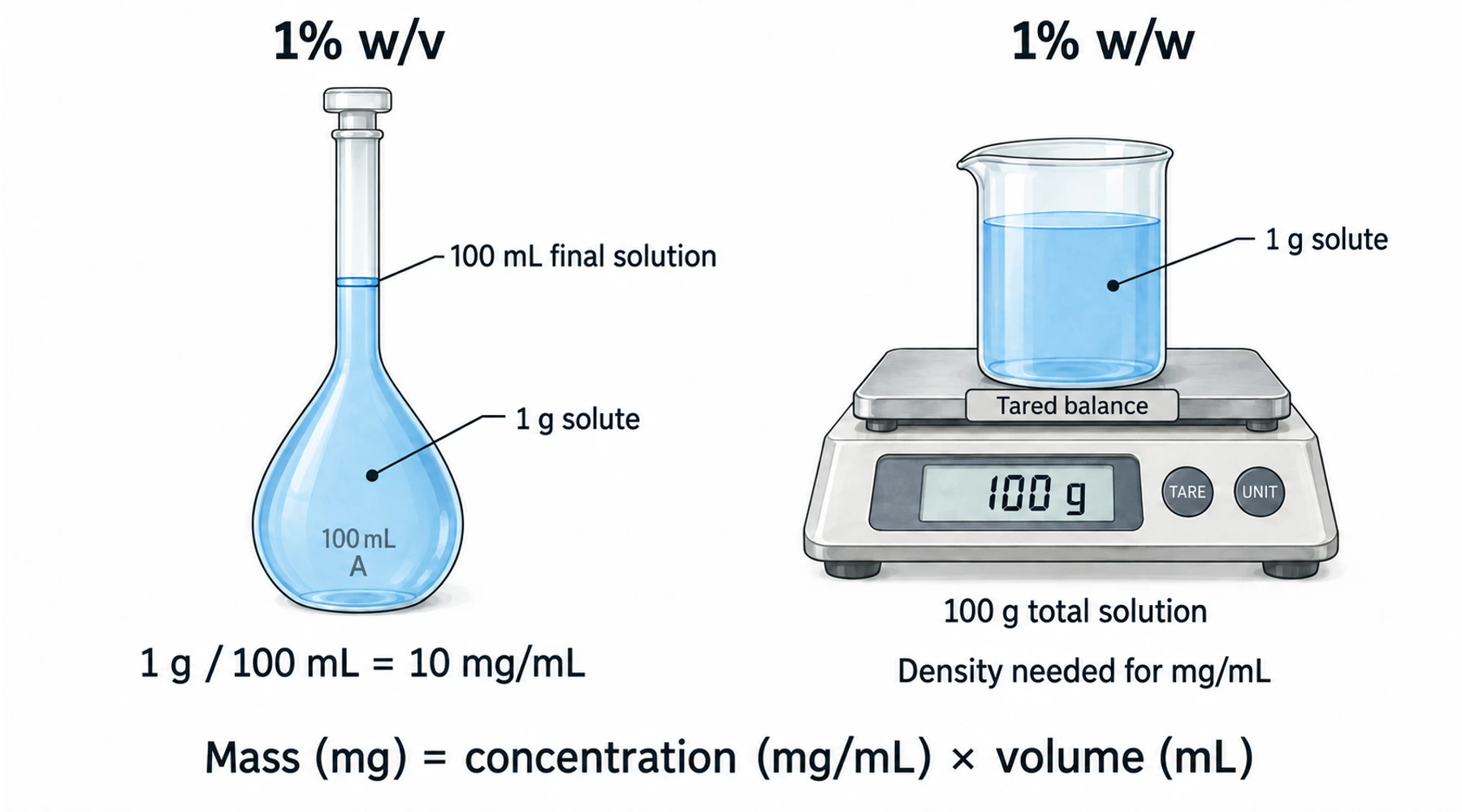
A 1% w/v methylene blue solution contains 10 mg/mL. A label that says only “1%” leaves an essential question unanswered: one gram per 100 milliliters of solution, or one gram per 100 grams? The first converts directly to mg/mL. The second needs the solution's density.
Open the concentration converter to enter the label basis, concentration, and measured volume. The tool runs in your browser and can be saved for offline use. It calculates chemical mass and unit equivalents. It does not select a human dose, administration route, or treatment schedule. Those questions require a different assessment, explained in why concentration is not a dosing recommendation.
Read the denominator before the number
Concentration describes how much of a component is present relative to a specified quantity of mixture. The denominator determines what the number means. NIST distinguishes mass concentration from amount-of-substance concentration: mg/mL describes mass per volume, whereas mol/L describes chemical amount per volume. They are different measurements.
For this converter, use these input definitions:
| Input | Meaning | What to enter |
|---|---|---|
| Percent w/v | Grams of the named component per 100 mL of final solution | Enter 1 for 1%, not 0.01 |
| Percent w/w | Grams of the named component per 100 g of total solution | Enter the percent and the solution density in g/mL |
| mg/mL | Milligrams of the named component per milliliter of solution | Enter the stated mass concentration directly |
| Measured volume | Volume of the solution being evaluated | Enter mL; 100 µL is 0.1 mL |
| Calibrated drop volume | Measured mean volume delivered by one drop | Enter mL/drop only when known for that liquid and dispenser |
The EMD Chemicals solution definitions explicitly distinguish w/v, w/w, and v/v. This calculator does not accept percent v/v, which describes a volume relationship and cannot be converted to a solute mass from the percentage alone.
Convert percent w/v to mg/mL
For a stated percentage p on a w/v basis:
Concentration in mg/mL = p × 10
The factor of 10 follows from unit conversion: p grams in 100 mL equals p × 1,000 milligrams divided by 100 mL. To go in the other direction, divide mg/mL by 10.
| Stated concentration | Equivalent mass concentration | Mass in 0.25 mL |
|---|---|---|
| 0.1% w/v | 1 mg/mL | 0.25 mg |
| 0.5% w/v | 5 mg/mL | 1.25 mg |
| 1% w/v | 10 mg/mL | 2.5 mg |
| 2% w/v | 20 mg/mL | 5 mg |
These are arithmetic examples, not suggested amounts to administer. Notice that doubling the concentration doubles the mass in the same volume. A volume instruction cannot be transferred between different strengths without checking the concentration.
“Final solution” also matters. A specification of one gram per 100 mL describes the total volume after dissolution. It does not mean adding one gram to an already measured 100 mL of water. For preparation work, the final volume is the reference quantity.
Convert percent w/w using solution density
For percentage p on a w/w basis and solution density ρ in g/mL:
Concentration in mg/mL = p × 10 × ρ
Suppose a hypothetical solution is 1% w/w and its documented density is 1.05 g/mL. One milliliter weighs 1.05 g. One percent of that mass is the named solute: 0.0105 g, or 10.5 mg. Its mass concentration is therefore 10.5 mg/mL, equivalent to 1.05% w/v.
The density in that example is deliberately hypothetical. It is not a measured value for a Blupreme product. Enter the density of the actual finished formulation, at the relevant temperature. The density of water or of dry methylene blue powder is a different quantity. If density is unavailable, the converter leaves the w/w calculation unresolved rather than silently inserting 1 g/mL.
For the reverse calculation, percent w/w equals mg/mL divided by 10 × density in g/mL. This explains why w/w and w/v can look numerically similar in some dilute aqueous mixtures without being interchangeable definitions.
Calculate the mass in a measured volume
Once concentration is expressed in mg/mL:
Mass in mg = concentration in mg/mL × volume in mL
A laboratory aliquot of 0.25 mL from a 5 mg/mL stock contains 1.25 mg of the component named in the concentration statement. “Aliquot” here means a measured portion of the solution. The calculation assumes that portion represents the stated homogeneous solution.
The instrument still determines whether 0.25 mL was actually delivered. Eppendorf documents how liquid properties and temperature affect air-cushion pipetting. Correct arithmetic cannot repair an unsuitable measuring device, an air bubble, or an incorrectly read scale. A displayed result with six significant digits is a numerical output, not a claim of six-digit measurement accuracy.
Why there is no default number of drops
The question “How many drops contain 1 mg?” needs both the concentration and a calibrated volume per drop. Neither “one drop” nor a dropper's appearance supplies that volume.
If the measured mean drop volume is d mL/drop:
Mass per drop = concentration × d
For an explicitly hypothetical calibration of 0.04 mL/drop and a 10 mg/mL solution, the mean mass is 0.4 mg/drop. One milligram corresponds arithmetically to 2.5 of those mean drops. That fractional result does not describe a reliably dispensable half-drop and is not an administration instruction.
NIST's droplet metrology work determines delivered droplet mass and volume through measurement. Its precision dispenser results cannot be assigned to a consumer dropper. Use calibration information for the actual liquid, dispenser, and operating conditions. Leave the optional field blank when that information is absent; the converter will still calculate mass from a measured volume.
Preserve the label's chemical basis
The converter carries the entered concentration through the arithmetic. It does not correct for a powder's assay, change between hydrate and anhydrous bases, identify impurities, or establish that a formulation is suitable for a particular use. Copy the full chemical description from the source document when recording a result. The guide to methylene blue solution concentration explains how to compare concentration statements across products.
Before using a result, record three things together: the original concentration and basis, the measured volume, and the resulting mass. Add density or drop calibration when either was used. That record makes the calculation reproducible and exposes the assumptions a bare number would hide.