
Article
Using a graduated dropper for methylene blue: reading volumes accurately
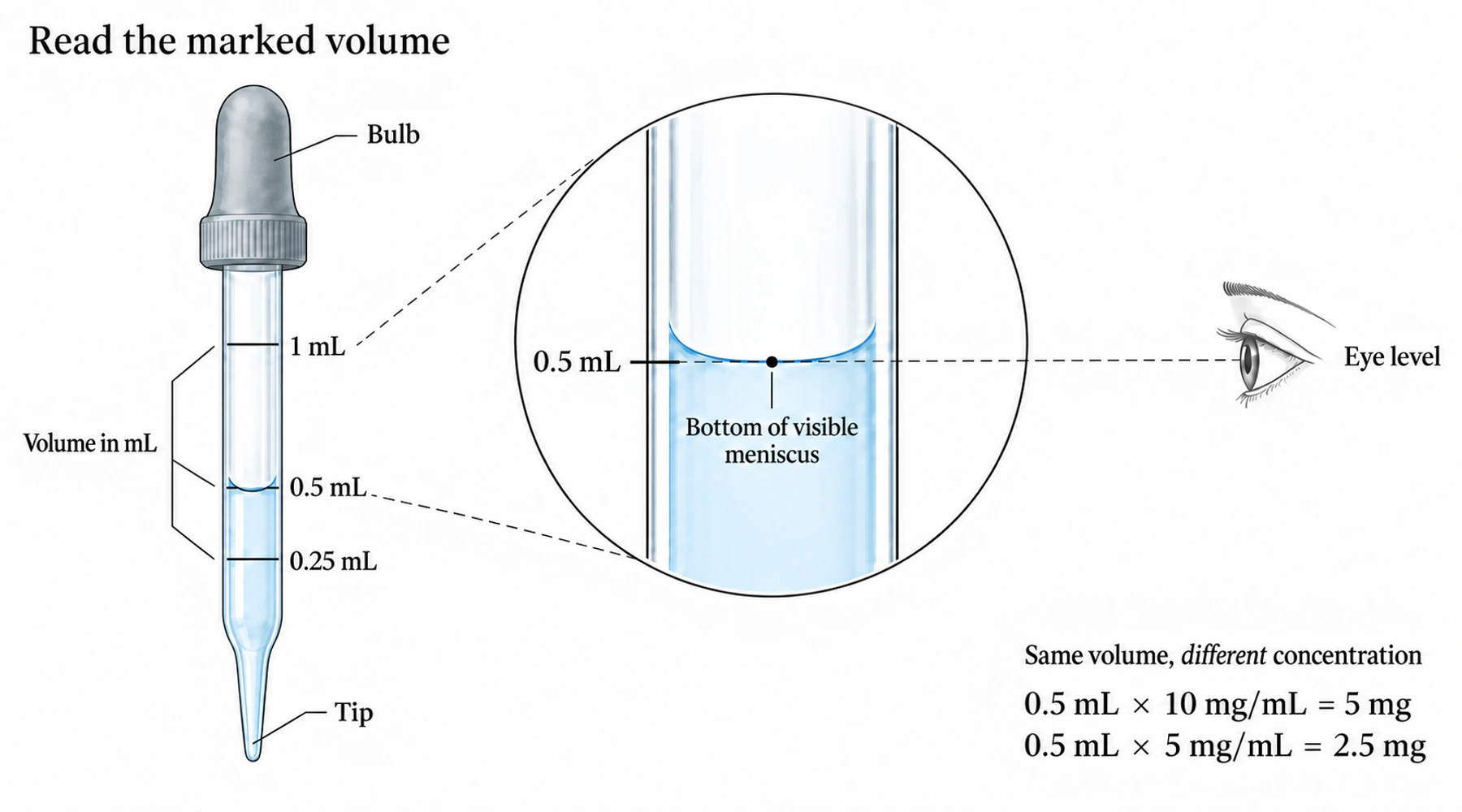
A graduated dropper measures liquid volume. To know the amount of methylene blue in that volume, you also need the solution's stated concentration. Neither the dropper nor that calculation tells you what amount a person should take.
Start with three separate questions: What unit is printed beside the marks? Which mark does the liquid reach? How many milligrams does the label say are in each millilitre? Keeping those questions separate prevents a common error: treating a drop, a millilitre, and a milligram as interchangeable quantities.
What the product listing establishes
The Blupreme 100 mL aqueous solution listing states a concentration of 1% weight per volume, equivalent to 10 mg/mL, and describes an included dropper with marks at 0.25 mL, 0.5 mL, and 1 mL. The 100 mL figure describes the bottle contents; the smaller numbers describe measured volumes in the dropper.
Use the label and device supplied with your own bottle. A product description does not establish the calibration tolerance of an individual dropper. The published listing does not provide a numerical accuracy specification, so the presence of a 0.25 mL mark should not be interpreted as a guarantee of accuracy to an additional decimal place.
The drawing below is an original explanatory schematic, not a photograph or calibration certificate. Its liquid is shown translucent to make the surface readable.
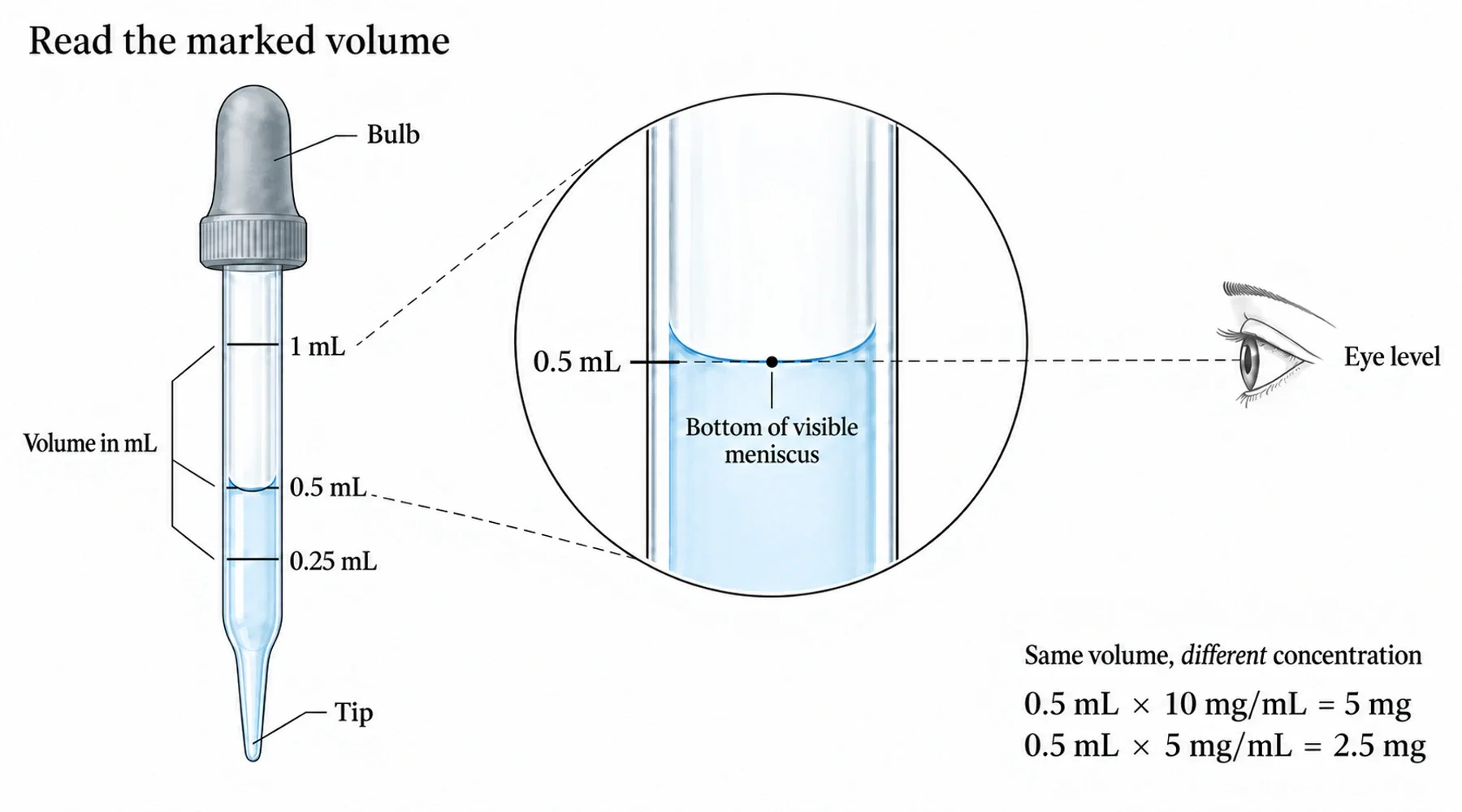
The lowest point of the visible concave meniscus aligns with 0.5 mL. The two calculations show why the same volume can contain different amounts. These are measurement examples, not recommended doses.
Read the scale before filling
Identify the units first. A mark labeled mL measures volume. A mark labeled mg would describe an amount only for the specific concentration for which that device was designed. An unmarked glass tube provides no reliable numeric volume reading.
Next, inspect the sequence and spacing. In the illustrated scale, 0.25 mL is nearer the tip, 0.5 mL is higher, and 1 mL is higher again. The numerical gap from 0.5 to 1 mL is twice the gap from 0.25 to 0.5 mL. Do not assume that every adjacent pair of printed numbers represents the same increment.
If another device has small intervening marks, determine their value from the labeled endpoints. For example, five equal intervals between 0.5 and 1 mL represent 0.1 mL each: the difference, 0.5 mL, divided by five. Count the spaces, not the number of visible lines. That example does not imply that the supplied product dropper has those extra divisions.
Bring the liquid surface to eye level
Follow the device's filling instructions. For a conventional bulb dropper, compress the bulb before immersing the tip and release it slowly to draw liquid into the tube. Keep liquid out of the bulb. Visible air gaps in the measured column occupy space that should contain liquid; redraw rather than accepting a bubble-filled reading.
Hold the tube upright and bring the relevant mark to eye level. Looking down from above or up from below can make the surface appear displaced relative to the scale. This viewing error is called parallax.
The curved liquid surface is the meniscus. For a visible concave surface, the conventional reading uses its lowest central point, as illustrated. NIST's guidance on reading a meniscus explains eye-level alignment and why the reading convention must agree with calibration. It also discusses the complications of opaque liquids.
Dark methylene blue can make that surface difficult to distinguish. Improve illumination and use a plain contrasting background. If the prescribed reference point remains obscured, obtain device-specific instructions or a suitable alternative measuring device. Do not silently substitute the top edge for an invisible bottom edge and assume the result is equivalent.
Convert measured volume to amount
The calculation is:
Amount in mg = measured volume in mL × concentration in mg/mL.
For a weight-per-volume percentage, 1% w/v means 1 g in 100 mL of final solution. Since 1 g is 1,000 mg, this is 10 mg/mL. A percentage without its basis is incomplete: weight per weight and weight per volume are different definitions.
| Example volume | Explicit concentration | Calculation | Amount contained |
|---|---|---|---|
| 0.25 mL | 1% w/v = 10 mg/mL | 0.25 × 10 | 2.5 mg |
| 0.5 mL | 1% w/v = 10 mg/mL | 0.5 × 10 | 5 mg |
| 1 mL | 1% w/v = 10 mg/mL | 1 × 10 | 10 mg |
| 0.5 mL | 0.5% w/v = 5 mg/mL | 0.5 × 5 | 2.5 mg |
The fourth row is a hypothetical comparison solution, not a claim about another Blupreme product. Notice that 0.25 mL of the first concentration and 0.5 mL of the second contain the same mass. Conversely, an identical 0.5 mL reading contains twice as much material at 10 mg/mL as at 5 mg/mL.
The concentration converter performs these unit calculations. Laboratory molarity requires additional information about molecular form and mass basis, addressed in the methylene blue molarity calculator.
Why drops and a “full dropper” are unreliable shortcuts
A drop is a liquid portion detached from a tip, not a universal calibrated volume. A study of pharmaceutical oral droppers by Brown and colleagues compared controlled laboratory dispensing with volunteer use. Tilting the tested droppers toward 45 degrees from vertical reduced delivered volumes and increased variability. This was a dispensing study with other pharmaceutical fluids, not a methylene blue trial.
Consequently, a drops-per-millilitre value established for one device and liquid cannot simply be transferred to another. Likewise, one squeeze of a bulb does not define a “full dropper” volume. Read the mark actually reached. Do not count drops as a substitute when the required measurement is expressed in mL.
Preserve the meaning of the measurement
Write 0.5 mL, including the leading zero. FDA's liquid-medication measurement recommendations emphasize matching label and device units and using leading zeros for quantities below one. These general measurement principles do not establish a medical use for a retail solution.
If a specified volume falls below the lowest mark, exceeds the capacity, or requires finer divisions than the device supplies, select equipment appropriate to that measurement with the relevant professional or laboratory. Do not estimate an unmarked fraction and report it as precise. Follow the manufacturer's dispensing and cleaning instructions; do not improvise extra rinsing or flushing to recover residual liquid.
For medical questions, the separate guide to methylene blue dosage units explains why an amount calculated from a bottle label is not itself a treatment recommendation. Accurate measurement answers how much is present. Selecting a human dose requires a separate clinical decision.