
Article
Methylene blue molarity calculator: hydrate form and assay basis
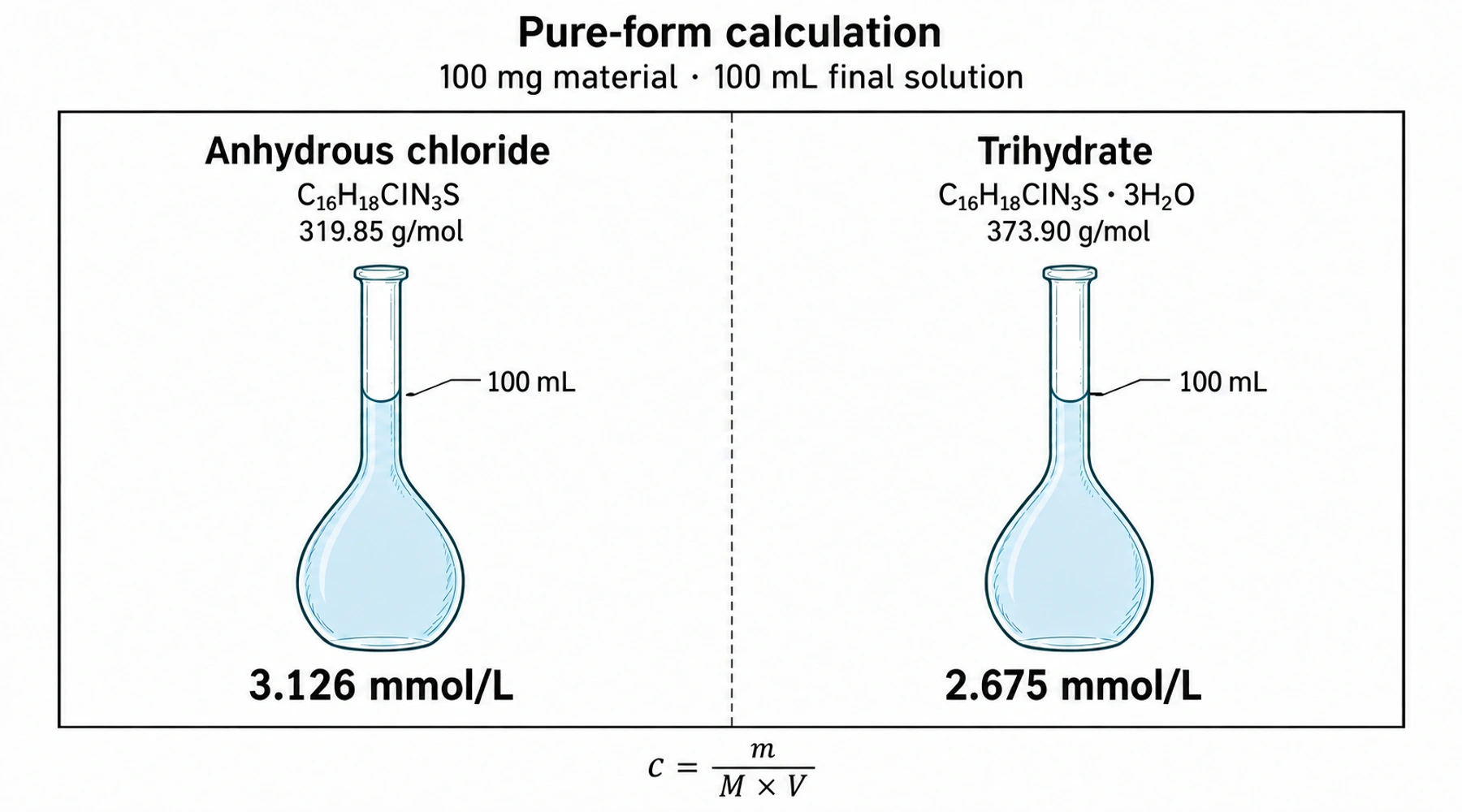
The same mass of methylene blue can give different molar concentrations depending on its molecular form and how its assay is reported. A calculation using anhydrous chloride mass is different from one using the mass of a hydrate. A dried-basis assay introduces another distinction: the reported percentage does not directly describe the material as weighed.
Open the methylene blue molarity calculator to enter mass, final solution volume, molecular form, and calculation basis. It runs in your browser, shows the substituted equation, and reports mol/L, mmol/L, and µmol/L. The examples below are laboratory calculations, not human or animal dose selections.
What the result measures
Molarity is the familiar name for amount concentration. The IUPAC definition of amount concentration divides the amount of a constituent by the volume of the mixture:
c = n / V
Here, n is the amount of methylene blue in moles and V is the final solution volume in litres. For pure material of a specified form, n = m / M, where m is mass in grams and M is molar mass in g/mol. These relationships follow the NIST definitions of molar mass and concentration.
The denominator is the volume after dissolution. “100 mL final solution” and “100 mL solvent added” are different preparation records. A calculation cannot resolve that ambiguity after the event.
Choose the material before choosing its molar mass
For an anhydrous chloride calculation, this tool uses 319.85 g/mol. For a documented trihydrate, it uses 373.90 g/mol. The Thermo Fisher trihydrate specification identifies the three-water formula and the latter molar mass. Water contributes to the weighed mass without adding another methylene blue unit.
Consider two nominal preparations, each containing 100 mg of pure material in 100 mL final solution:
| Assumed material | Calculation | Concentration |
|---|---|---|
| Anhydrous chloride | 0.100 / (319.85 × 0.100) | 3.126 mmol/L |
| Trihydrate | 0.100 / (373.90 × 0.100) | 2.675 mmol/L |
These are calculated examples, not measurements. Using the anhydrous denominator for pure trihydrate would overstate the concentration by about 16.9%. Extra decimal places would not repair the wrong material assumption.
A bottle described only as “hydrate” does not establish a fixed water count. The calculator therefore refuses a nominal calculation for unspecified hydration. For the underlying chemistry, see methylene blue molecular forms and hydration.
Match the assay to the mass it describes
The important question is not simply “What percentage is on the certificate?” It is “A percentage of what, expressed as which compound?” The calculator separates four meanings:
| Calculation basis | What you must know | Equation |
|---|---|---|
| Nominal pure form | Exact molecular form; explicit assumption of 100% purity | c = m / (M × V) |
| As-is selected form | Mass fraction of that same form in material as weighed | c = m × a / (M × V) |
| As-is anhydrous equivalent | Anhydrous chloride equivalent per mass of material as weighed | c = m × a / (319.85 × V) |
| Dried-basis anhydrous assay | Anhydrous chloride assay on the dried basis and matching measured loss on drying | c = m × (1 − d) × a / (319.85 × V) |
In these equations, a is the assay percentage divided by 100; d is the matching loss-on-drying percentage divided by 100. The last equation is a mass-balance conversion between the explicitly stated reporting bases. It is appropriate only when the drying correction matches the assay's definition.
The USP monograph preview expresses its assay as anhydrous methylene blue on the dried basis and gives a 97.0–103.0% acceptance range. An analytical result above 100% is not a literal claim that a sample contains more than its own mass of pure compound. The tool permits dried-basis assay estimates through 103% and labels that output an analytical estimate.
Worked example: a dried-basis result
Suppose a laboratory record documents 100.0 mg of material, a 99.0% anhydrous-equivalent assay on the dried basis, a matching measured loss on drying of 14.0%, and 100.0 mL final solution. These values are hypothetical.
- Convert the weighed mass: 100.0 mg = 0.1000 g.
- Apply the dry-mass fraction: 0.1000 × 0.860 = 0.0860 g.
- Apply the assay: 0.0860 × 0.990 = 0.08514 g anhydrous chloride equivalent.
- Convert to amount and divide by volume: 0.08514 / (319.85 × 0.1000) = 2.662 mmol/L.
Do not also divide by the trihydrate molar mass. The numerator is already expressed as anhydrous chloride equivalent. Adding a hydrate correction would count the water adjustment twice.
If the same record instead directly documented 85.14% anhydrous equivalent as received, the as-is mode would produce the same answer without a separate drying input. Agreement between those two routes is a useful arithmetic check.
When the available data are insufficient
Specifications are not necessarily lot measurements. For example, Merck's methylene blue hydrate product listing gives a minimum assay calculated on dried substance, a maximum loss on drying, and an anhydrous-basis molecular weight despite describing a hydrate. Substituting those limits as if they were measured values would create a point estimate the listing does not support.
Likewise, an unspecified assay percentage or a chromatographic area percentage does not automatically establish the mass fraction required here. Get the reporting convention from the certificate or supplier. The guide to reading a methylene blue certificate of analysis explains the document checks.
Blank fields, nonpositive mass or volume, unsupported units, and missing assay bases produce an error instead of a result. Changing an input replaces the previous result, including when the new value is invalid. Numerical overflow is rejected. The tool does not test whether a concentration is soluble, whether dissolution was complete, or whether a preparation remained stable.
Keep the calculation reproducible
Record the lot, molecular form, assay result and basis, any drying correction, weighed mass, final volume, and preparation conditions. Report only the precision your measurements support; the calculator's displayed digits are a convenience.
For an already documented stock solution, use the separate methylene blue dilution calculations. For percentage labels, first check the methylene blue concentration conversions. Neither a correct molarity nor a correctly converted percentage determines how a substance should be administered.