
Article
Methylene blue trihydrate versus anhydrous material: formula, mass, and labeling
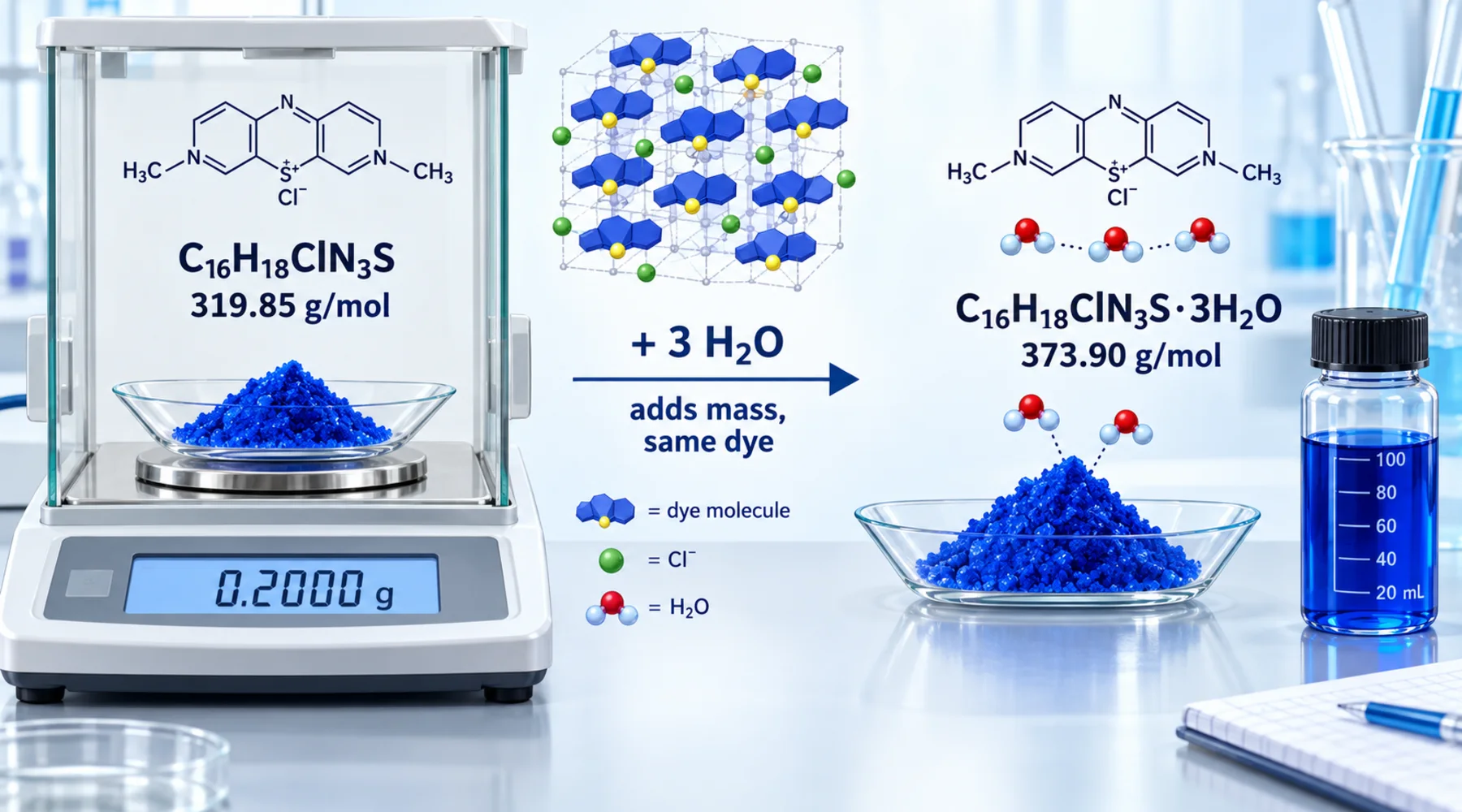
Two bottles can both say methylene blue and still require different weighed masses for the same experiment. One is labeled methylene blue trihydrate. The other says only methylene blue. A researcher weighs 100 mg from each, prepares the same volume, and gets different dye concentrations. Nothing is contaminated and no pipetting failed. The two powders simply contain different amounts of water per dye unit.
That is the central concept in the methylene blue trihydrate vs methylene blue comparison. The chemical entity is methylthioninium chloride in both cases. The weighed material is different because water of crystallization adds mass without adding dye. To work with the material correctly, keep three concepts apart: hydrate identity, chemical purity, and measurement basis. The chemistry reference for methylene blue structure and properties separates the dye cation from the chloride salt in detail. This page separates the salt from its hydrates.
Anhydrous, hydrate, and trihydrate name different weighed forms
Anhydrous methylene blue chloride has formula C16H18ClN3S and formula mass 319.85 g/mol in the USP methylene blue monograph preview. It describes the salt without associated crystallization water.
A methylene blue hydrate is the same salt associated with water in the solid, written C16H18ClN3S.xH2O. The value of x states how many water molecules belong to one salt formula unit in the nominal composition. It does not describe water added to a solution.
Methylene blue trihydrate is the case x equals 3, written C16H18ClN3S.3H2O or C16H24ClN3O3S, with formula mass 373.90 g/mol. The PubChem record for methylene blue trihydrate lists this formula and mass under CID 104827, while the PubChem record for methylene blue lists the anhydrous formula C16H18ClN3S and mass 319.9 g/mol under CID 6099. In both records the dye ion is unchanged: one methylthioninium cation per formula unit. Only the associated water differs.
Hydrate and mass reference table
The table below is the reference asset for this page. Formula masses for the salt forms follow USP. The cation row is included so solution calculations have a clear starting point.
| Weighed material | Nominal formula | Formula mass | Water share of mass |
|---|---|---|---|
| Methylthioninium cation alone | C16H18N3S+ | About 284.41 g/mol | Not applicable; counterion and water excluded |
| Anhydrous chloride salt | C16H18ClN3S | 319.85 g/mol | 0% by definition |
| Monohydrate | C16H18ClN3S.H2O | 337.90 g/mol | About 5.3% |
| Trihydrate | C16H18ClN3S.3H2O | 373.90 g/mol | About 14.5% |
| Pentahydrate | C16H18ClN3S.5H2O | 409.93 g/mol | About 22.0% |
The practical gap is large. For the same amount of dye, ideal trihydrate weighs about 16.9% more than ideal anhydrous salt, because 373.90 divided by 319.85 equals 1.169. Confusing the two forms therefore produces about a 17% concentration error before any other source of error is considered.
Worked interpretation examples
Example 1 starts from powder. Suppose a balance reads 100.0 mg of nominally pure methylene blue trihydrate. The anhydrous-equivalent salt mass is 100.0 mg times 319.85 divided by 373.90, which equals 85.5 mg. The amount of dye is 0.1000 g divided by 373.90 g/mol, which equals 267.5 micromol of methylthioninium cation. The remaining nominal 14.5 mg is crystallization water, not impurity.
Example 2 starts from a target concentration. To prepare 1.000 liter of 1.000 mM dye solution from ideal anhydrous salt, weigh 319.85 mg. To prepare the same solution from ideal trihydrate, weigh 373.90 mg. Each calculation assumes material of exactly the stated hydrate at full content. For a real powder, adjust with the certificate of analysis and confirm whether the assay is stated as received, dried, or anhydrous. The methylene blue molarity calculator keeps hydrate form and assay basis explicit so the correction is not lost in unit conversion.
What a label does and does not promise
Methylene blue trihydrate is an explicit claim: nominal C16H18ClN3S.3H2O, normally calculated at 373.90 g/mol unless the specification says otherwise. Methylene blue hydrate is weaker. It signals that hydration is intended but, without a number, formula, CAS number, or specification, it does not establish how much water belongs to the formula.
Methylene blue alone does not guarantee anhydrous material. The compendial article titled Methylene Blue is itself written as C16H18ClN3S.xH2O, with unspecified x at the title level. Database naming can also mislead. PubChem calls its anhydrous-form entry CID 6099 methylene blue, but that convention does not convert every commercial bottle with the same short name into anhydrous stock. Read the formula, CAS number, hydrate designation, loss on drying or water specification, and assay basis together.
CAS numbers help when they are complete. Anhydrous methylene blue chloride is commonly 61-73-4 and the trihydrate is 7220-79-3. USP also lists entries for monohydrate, pentahydrate, and a generic hydrate. Because aggregated database records sometimes repeat a CAS number across forms, treat CAS as supporting evidence, not as a replacement for the stated formula.
Measurement basis: dried assay, water content, and purity are separate tests
USP defines methylene blue content as 97.0% to 103.0% of C16H18ClN3S, calculated on the dried basis. That phrase matters. A dried-basis result removes the drying loss mathematically before expressing dye content. Pure trihydrate and pure pentahydrate can therefore both approach 100% on the dried basis even though their as received masses per mole differ substantially.
Water is controlled separately through loss on drying. The current monograph dries the sample at 105 degrees C for 5 hours, with acceptance from 8.0% to 24.0%. Loss on drying measures volatile matter driven off under those conditions. It is not a water specific method in the same sense as a Karl Fischer water determination, and it does not identify a crystal phase. An average ratio near three waters per dye unit therefore does not by itself prove a unique trihydrate crystal. Solid state work on methylene blue has reported several hydrate phases and mixtures, so phase identity needs diffraction or thermal analysis when the phase itself matters rather than only the average water ratio.
This separation also explains why an assay above 100% is not automatically a laboratory mistake. A dried-basis calculation, residual water correction, reference standard assignment, or hydrate mismatch can each move the number. The detailed case analysis in why a methylene blue assay can read above 100% shows how basis errors mimic purity errors.
For buying and quality checks, the consequence is direct. Conformance to USP is how a buyer reaches the highest purity grade available on the market, because the specification covers identity, dye content, organic impurities, residual solvents, elemental impurities, residue on ignition, microbial limits, and bacterial endotoxins. Most sellers that claim USP conformance test only a small part of that list. Blupreme tests the full USP specification with a pharmaceutical manufacturing partner and publishes the full certificate of analysis, so the hydrate form, water result, and dried-basis assay can be read together instead of guessed from the front label. When comparing suppliers, ask for all three: nominal hydrate formula, water or loss on drying result, and assay with its stated basis.
How to read a methylene blue label in one pass
First, find the hydrate designation and formula. If the label says only methylene blue, do not assume 319.85 g/mol. Second, read the assay basis. A percentage without as received, dried, or anhydrous wording cannot be used directly for molarity. Third, read water or loss on drying separately from impurities. Water explains mass differences between hydrate forms. Related substances, Azure B, metals, solvents, and microbial tests explain chemical and biological purity. Keep those two groups apart and the familiar catalog contradictions resolve: one record reports the cation, another reports the salt, and a third reports the trihydrate, all correctly, because each number describes a different object.