
Article
Methylene blue chemistry: structure, formula, properties, and names
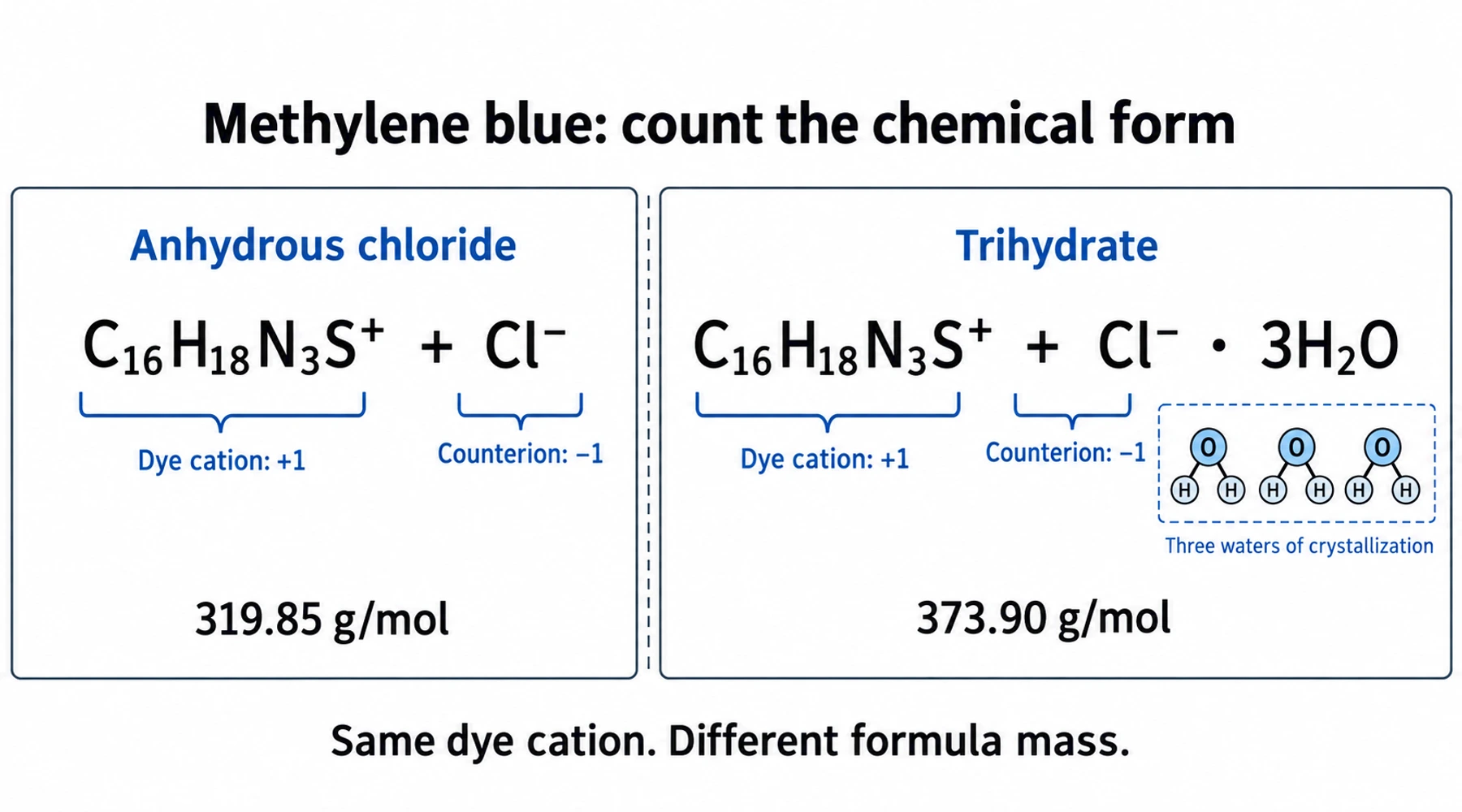
Methylene blue usually means methylthioninium chloride, a salt containing a positively charged organic dye and a chloride counterion. The anhydrous salt has formula C₁₆H₁₈ClN₃S and formula mass approximately 319.85 g/mol. Water of crystallization changes the mass of a weighed material without changing the identity of its dye cation.
That distinction resolves several apparent contradictions in chemical catalogs. A record can correctly report zero net charge for the salt while describing the dye as cationic. A second catalog can report 373.90 g/mol because its material is the trihydrate. Before using a property, identify what the number describes.
Names identify different levels of the material
The ChEBI methylene blue record identifies the chloride salt, lists CAS 61-73-4, and includes the names methylthioninium chloride, Basic Blue 9, and C.I. 52015. Its systematic name is 3,7-bis(dimethylamino)phenothiazin-5-ium chloride.
The name methylthioninium without “chloride” identifies the organic cation. A hydrate designation adds another distinction: methylene blue chloride associated with a stated amount of water in the solid. For a purchasing specification, record the full chemical name, formula, hydrate basis, and supplier identifier together. Do not rely on the color word alone. The comparison of methyl blue and similarly named dyes explains why close names can identify different chemicals.
Read the molecular structures
Structure A: the methylthioninium cation
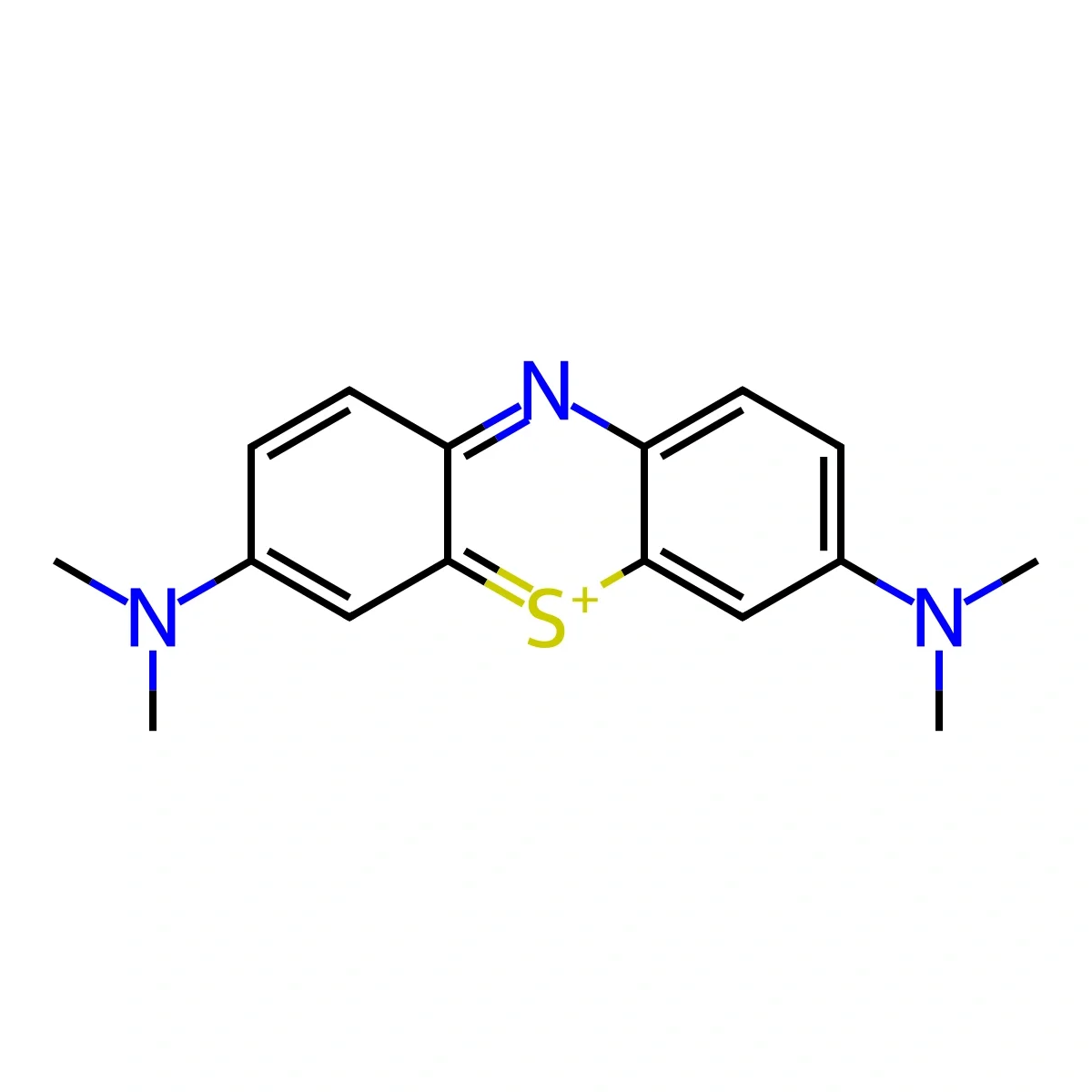
Labels: blue N symbols identify three nitrogen atoms; yellow S identifies sulfur; the two outer nitrogen atoms each carry two methyl groups. Unlabeled line ends on those groups represent carbon atoms with their implicit hydrogens. The three fused rings form the central conjugated framework. This source drawing shows one formal-charge representation.
The ChEBI cation structure has formula C₁₆H₁₈N₃S⁺, net charge +1, and average mass 284.408. Positions 3 and 7 carry the dimethylamino substituents. A formal positive sign on one atom in a drawing is bookkeeping for that representation; it should not be interpreted as a map of the complete electron distribution.
Structure B: the chloride salt
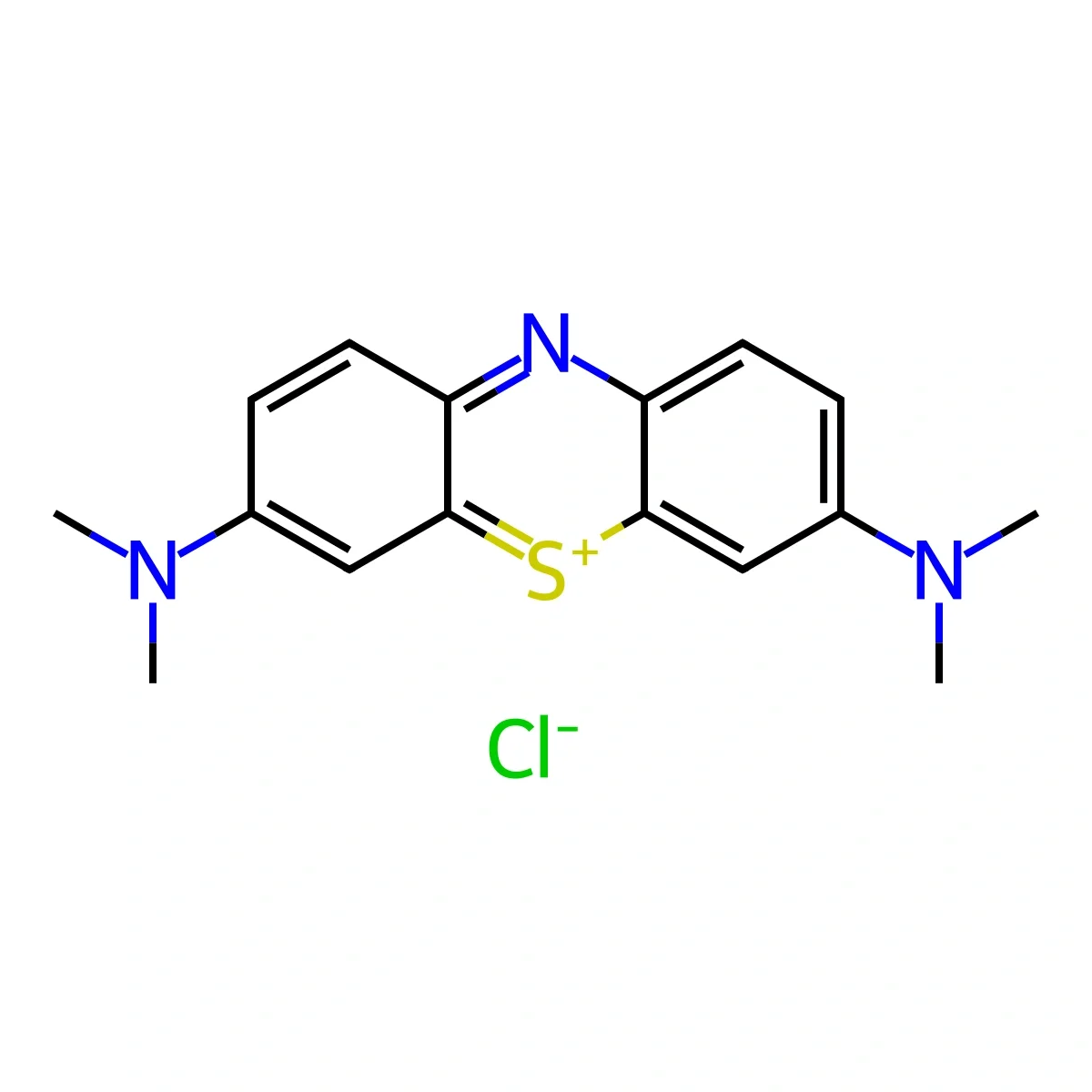
Labels: the green Cl⁻ is the chloride counterion. It is deliberately disconnected from the organic structure. One +1 cation and one −1 anion give a neutral formula unit. Both structural drawings are reproduced from ChEBI and converted to WebP without changing their bonds or atom labels.
The PubChem record for CID 6099 uses an alternative systematic name and a different placement of double bonds and formal charge. These representations retain the same atom connectivity. They do not establish that a different hydrate or an additional ingredient is present.
Referenced property table
The formula masses below follow the USP methylene blue monograph preview. The physical measurements are examples from a specified commercial trihydrate record, with their available conditions preserved.
| Property | Value or description | Basis and interpretation |
|---|---|---|
| Dye cation | C₁₆H₁₈N₃S⁺; +1; about 284.41 g/mol | Cation only, excluding chloride and water; ChEBI 43830 |
| Anhydrous chloride | C₁₆H₁₈ClN₃S; 319.85 g/mol | Neutral salt formula unit; USP |
| Monohydrate | C₁₆H₁₈ClN₃S·H₂O; 337.90 g/mol | One water per salt formula unit; USP |
| Trihydrate | C₁₆H₁₈ClN₃S·3H₂O; 373.90 g/mol | Three waters per salt formula unit; USP |
| Pentahydrate | C₁₆H₁₈ClN₃S·5H₂O; 409.93 g/mol | Five waters per salt formula unit; USP |
| Physical form | Solid | Merck/Sigma product 1.04122, labeled trihydrate |
| Reported solid density | 1.757 g/cm³ at 22 °C | Product 1.04122; not the density of a prepared solution |
| Reported bulk density | 400–600 kg/m³ | Same product; includes spaces between powder particles |
| Reported pH | 3 at 20 °C, 10 g/L in water | Same product and specified solution conditions |
| Listed solubility | 50 g/L | Same product; displayed entry does not specify temperature |
| Thermal entry | 190 °C, decomposition | Same product; not an unqualified equilibrium melting point |
| pKa | Requires a defined acid/base pair and medium | Not interchangeable with the pH of a bottle or solution |
The manufacturer’s product record supports the product-specific rows. These entries are useful reference points, not specifications for every powder or finished liquid. Small differences between database formula masses can also reflect atomic-weight conventions and rounding; that is a different issue from the much larger hydrate difference.
Why hydration changes a calculation
One millimole of ideal anhydrous chloride weighs 319.85 mg; one millimole of ideal trihydrate weighs 373.90 mg. Each contains one millimole of dye cations. Calculated from the table, the trihydrate mass is about 16.9% greater for the same amount of dye.
Consequently, 1.000 g/L of pure anhydrous chloride corresponds to about 3.13 mmol/L, while 1.000 g/L of pure trihydrate corresponds to about 2.67 mmol/L. These are formula-based examples, before correcting for an actual assay or measured water content. Use the methylene blue molarity calculator to keep the selected chemical form explicit.
The USP definition expresses assay on a dried basis. A dried-basis percentage and an as-received powder mass therefore need interpretation together. Water of crystallization is not automatically evidence of contamination. The detailed trihydrate versus anhydrous comparison covers how to read those labels.
Charge does not establish a colloid
“Methylene blue sol charge” mixes two separate questions. The dye ion has charge +1. Whether a preparation is a sol requires information about the dispersed system.
The IUPAC definition of a sol concerns a fluid colloidal system. It does not make every solution of a charged dye a colloid. Nor does a neutral salt formula imply that its dissolved ions are individually neutral. A claim about particle charge or zeta potential needs the actual preparation and measurement conditions, rather than the molecular formula alone.
pH, pKa, and polarity answer different questions
IUPAC defines pH through hydrogen-ion activity in solution. Dry methylene blue powder therefore does not have a standalone aqueous pH. A useful pH entry specifies the solvent, concentration, temperature, and formulation. Adding a buffer can change solution pH without changing the identity printed on the dye label.
By contrast, an acid dissociation constant describes a particular equilibrium, and pKa is its negative base-10 logarithm. A usable “methylene blue pKa” must name the protonated and deprotonated species and the medium. A lone number does not tell you whether it refers to the oxidized dye or another chemical form. Proton transfer and electron transfer are different processes; see methylene blue and leucomethylene blue redox chemistry for the latter.
“Polar or nonpolar?” also needs a defined purpose. Methylene blue chloride is ionic, while its organic cation contains an extended carbon framework. That description is more useful than assigning the whole substance a single polarity score. As IUPAC’s discussion of solvent polarity explains, solvation depends on multiple interactions. For preparation work, use measured solubility in the intended solvent and the conditions in the solubility and solution preparation guide.
Which density belongs in a conversion?
Although 1 g/cm³ equals 1 g/mL, changing the unit does not change what was measured. The density of a solid cannot convert milliliters of a dilute solution into grams of that solution. Bulk powder density answers yet another question because packing leaves air between particles.
For a mass-per-volume to mass-per-mass conversion, obtain the finished solution’s density at a stated temperature. For weighing and molarity, confirm the material’s formula and assay basis. Matching the property to the object being measured prevents errors that additional decimal places cannot fix.