
Article
Why a methylene blue assay can read above 100%
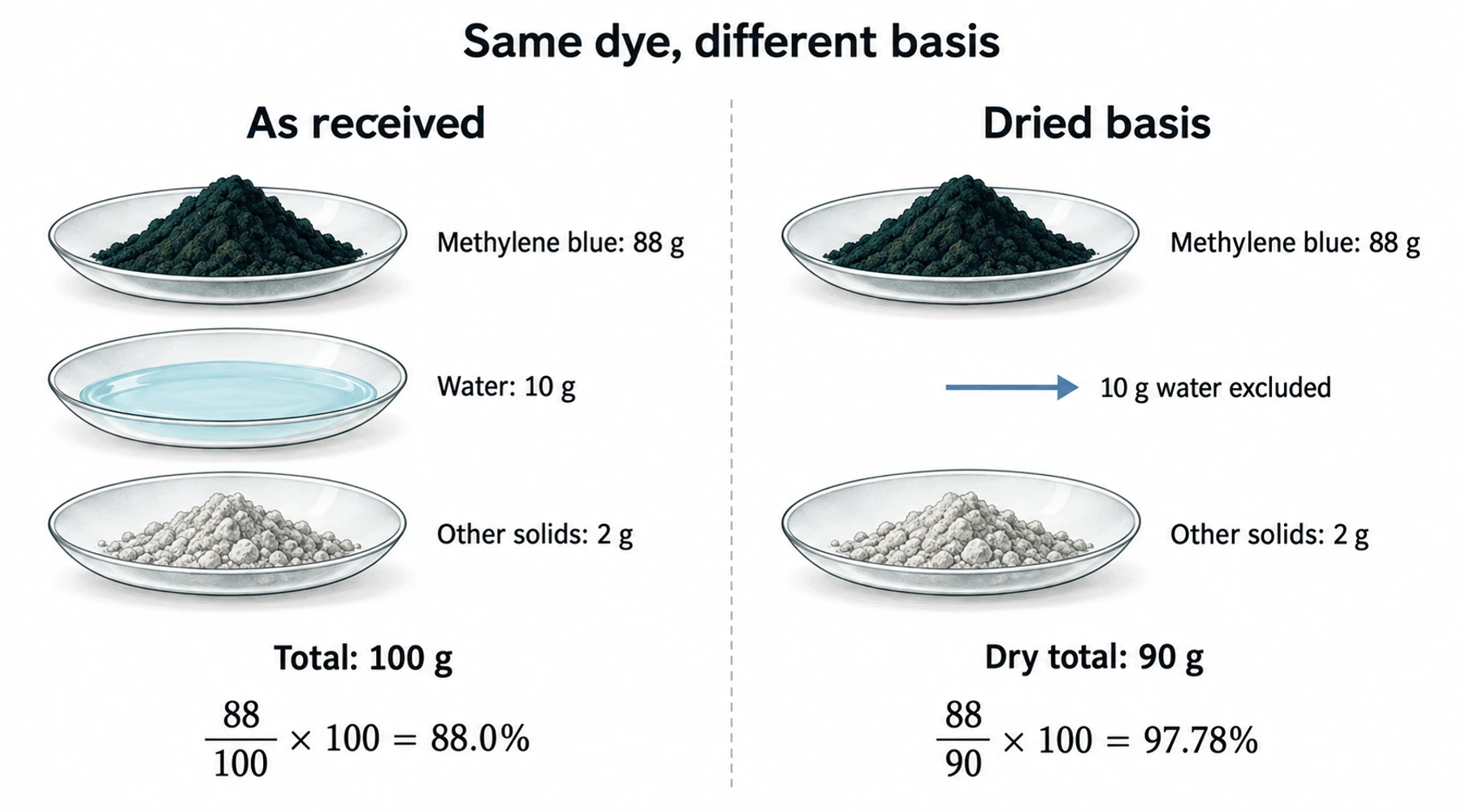
A methylene blue assay of 101.0% is a reported analytical result. It does not mean that 100 g of material physically contains 101 g of methylene blue. To interpret it, identify what was measured, which material mass supplied the denominator, and how the laboratory calculated the result.
The USP methylene blue definition specifies an assay range of 97.0% to 103.0%, calculated on the dried basis. Those are acceptance limits for a specified test. They are neither a claim of literal purity above 100% nor the uncertainty interval of every laboratory measurement.
Start with the denominator
An as-received result refers to the material in its received condition, including its water. A dried-basis result excludes the mass lost under the prescribed drying conditions from the denominator. It reports the analyte relative to the remaining material.
These terms require care. USP's Loss on Drying chapter defines the measurement in terms of volatile matter removed under specified conditions. Loss on drying is not automatically a water-specific measurement. Other volatile substances can contribute. Use the actual method and reporting basis on the certificate.
For a simple correction, where the assay and loss-on-drying results concern the same material and the analyte is retained:
Dried-basis assay (%) = as-received assay (%) × 100 / 100 − loss on drying (%)
The reverse conversion is:
As-received assay (%) = dried-basis assay (%) × 100 − loss on drying (%) / 100
Do not apply the correction again to a result already reported on a dried basis.
Worked example: one sample, two valid percentages
Suppose a hypothetical 100 g sample contains 88 g of methylene blue, expressed as the anhydrous chloride, 10 g of water, and 2 g of other nonvolatile solids. Assume the drying step removes exactly the water without losing or changing the dye. These are teaching quantities, not results for a product batch.
| Quantity | As received | After excluding water |
|---|---|---|
| Methylene blue | 88 g | 88 g |
| Water counted in denominator | 10 g | 0 g |
| Other nonvolatile solids | 2 g | 2 g |
| Total denominator | 100 g | 90 g |
| Methylene blue fraction | 88 / 100 × 100 = 88.0% | 88 / 90 × 100 = 97.78% |
| Other solids fraction | 2 / 100 × 100 = 2.0% | 2 / 90 × 100 = 2.22% |
The dry fractions total 100%. The higher assay did not remove the other solids or increase the amount of dye. It changed the comparison from the whole received sample to its dry portion.
Conversely, a report showing 99.0% dried-basis assay and 12.0% loss on drying implies an as-received assay of 99.0 × 0.88 = 87.12%, subject to the method's assumptions. Comparing that 87.12% directly with another supplier's 99.0% dried-basis result would compare different quantities.
Water can also belong to the crystal's hydrate form. The distinction between methylene blue trihydrate and anhydrous material explains why formula mass and assay basis must agree. A hydration label does not replace a lot-specific water or drying result.
Why the reported assay can exceed 100%
A correct dry-mass calculation with exact measurements cannot turn a true mass fraction into more than 100%. A result above that boundary comes from how the analytical estimate is obtained, including its measurement uncertainty, possible bias, or a reporting or calculation problem.
The official September 2023 USP revision bulletin describes an assay that compares the sample's liquid-chromatography response with a reference standard. It is a calibrated determination, not a physical sorting and weighing of every substance in the powder. Standard assignment, weighing, dilution, instrument response, and the drying correction can affect the reported estimate.
Consider a second hypothetical sample: 90 g of methylene blue and 10 g of water. Its true dry fraction is 100%. If the assay response is 1% high and the drying correction is otherwise exact, the method estimates 90.9 g equivalent in the original 100 g. Correcting that estimate gives 90.9 / 90 × 100 = 101.0%. The extra 0.9 g is an overestimate, not extra material.
NIST's explanation of measurement uncertainty distinguishes a measured estimate from exact knowledge of the underlying quantity. A laboratory must evaluate its own uncertainty. The 97.0% to 103.0% specification does not establish that the method has “±3% uncertainty.” Nor does a high result prove that random variation caused it. Persistent high results warrant checking calibration, sample preparation, correction factors, and calculation basis.
The 2026 USP proposal briefing explicitly identifies itself as a proposal based on the September 2023 official version. A proposed revision should not be treated as an effective test requirement merely because its date is newer.
Dye content and chromatographic purity answer other questions
“Dye content” needs a stated method and basis. For example, Sigma-Aldrich's M9140 specification lists dye content of at least 82% for a hydrated biological stain. That minimum is not a measured value for every lot. It does not identify the balance as hazardous contamination or establish equivalence to a pharmaceutical specification.
Likewise, chromatographic area percentage divides one detected peak's area by a defined sum of peak areas. It does not automatically divide methylene blue mass by the entire sample mass. USP's chromatographic submission guidance distinguishes area normalization from external-standard calculations and describes relative response factors, because equal masses can produce different detector responses.
| Illustrative report entry | What the arithmetic establishes | What it does not establish |
|---|---|---|
| Main peak area 990,000; included total area 1,000,000 | 99.0% of the included integrated response | 99.0% of the received powder's mass |
| Impurity peak area 10,000; included total area 1,000,000 | 1.0% area under that integration method | 1.0% mass without the necessary response relationship |
| A measured element at 5 mg/kg | 5 parts per million by mass, or 0.0005% | A value to subtract directly from an unrelated area percentage |
A detector may not measure water, inorganic salts, or every organic contaminant under the selected conditions. Separate assays can therefore coexist without summing neatly to 100%. An organic-impurity result, an elemental analysis, and loss on drying are complementary measurements.
Read the result as part of the report
Use the certificate-of-analysis reading guide to locate the lot identity, method, reporting basis, measured result, and acceptance limit. Keep each result with its units and denominator. For laboratory solution calculations, the methylene blue molarity calculator makes the material-form and assay assumptions explicit.
A 101% assay can satisfy the assay specification while another required test fails. A 99% assay cannot establish sterility, acceptable elemental impurities, or product authorization. The meaning of USP-grade methylene blue depends on the applicable requirements as a whole. A useful quality comparison asks whether the documented material meets those requirements, rather than ranking suppliers by the largest percentage.