
Article
USP-grade methylene blue: what the designation establishes
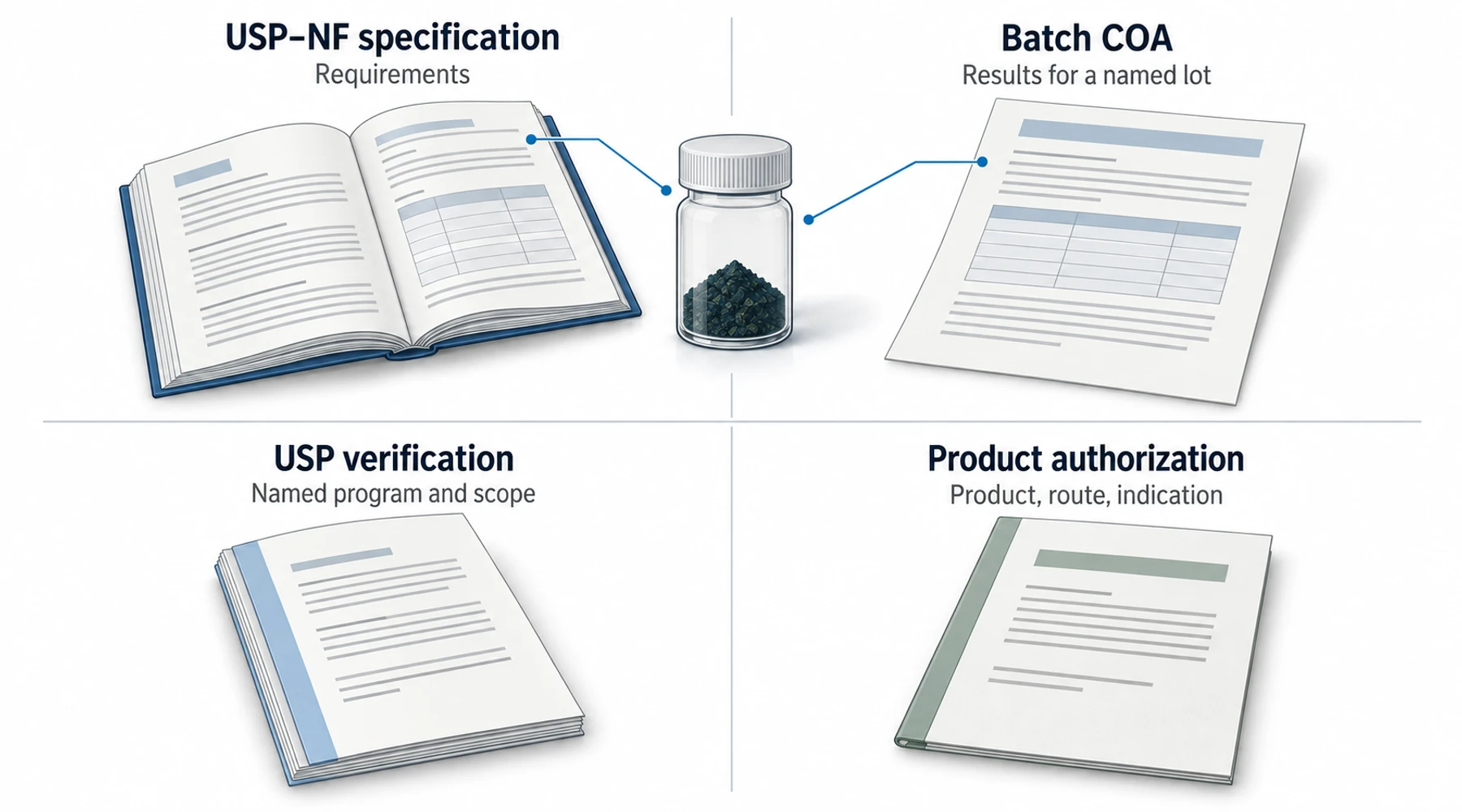
USP-grade methylene blue is a claim that the material conforms to applicable United States Pharmacopeia standards. It does not, by itself, mean that USP tested the batch, certified the seller, or authorized the finished product as a medicine.
Those distinctions matter when comparing bottles whose labels all say “pharmaceutical grade.” A specification describes what a material must meet. A certificate of analysis records results for a particular batch. A verification program evaluates a defined product or ingredient within its scope. A medicines regulator authorizes a particular medicinal product. Each answers a different purchasing question.
What the grade refers to
USP–NF is a compendium of quality standards. Its monographs describe individual articles, while the General Notices and Requirements explain how the compendium is interpreted and applied. A defensible conformity claim therefore needs the applicable monograph, relevant general requirements, and an identified version.
For the ingredient, the relevant monograph is Methylene Blue. Do not silently substitute a specification for an injection or assume that testing the ingredient establishes every property of a finished solution. Adding water, filling bottles, and storing a formulation introduce questions about concentration, contamination, container compatibility, and shelf life that an ingredient report cannot answer alone.
The public USP monograph definition specifies 97.0%–103.0% methylene blue on the dried basis. That is an assay acceptance range with a specified calculation basis. It is not a marketing definition of “at least 99% pure,” and it is not the concentration of a bottled solution. A percentage without its method, denominator, and basis is an incomplete result.
Check the official version, not just the year
The checklist below was checked against USP’s publicly available revision bulletin official on September 1, 2023. The 2026 methylene blue proposal explicitly identifies that version as its starting point. It proposes changes to assay preparation, solution stability, impurity reporting, and the microorganism chapter reference. A proposal is not evidence that those changes have become official.
For procurement, require the supplier to identify the official USP–NF text in force for its conformity statement. Check subsequent official changes when placing a new order. USP’s compendial notices describe changes in standards status; a newer search result can be commentary or a proposal rather than a replacement specification.
Grade and documentation checklist
Use the limits as a comparison aid for the identified bulletin, with the supplier’s current official specification alongside it. NMT means “not more than.” The table is a document check, not a batch release decision.
| Check | Requirement in the identified monograph | Record to inspect |
|---|---|---|
| Identity | Infrared; chromatographic retention; chloride identification | Results and methods for all three |
| Assay | 97.0%–103.0%, dried basis | Measured value and calculation basis |
| Related impurities | Azure B ≤2.5%; each unspecified ≤0.10%; total excluding Azure B ≤0.5% | Individual results, total definition, reporting threshold |
| Drying loss | 8.0%–24.0%; 105°C, 5 hours | Result and conditions |
| Ignition residue | ≤0.15% | Result and method |
| Microbial counts | Aerobic ≤100 CFU/g; yeast/mold ≤10 CFU/g | Counts and methods |
| Endotoxins | Must permit compliance with relevant dosage-form requirements | Applicable limit, evidence, processing statement |
| Packaging and storage | Well-closed; protected from light; below 30°C | Packaging specification and storage record |
Do not treat a heavy-metal panel as a substitute for these checks. Conversely, absence of a named metal from this table does not make it irrelevant. In its 2023 response to comments on methylene blue, USP explained the decision to handle elemental impurities through its broader drug-product control strategy rather than retain individual tests in this drug-substance monograph. Ask which elemental-impurity requirements apply to the intended product and how the supplier supports them. A seller’s additional testing panel and a monograph requirement should remain identifiable as separate things.
For a usable purchasing record, download the grade and documentation worksheet. It includes fields for version, lot linkage, missing evidence, and the scope of each claim.
What “USP certified” would need to mean
Ask the seller to name the program. USP operates verification services for supplements and ingredients, including active pharmaceutical ingredients. These are defined programs; the words “USP” on a specification do not establish participation.
For example, USP describes its dietary supplement verification program as voluntary submission followed by testing and auditing against program criteria. That program is evidence about the products within its scope. It does not turn every ingredient or product from a participating company into a verified article.
If a supplier says “USP certified methylene blue,” request the program name, exact covered ingredient or product, manufacturer, and a current confirmation from USP. If the document is instead a laboratory COA stating compliance with USP methods, describe it as that. A laboratory can test against a standard without being the organization that publishes the standard.
Product authorization is a separate lookup
For a claim of US drug approval, use the regulator’s record for the exact product. The FDA’s guide to checking whether a drug is approved directs readers to Drugs@FDA. Match the applicant, product name, strength, dosage form, route, and approved labeling.
An NDC number is insufficient: the FDA states that assignment of an NDC does not denote approval. Likewise, approval of an injectable medicine cannot be transferred to a different seller’s oral solution because both contain methylene blue. For another country, check that country’s medicines register and the exact authorization claimed.
Neither grade nor a COA establishes that a product is suitable for an individual’s treatment. Injectable use particularly requires an appropriate finished medicinal product; ingredient-grade powder and ordinary bottled solutions are not interchangeable with it. The same distinction applies when assessing methylene blue supplements, labels, and regulatory status.
Connect the documents to the bottle
Start with the batch number on the package. Blupreme’s quality and batch-documentation page describes how its records link a product batch to an ingredient batch and that ingredient’s COA. Use that relationship to locate the relevant report. The displayed specification is not itself the measured result for your lot.
Record exactly what you found: the ingredient covered, the tests reported, the specification version, and the link to the finished product batch. If a claimed test is missing, request its supporting record instead of filling the gap with the word “USP.” Use the methylene blue buying checklist to compare the remaining product details before making a purchasing decision.