
Article
Methylene blue supplements: evidence, labels, and regulatory status
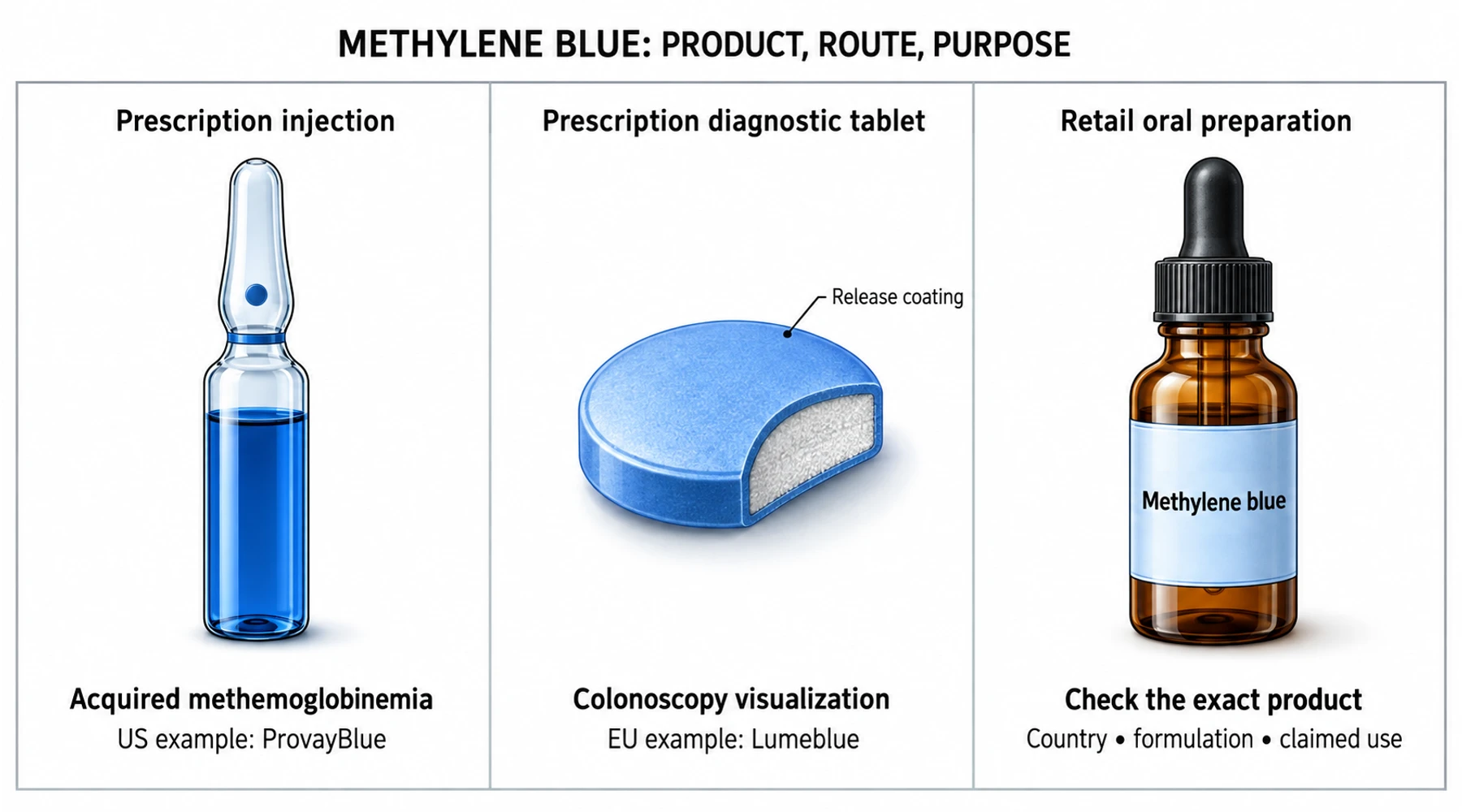
“Methylene blue supplement” describes how a product is marketed. It does not, by itself, establish its legal category, approved purpose, or clinical benefits. The same chemical name appears on prescription medicines, retail oral preparations, laboratory reagents, and aquarium products.
The answer to “Is methylene blue FDA approved?” is therefore product-specific. ProvayBlue is an approved intravenous medicine for acquired methemoglobinemia. Its approval does not extend to a different manufacturer's drops or capsules promoted for memory or longevity. Conversely, saying that all oral methylene blue is unapproved worldwide is also wrong: the EU has an authorized oral diagnostic medicine, and Canada has a nonprescription oral drug record.
Start with the complete product description
A useful description includes the manufacturer, exact product name, formulation, concentration, route, country, and claimed use. “Methylene blue, USP” answers only part of that description.
Three distinctions prevent common mistakes:
- Formulation: an injectable solution, a coated tablet, and an ordinary liquid can contain the same substance while delivering it differently.
- Intended use: correcting methemoglobinemia, staining the colon during an examination, and improving everyday concentration are different claims requiring different evidence.
- Regulatory category: prescription medicine, nonprescription drug, food supplement, and laboratory reagent are not interchangeable descriptions.
The guides to methylene blue gummies and methylene blue capsules and tablets explain presentation differences. A convenient format does not establish an authorized use.
Product and jurisdiction matrix
Records checked on 12 September 2026. This matrix compares specified products or categories. It is not an exhaustive register, a ruling on every seller, or a personal import permission. The linked authority records and product documents provide the basis for each row.
| Country or market | Product or formulation and route | Intended use established by the cited record | Authority and status distinction |
|---|---|---|---|
| United States | ProvayBlue, methylene blue injection, intravenous | Acquired methemoglobinemia in pediatric and adult patients | FDA-approved medicine; current prescribing information identifies this product and indication. |
| United States | Retail oral drops or capsules marketed as supplements | Seller-dependent wellness claims | FDA supplement rules do not confer premarket approval on supplements; classification and claims require separate assessment. |
| United Kingdom | Proveblue 5 mg/mL solution for injection, intravenous | Acute symptomatic medicine- or chemical-induced methaemoglobinaemia | Prescription-only medicine, PLGB 40051/0002, in the UK prescribing information. |
| European Union | Lumeblue 25 mg prolonged-release tablets, oral | Improved visualization of colorectal lesions during adult screening or surveillance colonoscopy | EMA's Lumeblue assessment describes an authorized prescription diagnostic medicine. |
| Canada | METHYLENE BLEU LIQ 1%, Laboratoire Atlas, oral liquid | No electronic product monograph supplied in the database; do not infer a wellness indication | Health Canada's Drug Product Database lists DIN 00050466 as marketed and nonprescription. |
| Australia | Proveblue 50 mg/10 mL injection ampoule | Consult the product information for the authorized indication | TGA record ARTG 224639 identifies a registered injectable medicine. |
| Australia | Imported unregistered oral methylene blue products | Cognitive, mood, and anti-ageing uses promoted by sellers | TGA's oral-product advisory says these products have not been assessed for quality, safety, or efficacy. |
United States: supplement labeling is not drug approval
FDA does not approve dietary supplements before sale. Its definition also generally excludes ingredients previously approved as new drugs, subject to exceptions involving earlier food or supplement marketing. A seller must establish the applicable regulatory basis; printing “Supplement Facts” cannot settle that question.
Disease claims can establish drug intent even when a product is called a supplement. In a 2020 warning letter concerning methylene blue capsules, FDA challenged products promoted for COVID-19 as unapproved and misbranded drugs. That is an example of enforcement against particular claims, not a current determination about every methylene blue seller.
United Kingdom: claims and pharmacological action matter
The MHRA's borderline-product guidance explains that both presentation and the active substance can affect whether a product is medicinal. A label calling a preparation a food supplement does not override that assessment. Nor does a laboratory label resolve a sales page that directs consumers toward therapeutic use.
The UK injection's authorization belongs to its named product. Its licence number retains the PLGB prefix: the MHRA product service explains that existing Great Britain authorizations became UK-wide in January 2025 without changing their numbers.
European Union: oral approval can serve a specific diagnostic purpose
Lumeblue illustrates why route alone is insufficient. Its coating and release characteristics support staining the colorectal lining during colonoscopy. That evidence concerns a diagnostic procedure, not daily cognitive enhancement. A retail capsule containing methylene blue does not inherit Lumeblue's authorization because both are swallowed.
Canada: read the exact DIN record
The Atlas record prevents a blanket statement that Canadian oral methylene blue is always prescription-only. However, the entry does not supply an electronic monograph establishing memory or longevity claims. A DIN belongs to the named drug product; it cannot be transferred to another seller's bottle. Verify any claimed DIN or natural product number against the matching official record, including the company and formulation.
Australia: registration and scheduling answer different questions
The TGA's advisory distinguishes registered injection products from unregistered oral products marketed online. Whether a substance requires a prescription is a scheduling question; whether a particular therapeutic product has been assessed and registered is another question. Do not interpret a less restrictive schedule as approval of an oral wellness preparation. The 2026 methylene blue scheduling consultation is a proposal process, not itself an enacted change.
What the evidence can support
There is human research on oral methylene blue, but research findings and product authorization remain separate. A randomized, double-blind trial in 26 healthy adults compared oral methylene blue with placebo and assessed functional MRI and attention/memory tasks before and one hour after administration. It reported changes in brain activity and memory retrieval performance.
That small, acute experiment does not establish sustained daily benefits, prevention of cognitive decline, or equivalence of retail formulations. A seller citing it should identify the tested preparation, population, timing, and endpoint. The broader guide to methylene blue benefits and evidence separates established uses from preliminary findings.
What “USP” establishes
The USP methylene blue monograph preview defines an assay range of 97.0% to 103.0%, calculated on the dried basis. That is a pharmacopeial specification, not a clinical indication. The public preview does not expose the complete monograph.
“Made with USP-grade methylene blue” also leaves a practical question: what evidence covers the finished preparation? Source-material identity, final concentration, other ingredients, and batch testing are separate checks. Use the explanation of USP-grade methylene blue alongside a batch certificate of analysis. Neither blue color nor a high assay value proves sterility. The guide to methylene blue injections and IV infusions explains why grade alone cannot establish injectable suitability.
Make the label check actionable
Before accepting a claim, match the actual product to its regulatory record and supporting evidence. Record the jurisdiction, route, intended use, authorization identifier where applicable, and the date checked. Keep the batch documents separate from the evidence for clinical benefits.
For personal oral use, the TGA identifies clinically relevant risks including interactions with serotonergic medicines, harm during pregnancy, and hemolysis in people with G6PD deficiency. Those risks remain relevant even when a seller uses wellness language. The methylene blue safety guide explains the practical screening questions.
“Is methylene blue legal?” needs a specified activity: possession, sale, therapeutic promotion, and importation are different questions. Once the product's status is clear, use the separate guide to buying methylene blue internationally for destination and import checks.