
Article
Methylene blue gummies: ingredients, testing, and comparison with drops
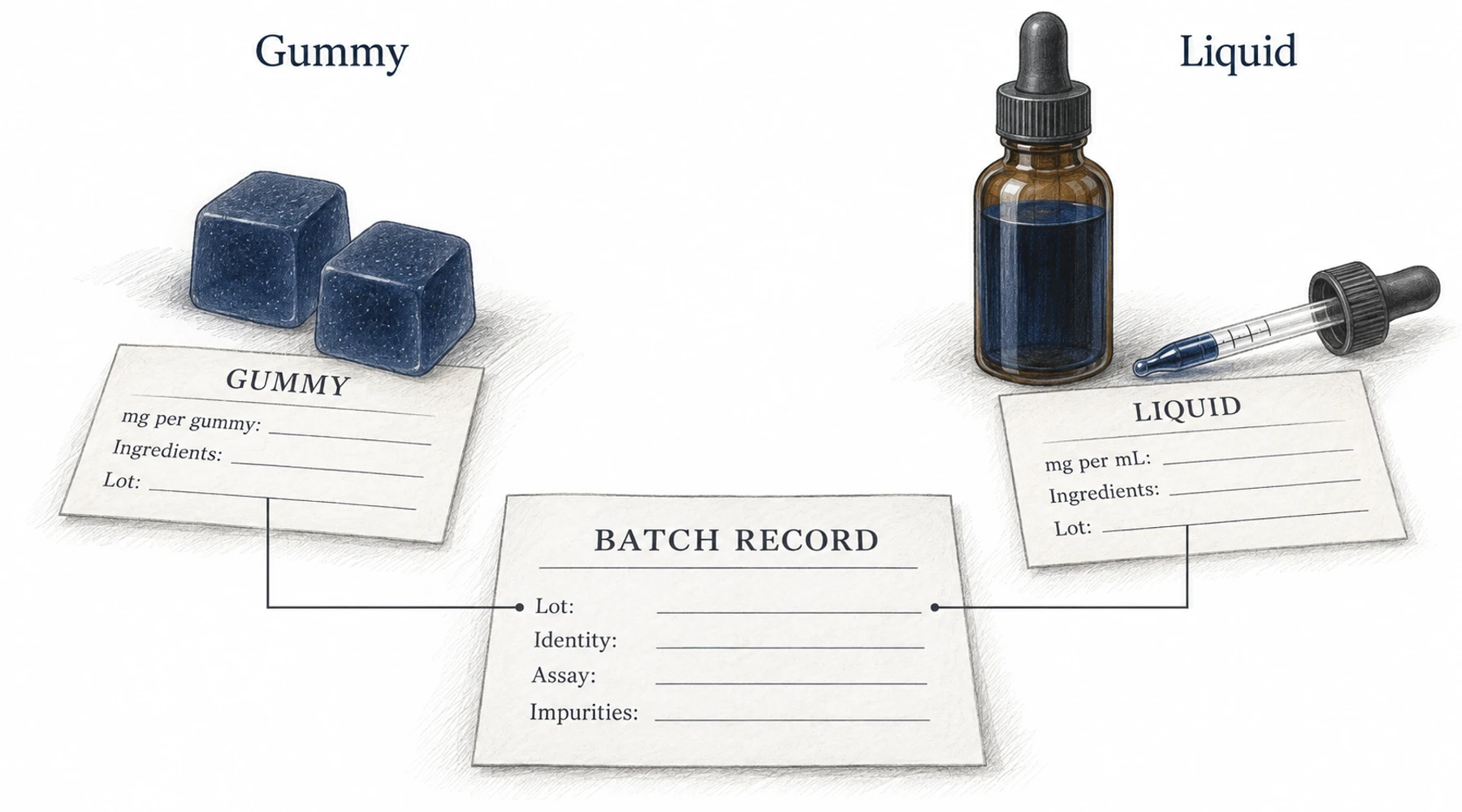
Methylene blue gummies change how a product is packaged, flavored, and measured. They do not, by their shape alone, establish better absorption, proven cognitive benefits, or greater safety than liquid drops. A useful comparison starts with the exact ingredient list and ends with evidence about the finished batch.
The Blupreme catalog lists methylene blue solution and powder, with no gummies currently listed. This commercial interest matters: the examples below compare disclosed information rather than award either format a quality ranking.
What is actually in the product?
A gummy contains a gel-forming base, usually alongside sweeteners, flavoring, and other formulation ingredients. Some products also combine methylene blue with additional active ingredients. An aqueous solution can have a shorter ingredient list, but that does not establish its suitability for a particular use or its clinical effectiveness.
For products marketed as supplements in the United States, the FDA explains how serving size, amounts per serving, and other ingredients appear on labels. Read the whole label. A front-panel number might describe one gummy, several gummies, or the entire package. A supplement-style label does not itself establish a product's legal status or FDA approval.
The following snapshot uses sellers' product-page ingredient and strength statements inspected on September 12, 2026. It is not an independent laboratory analysis or a claim that the physical packs have been inspected. Confirm the current pack label before purchasing.
| Label detail | Simpyl gummies | Wild Bounty Organics gummies | Blupreme aqueous solution |
|---|---|---|---|
| Declared methylene blue amount | 5 mg trihydrate per gummy | 5 mg per gummy, described as USP grade | 1% weight/volume, stated as 10 mg/mL |
| Pack quantity | 30 gummies | 60 gummies | 100 mL |
| Base and other ingredients | Cane syrup, sugar, water, pectin, sodium citrate, natural blueberry flavor | Tapioca syrup, sugar, corn starch, agar, pectin, citric and malic acids, sunflower lecithin, fruit/vegetable juices, beta carotene | Purified water and methylene blue |
| Additional actives listed | None in the inspected ingredient list | Niacin, N-acetyl-cysteine, L-theanine | None listed |
| Testing statement | Third-party purity and heavy-metal testing for every batch | Purity, potency, and heavy-metal testing; batch COA available on request | Tests of the methylene blue ingredient against the applicable USP–NF specification |
These details come from the Simpyl ingredient listing, Wild Bounty Organics formulation description, and Blupreme solution specification. The testing row records what each seller says. It does not establish that their test panels, sampling, or acceptance limits are equivalent.
The blend example shows why the ingredient list changes the purchasing task. A reported effect after taking several active ingredients cannot automatically be attributed to methylene blue. Buyers also need the amounts of the additional actives, which the inspected Wild Bounty ingredient description did not provide.
Compare units before comparing formats
Milligrams describe an amount; milligrams per milliliter describe concentration. For a liquid, the amount in a measured volume is concentration multiplied by volume. A percentage needs its basis: 1% weight/volume means 1 g in 100 mL, equivalent to 10 mg/mL. It does not mean 1 mg per drop.
Gummies remove the step of measuring a liquid volume, but the declared amount still depends on manufacturing consistency. A batch-average assay and evidence that individual gummies contain a consistent amount answer different questions. Cutting a gummy does not establish how much active ingredient is in each piece.
For liquids, a graduated measuring device is more interpretable than an unspecified drop count. Do not assume every supplied dropper produces the same drop volume. These are label-reading distinctions, not instructions for selecting a personal dose.
Also check the chemical basis of the stated strength. A listing that explicitly names a hydrate deserves a specification explaining how the assay and declared milligrams are reported. Resolve that detail with the supplier before treating two numbers as directly interchangeable.
Side-by-side documentation checklist
Use this checklist for each candidate. Record the document name and date, then mark each row confirmed, unclear, or not supplied. Missing documentation means that the claim remains unverified; it does not prove that a product failed testing.
| Check | Ask the gummy supplier | Ask the liquid supplier | Evidence to retain |
|---|---|---|---|
| Identity and strength | What exactly is declared per gummy and per serving? | What is the concentration, percentage basis, and chemical basis? | Current full label and specification |
| Batch traceability | Does the report identify the finished gummy lot? | Does it identify the bottled solution lot? | Matching pack lot and COA |
| Finished-product amount | How is methylene blue recovered from the gummy base for assay? How is unit consistency assessed? | How is the finished solution concentration verified? | Test method, sampling explanation, result, and limit |
| Impurities and contamination | What is tested after combining the ingredients? | Which results apply to the ingredient, and which to the bottled solution? | Named analytes, methods, numerical results, reporting limits |
| Shelf life and packaging | What supports potency and quality through expiry in this pack? | What supports expiry and any period after opening? | Storage instructions and stability summary |
This separation follows the quality dimensions described in the FDA's manufacturing-practice backgrounder: identity, purity, strength, composition, and contamination control. The checklist is a purchasing aid, not a certification or a legal compliance determination.
A raw-material certificate follows the ingredient before formulation. It cannot, by itself, demonstrate the amount in a finished gummy or bottle. Likewise, a heavy-metal panel answers questions about the elements tested; it does not establish methylene blue identity, organic-impurity levels, or unit consistency. Apply that distinction to Blupreme's ingredient-testing statements as well as to other sellers.
Do gummies have different benefits or absorption?
The product pages inspected do not establish a head-to-head clinical comparison between their gummies and an equivalent liquid formulation. Convenience is observable: a gummy is portable and does not require pouring. A claim about faster absorption, better memory, or longer-lasting effects needs a different kind of evidence.
Ask whether the cited study tested that finished formulation, at that amount, by that route, in a relevant population. A study of injected methylene blue cannot establish the effectiveness of a retail gummy. Ingredient purity testing also cannot demonstrate a clinical benefit. For related label issues, compare capsules, tablets, and other solid formats.
The familiar confectionery format does not remove pharmacological concerns. The prescription methylene blue label documents serotonin-syndrome and G6PD-related hemolysis risks. That intravenous label does not quantify risk for a particular gummy, but it is a reason to discuss medication use and G6PD status with a clinician before considering oral use. Keep gummies in their original packaging, inaccessible to children.
Choose a format only after resolving the label and documentation questions relevant to your intended use. The broader buyer's comparison checklist helps compare supplier evidence across products without assuming that either a gummy or a dropper bottle is inherently superior.