
Article
Methylene blue capsules and tablets versus liquid drops
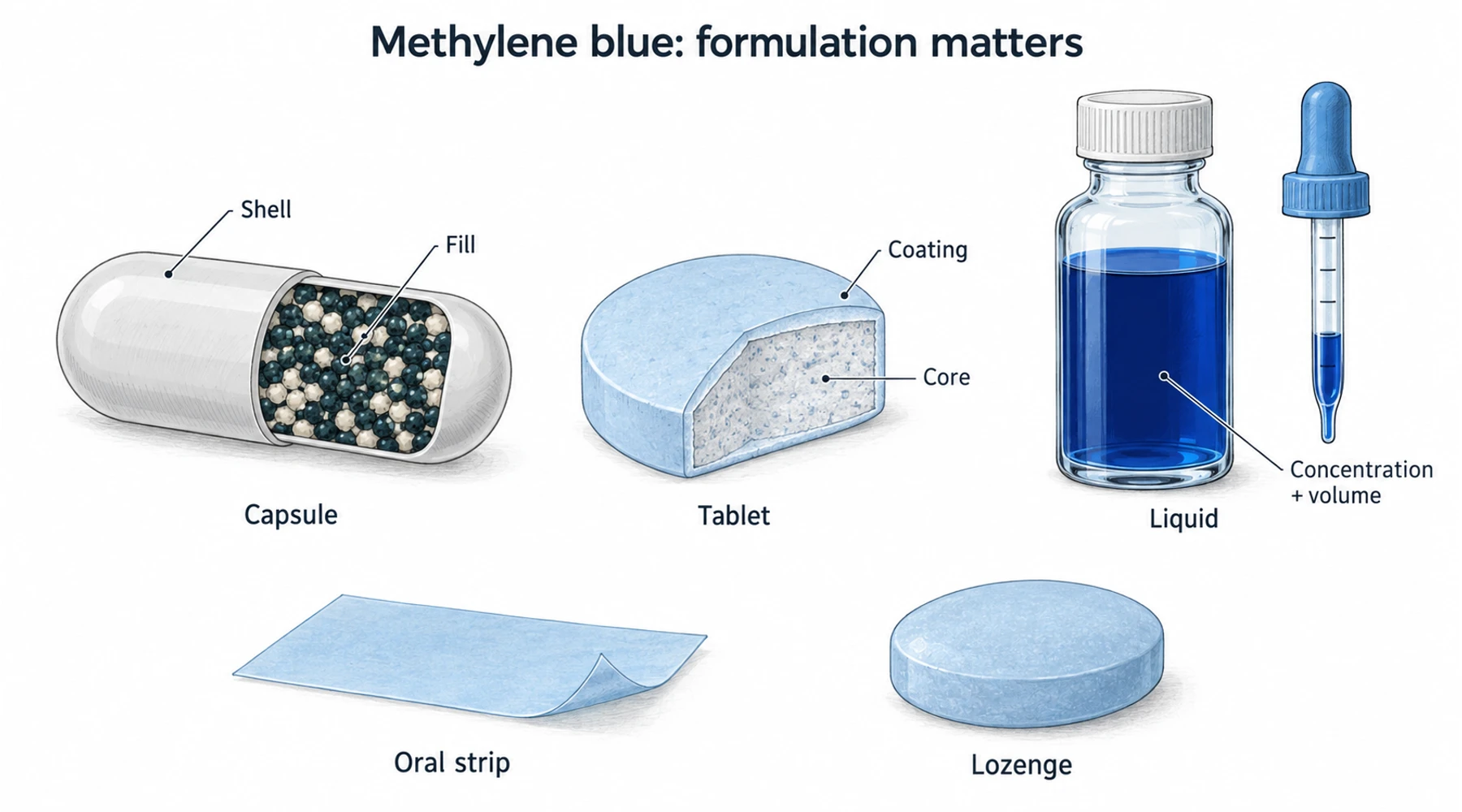
Methylene blue capsules and tablets offer a premeasured unit. Liquid drops require a concentration and a measured volume to establish an amount. That practical difference is clear. Which format delivers more methylene blue into the bloodstream is a separate question that requires evidence about the actual formulation.
A capsule, tablet, oral strip, or lozenge is a delivery system, not a quality grade. A convenient shape cannot establish ingredient identity, accurate contents, clinical benefit, or suitability for a particular person. Compare those questions separately before choosing a format.
What changes when methylene blue becomes a pill?
A capsule encloses a fill inside a shell. A tablet compresses ingredients into a solid unit, sometimes with a coating. Excipients are ingredients other than the active substance: they can provide bulk, hold a tablet together, help it break apart, or control release. Their presence is not automatically evidence of poor quality. Their identity and purpose should be disclosed.
An oral solution already contains dissolved material, so it does not need a capsule shell or tablet core to break apart. That removes one formulation step; it does not prove faster clinical effects or greater total absorption. The formulation still has a concentration, other ingredients, packaging, and storage requirements.
Release design can also be deliberate. The EMA description of Lumeblue documents a prescription methylene blue tablet used to improve visualization during colonoscopy. Its coating and slow release help deliver dye to the colon. This is a specific diagnostic medicine with a specific purpose. Its existence does not validate a retail tablet sold for unrelated uses, and its release behavior should not be assigned to every product called a tablet.
What absorption research can actually tell you
In Walter-Sack and colleagues' phase I study, 16 healthy volunteers participated in a randomized crossover comparison of intravenous methylene blue and an aqueous oral formulation. The researchers reported mean absolute bioavailability of 72.3%, with a standard deviation of 23.9%. Absolute bioavailability estimates how much reaches systemic circulation relative to intravenous administration, accounting for the amounts administered.
This supports substantial absorption of that tested aqueous formulation under those conditions. It does not establish a universal percentage for all dropper bottles. The study also did not directly compare contemporary retail capsules, tablets, oral strips, and lozenges.
Comparisons across unrelated studies can mislead when the dose, participants, food conditions, sampling schedule, or analytical method differ. A higher reported percentage in a separate paper is not enough to rank two commercial products.
The ICH M13A bioequivalence guidance explains why product comparisons assess exposure measures such as peak concentration and area under the concentration-time curve. Peak concentration describes the highest measured level; area under the curve summarizes exposure over time. A formulation can change the timing of exposure without a proportional change in its total extent.
For a seller claiming superior absorption, ask for the tested product's full composition, route, comparator, study population, and measured endpoint. A dissolution video shows material dispersing. It does not measure absorption in a person.
Format comparison: labels, ingredients, evidence, handling
This table is a purchasing aid, not a ranking of clinical effectiveness. Entries describe what to check; actual products vary.
| Format | Dose labeling to check | Excipients to identify | Documentation to request | Handling difference |
|---|---|---|---|---|
| Capsule | Milligrams per capsule and capsules per stated serving | Shell material, fill ingredients, added actives | Finished-unit assay, content uniformity, release information, batch identity | Portable fixed unit; swallowing requirements and instructions about opening matter |
| Tablet | Milligrams per tablet; immediate, delayed, or prolonged release; any validated subdivision | Binders, diluents, disintegrants, lubricants, coating | Assay, uniformity, disintegration or dissolution as applicable; evidence for splitting if claimed | No liquid measurement; crushing or splitting may change delivery |
| Liquid drops | Milligrams per milliliter, defined concentration basis, measured serving volume | Solvent, preservatives, flavorings, other actives | Finished-solution concentration, relevant impurity and microbial testing, packaging and stability information | Requires measurement; spills and contact staining are practical considerations |
| Oral strip | Milligrams per complete strip and strips per serving | Film-forming ingredients, plasticizers, sweeteners, flavorings | Unit-content uniformity, stability, disintegration; human data for any absorption claim | Small unit; packaging and moisture instructions matter; do not assume cutting preserves dose accuracy |
| Lozenge | Milligrams per lozenge, serving size, intended administration | Sugar or sugar-free base, binders, flavors, added actives | Unit-content uniformity, release behavior, route-specific human evidence | Dissolves in the mouth; contact time and swallowing behavior differ from an intact capsule |
You can download the comparison and supplier worksheet to record evidence for two candidate products.
Read the unit before comparing the number
“Milligrams per serving” may refer to several capsules or strips. “Milligrams per bottle” refers to the entire container. Neither automatically describes one unit. For liquid, the amount in a measured portion follows concentration multiplied by volume; a drop count needs a validated relationship to volume for the supplied dispenser.
An illustrative label reading “12 mg per serving; serving size 3 capsules” declares 4 mg per capsule, assuming its contents match the label. It does not declare 12 mg in each capsule. This is label arithmetic, not a suggested amount to take.
Ask what substance basis the stated milligrams use when labels or certificates specify different chemical forms or assay conventions. Comparing bottle prices before resolving unit and chemical identity can produce a meaningless value comparison.
Premeasured units also depend on manufacturing consistency. An assay of pooled material can describe an average while leaving unit-to-unit variation unanswered. The question is whether individual finished units consistently meet the stated specification, not merely whether the raw ingredient passed a purity test.
Strips and lozenges: dissolving is not an absorption result
“Oral,” “sublingual,” and “buccal” are not interchangeable descriptions. Sublingual means under the tongue; buccal refers to placement against the cheek. A product that dissolves in saliva may then be swallowed. Its disappearance from the mouth does not establish how much crossed the oral mucosa.
The FDA guidance on orally disintegrating tablets treats disintegration as a dosage-form characteristic. It is not a certificate of superior bioavailability. For methylene blue strips or lozenges, ask for human pharmacokinetic evidence using the actual formulation and intended route. The sources located for this comparison did not establish that commercial strips or lozenges outperform capsules or liquid.
Check all ingredients rather than treating a “sugar-free” or “fast-dissolving” claim as a complete formulation description. Methylene blue gummies have their own ingredient and testing questions.
Choose documented suitability, then convenience
Do not improvise fractional units by opening capsules or cutting strips. For tablets, the FDA's tablet-splitting advice explains that a product without evaluated splitting instructions has not necessarily demonstrated equal drug content or equivalent behavior in its halves. Modified-release designs need particular care.
Changing format also does not remove methylene blue's pharmacology. Medication compatibility remains relevant; use the methylene blue interaction guide when preparing questions for a clinician or pharmacist. The EMA's oral diagnostic product also has contraindications including G6PD deficiency and pregnancy, illustrating why “oral” does not mean unrestricted suitability.
For the purchasing decision, first establish intended use, legal product status, clear labeling, and batch-linked finished-product evidence. Then compare swallowing, measurement, portability, ingredients, and packaging against the actual need. The buyer's comparison checklist provides the broader quality framework. A capsule may solve a handling problem; a liquid may solve a measurement requirement. Neither conclusion establishes absorption equivalence or clinical benefit.