
Article
Methylene Blue Injections and IV Infusions
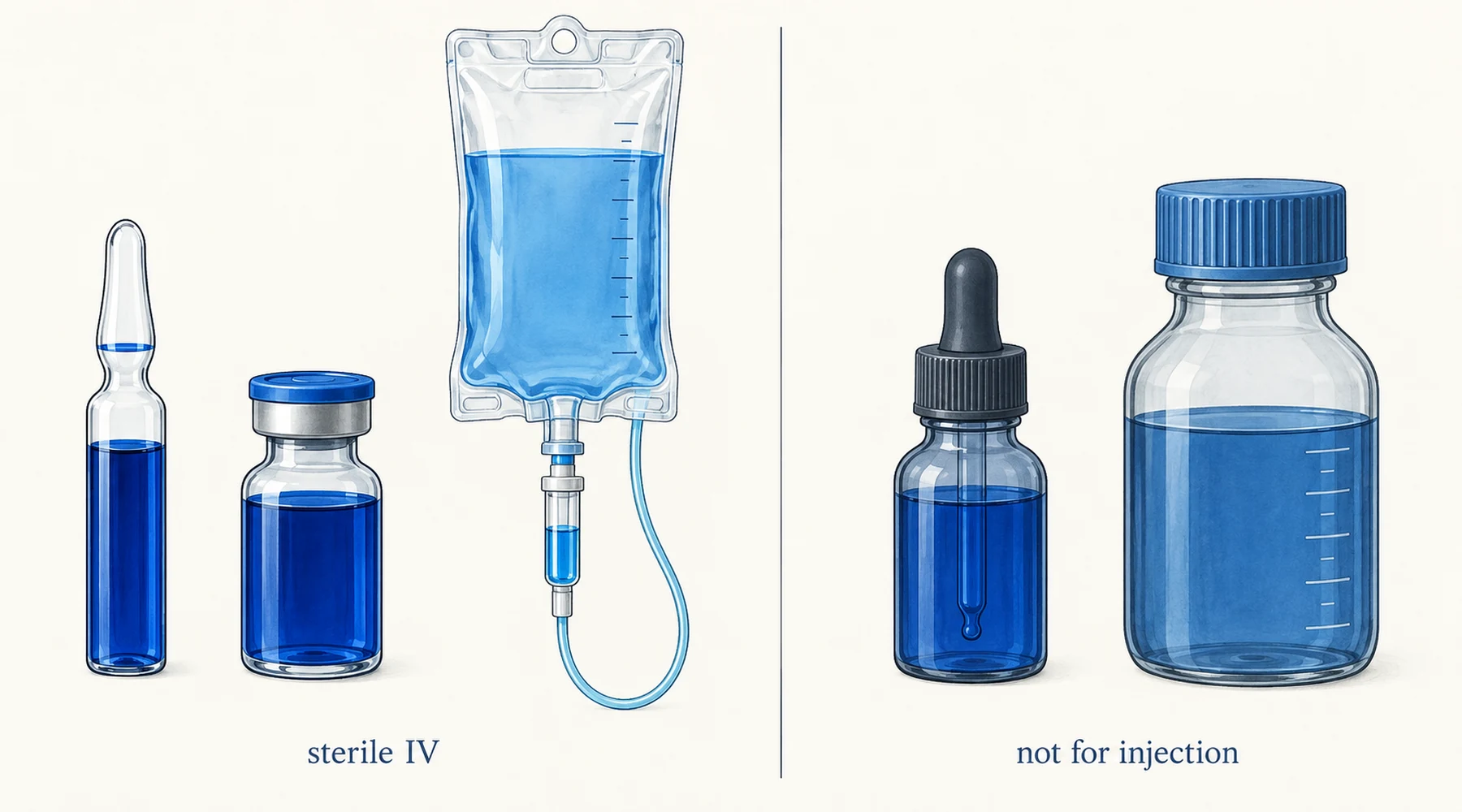
Two vials of deep blue liquid can look identical on a countertop. One is a sterile injection made for veins. The other is an oral dropper, a laboratory stain, or an aquarium product that must never enter a vein. The color tells you nothing. The formulation tells you everything.
This is the central concept of this article: chemical identity is not the same as injectable suitability. A solution can contain genuine methylene blue at high chemical purity and still be unfit for injection, because injections must also be sterile, low in bacterial toxins, controlled for particles, and packed in a suitable container. Keep that distinction in mind and the rest of this guide falls into place.
The approved sterile injection
The reference product is ProvayBlue, a prescription methylene blue injection approved for acquired methemoglobinemia in adults and children. Its strength is 5 mg/mL (0.5%), expressed on a methylene blue trihydrate basis, supplied as 10 mg in 2 mL and 50 mg in 10 mL single-dose ampules or vials. The only inactive ingredient is Water for Injection, with a solution pH of 3.0 to 4.5, as described in the current ProvayBlue label on DailyMed.
Several generic equivalents now reference that product, so ProvayBlue is a brand name rather than the only approved injection. One caution: a product page on DailyMed does not by itself prove FDA approval. At least one marketed 1% methylene blue injection states on its own label that FDA has not found it safe and effective. Check for approval status and the words sterile and single-dose rather than assuming any blue vial qualifies.
Dosing under the approved label is narrow. Adults and children receive 1 mg/kg intravenously over 5 to 30 minutes, which equals 0.2 mL/kg of the 5 mg/mL solution. If methemoglobin stays above 30% or symptoms persist, one further 1 mg/kg dose may follow after an hour. If two doses do not resolve the problem, the label points to alternative interventions rather than more methylene blue. Patients with moderate or severe kidney impairment receive only a single 1 mg/kg dose, because exposure rises steeply as renal function falls.
Administration has its own rules. The product is for intravenous use only and must not be given under the skin. The solution is hypotonic, so it may be diluted in 50 mL of 5% dextrose to reduce local pain, especially in children, and the diluted solution should be used immediately. It must not be diluted in sodium chloride solutions, because chloride lowers the solubility of methylene blue. Inspect each container, use the contents of a single-dose ampule or vial once, and discard the rest. Storage is at room temperature, protected from light, without refrigeration or freezing.
Readers who want background on what the molecule does once it reaches the blood can start with how methylene blue acts in the body, which keeps the pharmacology separate from the formulation questions covered here.
Off-label infusions use the same molecule under different rules
Beyond methemoglobinemia, clinicians sometimes give methylene blue intravenously for conditions such as vasoplegia after cardiac surgery or septic shock, where its effects on vascular tone are under study. These protocols typically involve different doses, continuous infusions, or repeated administration that do not match the approved two-dose regimen. That makes them off-label uses: the drug product may be an approved injection, but the regimen itself is not the FDA approved one. Early trial evidence in vasoplegia and septic shock shows why researchers are interested, and also why dosing remains investigational rather than settled.
Compounded infusions add a second layer of difference. A compounded preparation can differ in final concentration, diluent, container, excipients, and beyond-use time, and compounded drugs as a category are not FDA approved for safety or effectiveness, as FDA explains in its compounding questions and answers. Whether the syringe holds a branded, generic, or compounded preparation, the molecule carries the same hazards described in the approved labeling, including serotonin interactions, hemolysis risk, and light sensitivity, which the next sections cover.
Why grade alone does not make a liquid injectable
This is where most confusion happens. A retail solution may advertise USP grade methylene blue, show an assay above 98%, and still be unsuitable for injection. Chemical grade describes the powder: identity, assay, organic impurities, residual solvents, metals, and similar tests. An injectable must pass those tests and additional parenteral requirements that grade alone never covers.
| Requirement | Approved sterile injection | Retail oral or laboratory solution |
|---|---|---|
| Sterility | Manufactured aseptically and tested sterile | Not manufactured or tested as sterile |
| Bacterial endotoxins | Controlled within a pyrogen limit | Not tested; fever or shock risk if injected |
| Particles and container | Controlled particles, sealed single-dose glass | Dropper or bulk bottles, uncontrolled particles |
| Indication and oversight | Prescription use for a labeled indication | Oral, topical, aquarium, or lab use only |
| Label clarity | States sterile, route, and single-dose handling | No injectable route; must never be injected |
Each row blocks a different failure. Non-sterile liquid can seed bloodstream infection. Endotoxins from dead bacteria survive simple filtering and can trigger violent fever or shock. Particles and precipitates can lodge in small vessels. An unsuitable container can leach or fail to hold a seal. None of these defects change the blue color or the assay number, which is exactly why visual inspection and a purity percentage cannot qualify a product for veins. For the full picture of what complete purity testing covers, see how USP grade is verified.
The practical rule is short: never inject an oral, aquarium, or laboratory methylene blue product, regardless of its stated purity. Injection requires a product manufactured, tested, labeled, and prescribed as an injection.
Safety points carried over from the approved label
The approved labeling concentrates the risks worth knowing before any intravenous use. First is serotonin syndrome, which carries a boxed warning: methylene blue inhibits monoamine oxidase, so combining it with serotonergic antidepressants, certain opioids, and related drugs can provoke a serious or fatal reaction. Patients are told to avoid such drugs for 72 hours after the last dose unless a clinician judges co-administration unavoidable and monitors closely.
Second is glucose-6-phosphate dehydrogenase deficiency, which is a contraindication: affected patients risk severe hemolysis, and the drug may not work because its action depends on an enzyme pathway these patients lack. Severe allergy to methylene blue or another thiazine dye is the other contraindication.
Further cautions include renal impairment with higher systemic exposure, fetal harm with intra-amniotic exposure and a monitoring list for exposed newborns at term, and reported phototoxicity that calls for protection from light. Two monitoring quirks matter in hospitals: the blue color falsely lowers pulse oximeter readings, so arterial blood analysis is preferred, and it can disturb anesthesia depth monitors and blue-dye urine tests. In the adult safety dataset of 31 patients, serious reactions occurred in about 3%, and the reactions seen in at least 2% included headache, nausea, diarrhea, low potassium and magnesium, muscle jerks, and seizure-like events.
None of this is an argument for or against any particular off-label protocol. It is a reminder that the risk profile travels with the molecule, whatever the infusion bag says.
What to verify before any IV use
If you are a patient or caregiver, confirm four things with the treating team: that the product is a sterile injection approved or compounded for intravenous use, that the indication and dose follow a deliberate protocol, that serotonergic medicines and G6PD status were reviewed, and that monitoring covers oxygen measurement by blood analysis rather than pulse oximetry alone. If anyone suggests injecting a retail dropper or laboratory solution, treat that as a hard stop and ask for the hospital pharmacy instead.
Formulation is the concept, and the label is the contract. Match the liquid to the route, and the blue color stops being a source of confusion.