
Article
Methylene blue for vasoplegia and septic shock: what the clinical trials show
A patient leaves the operating room after heart surgery with a normal cardiac output and a blood pressure that will not hold. In another bed, a patient with severe infection needs ever larger doses of norepinephrine to keep pressure above target. Both cases involve vessels that have lost their tone, and both have led intensivists to try methylene blue. This article reviews what the clinical trials actually tested and what they found.
Two distinctions organize everything below. First, vasoplegia after cardiac surgery and septic shock are different diseases with different trial designs, so each gets its own section. Second, needing less vasopressor is not the same as surviving more often. Most trials measured the first; almost none were large enough to settle the second.
Why methylene blue might raise vascular tone
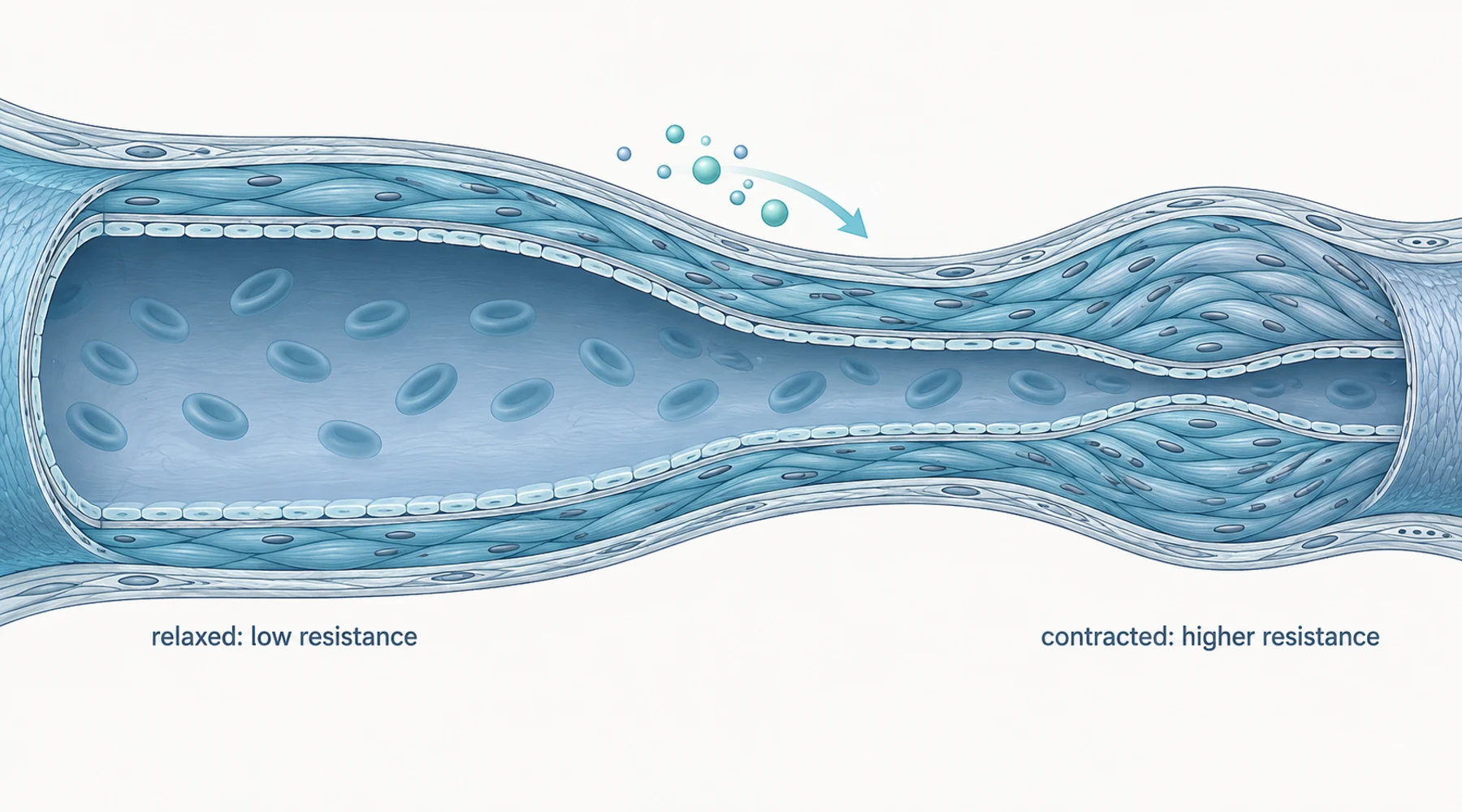
Arteries narrow and widen as their smooth muscle contracts and relaxes, and that diameter sets much of systemic vascular resistance. One relaxation signal runs from nitric oxide through soluble guanylate cyclase to cyclic GMP, which promotes relaxation. Methylene blue interferes with this pathway, which is why it can oppose the profound vasodilation of shock. The pharmacology is broader than a single clean blockade: in experimental work on nitric oxide synthesis and vessel relaxation, methylene blue acted at more than one point in the signaling chain. That work explains a plausible mechanism. It does not predict any individual patient's pressure response.
Every trial below used intravenous methylene blue in a hospital, on top of standard intensive care. Nothing here tests an oral product taken at home.
Vasoplegia after cardiac surgery
Vasoplegia here means severely reduced vascular tone following cardiopulmonary bypass: low pressure and low resistance despite preserved cardiac output. The randomized evidence for treating established vasoplegia rests largely on one small trial. Two further trials tested methylene blue before or during surgery to prevent vasoplegia, which is a different clinical question.
In Levin and colleagues' randomized trial of established postoperative vasoplegia, 56 patients were assigned to 1.5 mg/kg infused over one hour or to placebo. Vasoplegia resolved rapidly in the treated group, while 8 of 28 placebo patients remained vasoplegic beyond 48 hours, and deaths were 0 of 28 against 6 of 28. The shock reversal result is striking, but 56 patients cannot establish a survival effect, and the mortality gap is too fragile to generalize.
Prevention trials point in mixed directions. In Ozal and colleagues' study of high-risk coronary bypass patients, preoperative infusion reduced vasoplegia from 13 of 50 to 0 of 50. Maslow and colleagues found a shorter lived intraoperative effect during bypass, while Cho and colleagues found essentially no hemodynamic or vasopressor advantage. Prevention in selected surgical patients and rescue of established vasoplegia should be read as separate claims with separate evidence.
Septic shock
Septic shock combines infection with circulatory failure that persists after fluids, so norepinephrine becomes the backbone of care and trials ask whether methylene blue shortens catecholamine exposure. The signal is more consistent than in surgery but still heterogeneous, and it concerns vasopressor sparing rather than survival.
The largest modern trial is Ibarra-Estrada and colleagues' 2023 randomized study of early adjunctive methylene blue, in which 91 analyzed adults received a six-hour infusion daily for three doses or a matched placebo, on top of norepinephrine, hydrocortisone, and vasopressin as indicated. Median time to stopping vasopressors was 69 hours against 94 hours, while mortality and ventilation duration were similar. Earlier trials were smaller: Kirov and colleagues' 20-patient pilot showed large catecholamine reductions with a 2 mg/kg bolus followed by escalating infusions, and Memis and colleagues found a higher post-infusion mean arterial pressure (85 against 74 mmHg) without a vasopressor sparing endpoint. Against these, a 72-patient placebo controlled trial by Dong and colleagues found no meaningful norepinephrine or pressure advantage, and one comparison found vasopressin superior to methylene blue as the second vasopressor at 12 and 24 hours. Dose finding work by Juffermans and colleagues showed pressure and resistance rising with dose, with impaired splanchnic perfusion as a concern at 7 mg/kg.
Trial table
IV means intravenous. NE means norepinephrine. MAP means mean arterial pressure. SVR means systemic vascular resistance. Each row is a study exposure, not a treatment recommendation.
| Trial and setting | Regimen | Vasopressor outcome | Hemodynamic outcome | Mortality | Adverse events |
|---|---|---|---|---|---|
| Levin 2004: established vasoplegia after cardiac surgery, 28 against 28 | 1.5 mg/kg IV over 1 hour | Vasoplegia gone in all treated patients within 6 hours; 8 of 28 controls affected beyond 48 hours | Rapid MAP and SVR recovery in treated group | 0 of 28 against 6 of 28; too small to establish a survival effect | No major toxicity signal reported at this regimen |
| Ozal 2005: prevention in 100 high-risk bypass patients, 50 against 50 | 1 percent solution infused starting 1 hour before surgery | Vasoplegia 0 of 50 against 13 of 50; prevention, not rescue | Higher intraoperative pressures in treated group | Not a mortality trial | No major toxicity signal reported |
| Cho: prophylactic methylene blue in cardiac surgery | Perioperative infusion | No significant vasopressor difference | MAP and SVR not significantly different | Not a mortality trial | No dedicated adverse event rate reported |
| Kirov 2001: septic shock pilot, 10 against 10 | 2 mg/kg bolus then stepwise infusion to 5.75 mg/kg total | NE reduced up to 87 percent; epinephrine down 81 percent; dopamine down 40 percent | MAP significantly higher at 6 and 24 hours | 28-day deaths 5 of 10 against 7 of 10; not a mortality trial | Blue urine and skin discoloration; no major organ toxicity signal |
| Memis 2002: severe sepsis, 15 against 15 | 0.5 mg/kg per hour for 6 hours | No quantitative sparing endpoint | Post-infusion MAP 85 against 74 mmHg | Not powered for mortality | No major toxicity signal reported |
| Ibarra-Estrada 2023: septic shock, 91 analyzed | Six-hour infusion daily for three doses | Median time off vasopressors 69 against 94 hours | Pressures managed to target in both arms | Mortality similar between arms | Blue or green urine common; G6PD deficiency and recent SSRI use were exclusions |
| Dong 2025: ventilated septic shock, 36 against 36 | 2 mg/kg over 15 minutes plus 1 mg/kg over 12 hours | NE difference near zero; no difference in time off pressors | MAP difference minus 1.2 mmHg, not significant; microvascular flow improved | 28-day deaths 9 of 36 against 15 of 36, not significant | Blue or green urine in all treated patients; no hepatic, renal, or oxygenation signal |
Does any of this show fewer deaths?
Pooled analyses have looked more favorable than the individual trials, but the favorable estimates weaken under scrutiny. A 2024 synthesis of six septic shock trials found a short-term mortality risk ratio of 0.66, yet the effect lost significance once high risk of bias trials were excluded. The most current RCT-only synthesis, covering nine trials and 535 patients, found a 28 to 30 day mortality odds ratio of 0.73 with a confidence interval from 0.40 to 1.36, which is not significant, and its trial sequential analysis estimated that 1,773 patients would be needed against the few hundred available. The honest summary is that a survival benefit is unproven, not that it has been disproven.
Safety notes from the hospital evidence
The common effects in trials were blue or green urine and skin discoloration, with modest methemoglobin elevation. The serious risks come from the licensed intravenous product information rather than from trial event counts: serotonin syndrome when combined with serotonergic medicines or opioids, a contraindication in G6PD deficiency because of hemolysis risk, falsely low pulse oximeter readings during and shortly after infusion, and hypertension as a reported adverse reaction. Several modern trials excluded patients with G6PD deficiency or recent serotonergic drug exposure, so their clean safety tables do not measure risk in those groups. This evidence also belongs next to the broader overview of clinical uses and the safety assessment; readers unfamiliar with trial design may start with the guide to reading methylene blue research.
Vasoplegia and septic shock may yet warrant separate in-depth reviews if the evidence grows, but the current literature fits one critical care review: a real vasoconstrictor and pressor sparing effect, clearest in established vasoplegia and early septic shock, with no demonstrated survival gain and with safety boundaries that exclude several patient groups. Anyone facing these conditions is already in intensive care, and methylene blue in this setting is an ICU decision made by the treating team, not a home treatment inferred from hospital infusions.