
Article
Methylene blue in medicine: authorized uses and investigational applications
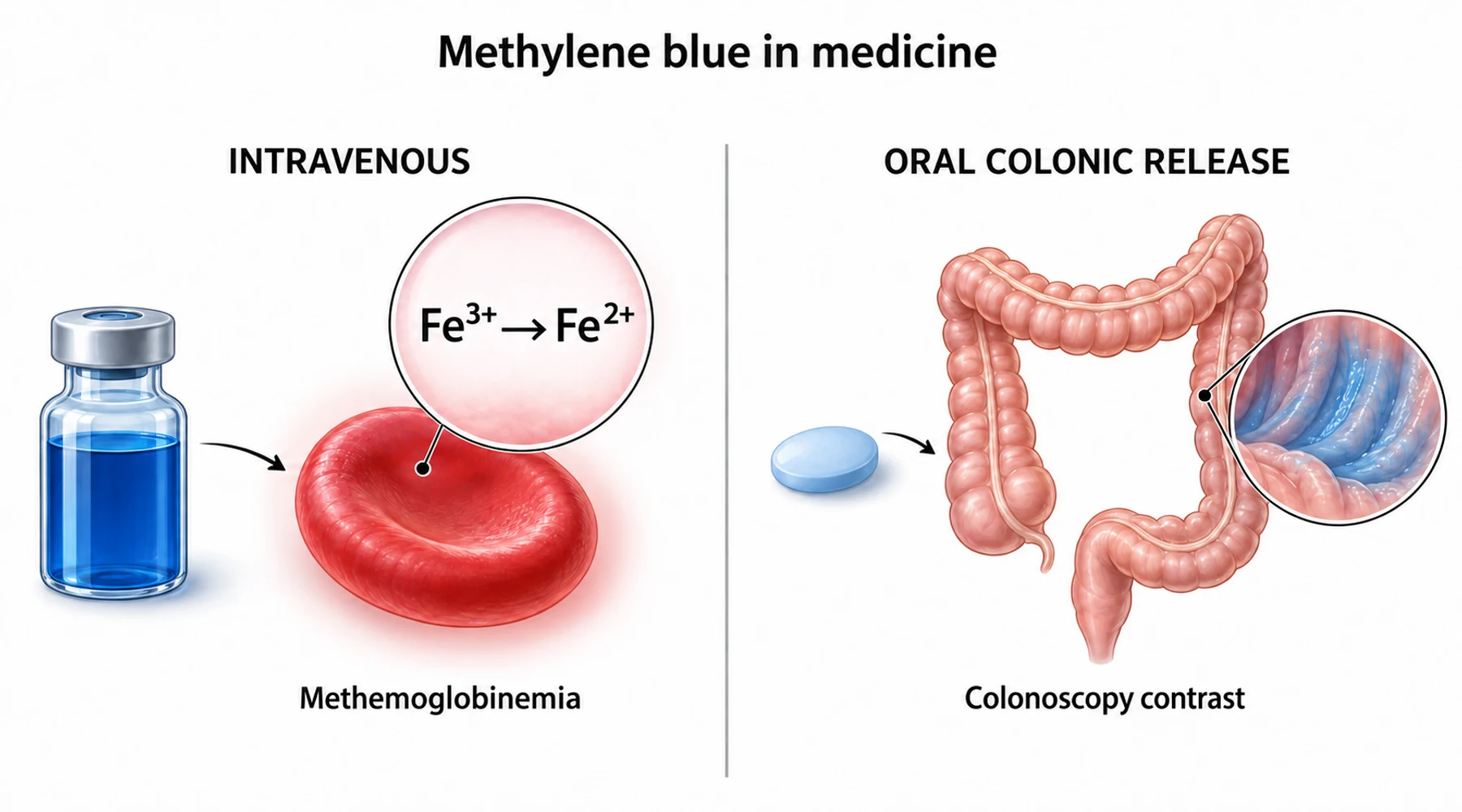
Methylene blue has established medical uses, but authorization belongs to a particular product and indication. An injectable antidote, a tablet designed to stain the colon, and an experimental oral treatment are different interventions, even when they contain related chemistry.
In the United States, the ProvayBlue prescribing information identifies acquired methemoglobinemia as its indication in adults and children. The European Union also authorizes a different formulation, Lumeblue, to improve visualization during colonoscopy. Neither authorization establishes that retail methylene blue drops treat an unrelated disease.
Read the authorization and evidence fields separately
Authorized use means the named product's authorization covers the indication, route, and patient group described. Off-label use means an authorized medicine is used outside its labeling. Investigational use means researchers are evaluating an application. An application can be both off-label in clinical practice and investigational in trials.
These descriptions do not rank evidence by themselves. A small trial can provide a useful signal without establishing routine benefit. Conversely, an established antidote for an uncommon emergency may be supported by clinical experience and patient series rather than the large placebo-controlled trials expected for chronic disease.
The matrix below checks named US, EU, and UK product records as of 12 September 2026. It is a clinical orientation, not an exhaustive register of every national product. For research rows, “outside reviewed labels” refers to the named methylene blue medicines above, rather than a claim about every jurisdiction or device authorization.
Clinical-use matrix
| Use | Jurisdiction and authorization | Route and formulation | Human evidence and its boundary |
|---|---|---|---|
| Acquired methemoglobinemia | US: ProvayBlue is FDA-approved for adults and children. | Intravenous, sterile 5 mg/mL solution. | Label-supported treatment of abnormal hemoglobin oxidation; does not establish treatment of ordinary fatigue or lung disease. |
| Medicine- or chemical-induced methemoglobinemia | EU: Proveblue is authorized for acute symptomatic treatment, including children. | Intravenous, 5 mg/mL injection. | Established antidote indication with product-specific restrictions. Congenital disease is not the indication stated here. |
| Medicine- or chemical-induced methemoglobinemia | UK: covered by the Proveblue SmPC, including adults and children. | Intravenous, 5 mg/mL injection. | The UK product information specifies clinical administration and monitoring; other routes are not interchangeable. |
| Colorectal lesion visualization | EU: Lumeblue is authorized for adult screening or surveillance colonoscopy. | Oral 25 mg prolonged-release tablets, designed for colonic release. | A comparative study improved adenoma/carcinoma detection. This is a diagnostic aid, not cancer treatment. |
| Vasoplegia after cardiac surgery | US/EU/UK: outside reviewed injection labels; specialist off-label use. | Intravenous methylene blue in hospital protocols. | Levin and colleagues randomized 56 patients with postoperative vasoplegia. Small trials concern selected surgical populations, not all causes of low blood pressure. |
| Septic shock | US/EU/UK: outside reviewed labels; investigational adjunct. | Intravenous solution added to standard intensive care. | A 91-patient randomized trial shortened vasopressor treatment; mortality was similar. |
| Ifosfamide-associated encephalopathy | US/EU/UK: outside reviewed labels; specialist off-label treatment or prophylaxis. | Intravenous methylene blue in reported oncology practice. | Pelgrims and colleagues reported 12 cases, eight treated with methylene blue. Nonrandomized recovery cannot establish the treatment effect. |
| Sentinel lymph-node mapping | US/EU/UK: outside reviewed antidote labels; procedural use requires its own product and local assessment. | Local tissue injection of surgical dye solution; not systemic antidote delivery. | A UK prospective comparison in 329 patients evaluated node identification with dye alone or dye plus radiotracer. Accuracy is procedure-specific. |
| Urinary symptom combination products | US: the inspected Uribel Tabs record lists an unapproved drug, despite prescription labeling. | Oral multi-ingredient tablets containing methylene blue and other active ingredients. | A listed label is not FDA approval. Combination-product claims cannot establish that methylene blue alone treats infection. |
| Memory and neurological research | US/EU/UK: outside reviewed methylene blue labels; investigational. | Oral methylene blue in short experiments; distinct methylthioninium formulations in dementia trials. | A 26-person healthy-volunteer trial measured short-term task and imaging changes. It did not test dementia treatment or lasting everyday benefit. |
| Malaria transmission reduction | Trial in Mali; not an indication in reviewed US/EU/UK labels. | Oral methylene blue added to a specified antimalarial combination. | An 80-participant phase 2 trial studied mosquito infectivity in G6PD-normal males with asymptomatic infection. Findings do not establish standalone treatment of severe malaria. |
| Periodontal photodynamic treatment | Trial in Iraq; not an indication in reviewed systemic medicine labels. Local device/formulation status requires separate verification. | Methylene blue applied locally with activating light, alongside mechanical treatment. | An 18-patient split-mouth trial reported periodontal improvements. The 332 measured sites were not 332 independent patients. |
Why the route changes the clinical question
In methemoglobinemia, hemoglobin iron has been oxidized from its functional ferrous state, Fe²⁺, to ferric iron, Fe³⁺. Methylene blue participates in a reduction pathway that helps restore functional hemoglobin. The Proveblue pharmacology description explains this conversion. The clinical target is a specific blood abnormality, not a general shortage of energy. Our explanation of hospital treatment for methemoglobinemia follows that distinction in detail.
Lumeblue uses a different property: staining. Its coating delays release so dye can color the bowel lining during preparation for examination. The EMA's assessment summary reports detection in 56% versus 48% of participants in the principal comparison. The measured benefit was finding lesions, confirmed by tissue examination. It was not shrinkage of a tumor or an observed reduction in cancer deaths.
That distinction also explains why a local surgical dye injection, oral liquid, and intravenous medicine cannot be substituted merely by matching the mass of dye. Site of exposure, sterility, release properties, and the procedure determine what the product does. The details belong in injections and intravenous formulations and surgical and diagnostic applications.
What the promising trial results actually establish
The septic-shock trial provides a useful example of reading past a favorable headline. It was a single-center, placebo-controlled study in which methylene blue was added early to existing treatment. Median time until vasopressors could be stopped was 69 hours with methylene blue versus 94 hours with placebo. Mortality and ventilator duration were similar. This supports further investigation of a vasopressor-sparing effect; it does not demonstrate a survival benefit. Vasoplegia and septic-shock trials require separate interpretation because their patients and causes of circulatory failure differ.
Neurological research adds a formulation problem. The 891-participant phase 3 LMTM trial studied leuco-methylthioninium bis(hydroxymethanesulfonate), a reduced methylthioninium formulation, over 15 months in mild-to-moderate Alzheimer's disease. Its prespecified primary analyses found no benefit on cognition or activities of daily living at the tested higher doses versus the low-dose control. Subgroup interpretations do not replace that primary result, and the formulation is not an ordinary bottle of methylene blue.
This is one trial within a continuing research program, not a verdict on every later compound or study. Read the Alzheimer's trial analysis for the evolving evidence. The same discipline applies to cancer research: killing cultured cells, improving an imaging endpoint, and helping patients live longer are different findings.
Safety is part of the formulation, not a separate checkbox
The US injection label warns about serious serotonin syndrome with serotonergic medicines and opioids, contraindicates use in G6PD deficiency, and describes interference with pulse-oximeter readings. These are practical reasons for clinicians to assess the actual medicine list and laboratory context. An apparently lower oxygen reading after exposure does not by itself show that oxygen delivery has worsened.
The UK SmPC additionally specifies contraindications for chlorate poisoning and certain nitrite-related circumstances. “Antidote” therefore does not mean appropriate for every poisoning. Severe breathing difficulty, collapse, or sudden confusion requires urgent assessment, not a home trial of blue dye.
For a proposed treatment, identify the exact product, route, diagnosis, and outcome first. Bring those details to the clinical conversation checklist and consult the side effects and contraindications guide. The useful question is whether evidence supports that specific intervention in that specific setting.