
Article
Methylene blue for mouth sores and sore throat: what the evidence supports
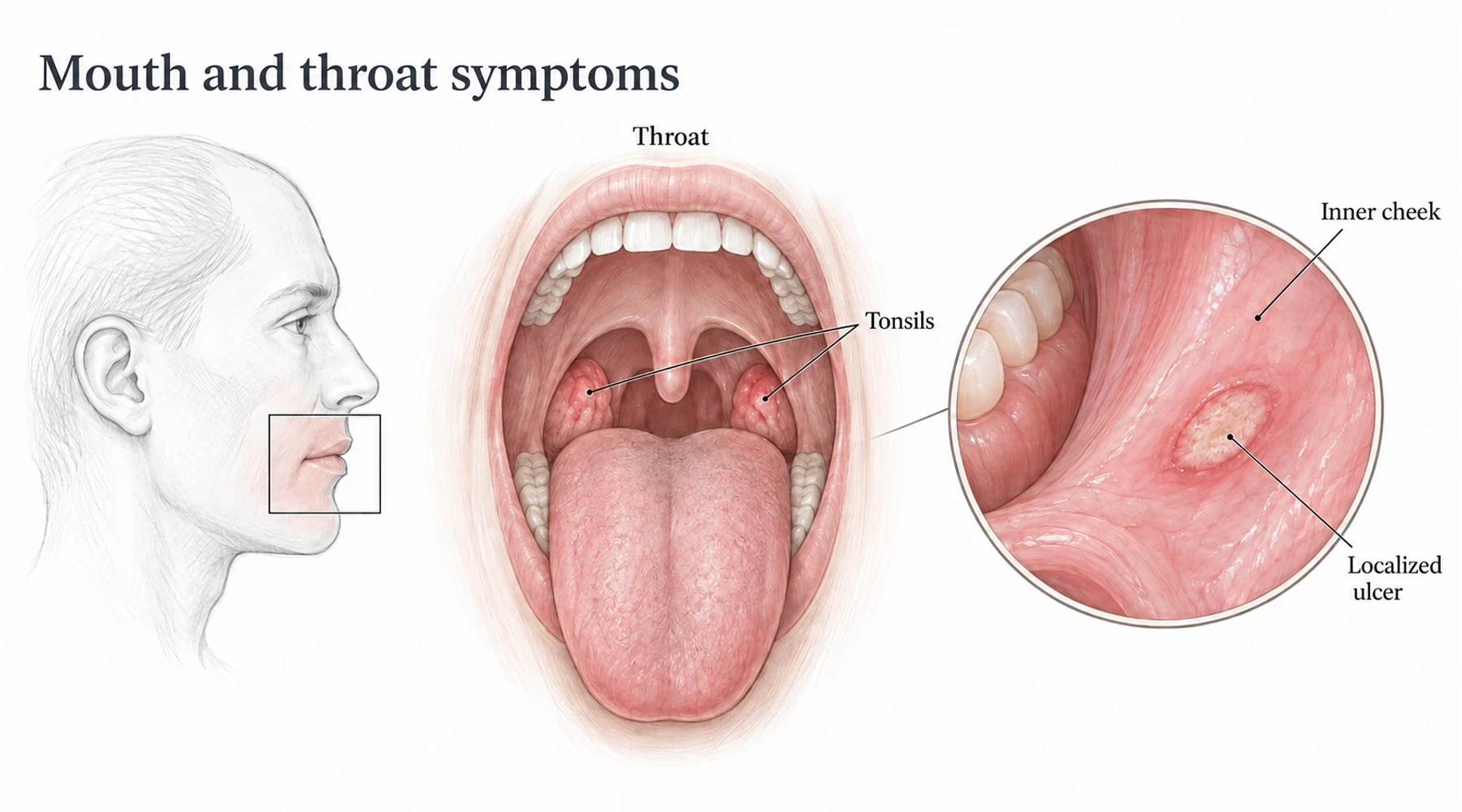
Methylene blue research does not establish a routine home treatment for an ordinary canker sore or sore throat. Studies of prescribed rinses for cancer-treatment pain and studies combining dye with dental light equipment address different conditions and interventions. They cannot validate swabbing an unidentified lesion with a retail solution.
The useful first question is what is causing the soreness. A shallow cheek ulcer, inflamed tonsils, and a fungal infection can all make eating uncomfortable. That shared symptom does not make their treatments interchangeable.
What does “mouth sore” mean?
A canker sore is an aphthous ulcer, a localized break in the mouth lining. It is not automatically a bacterial or fungal infection. An ulcer from a sharp tooth or cheek bite is another possibility. The NHS guide to mouth ulcers distinguishes these lesions from cold sores and describes several causes, including trauma and underlying conditions.
“Stomatitis” means inflammation of the mouth. It is a broad description, not the name of a single organism. A study indexed under stomatitis might concern recurrent aphthous ulcers, inflammation under dentures, or damage from cancer therapy. Reading only that keyword can produce a misleading treatment recommendation.
Tonsillitis affects the tonsils at the sides of the throat and can result from viral or bacterial infection. White spots do not make it equivalent to oral thrush. Oral thrush is a fungal infection that can cause white patches or a sore, red mouth and is treated with antifungal medicine. Appearance alone may not settle the diagnosis.
Symptom-to-evidence matrix
Use this matrix to organize a conversation with a dentist, pharmacist, or doctor. The first column identifies possibilities, not a diagnosis you can make from a photograph.
| Symptom and suspected condition | Methylene blue formulation or intervention | Setting and appropriate evidence | Referral question |
|---|---|---|---|
| Small painful ulcer inside the cheek or lip: aphthous or traumatic ulcer | Home swab or rinse of uncertain composition | Direct trials in diagnosed ordinary ulcers would be needed. Cancer-mucositis pain results do not establish healing or prevention here. | Is this a recurrent aphthous ulcer, or is a tooth, appliance, medicine, or another condition causing it? |
| Painful swallowing with inflamed tonsils: tonsillitis or pharyngitis | Laboratory light-activated methylene blue, sometimes studied with silver nanoparticles | Bacterial cultures from throat swabs are laboratory evidence. They are not a trial of treating patients' throats. | Does the examination suggest a bacterial infection, and is testing or specific treatment needed? |
| White patches or diffuse oral redness: possible Candida infection | Defined photosensitizer plus clinical light equipment | Dental trials in diagnosed candidiasis measure lesion response and microbial counts. An unilluminated household rinse is a different intervention. | Is Candida responsible, and which antifungal or other management is appropriate? |
| Widespread painful mouth lining during chemotherapy or radiotherapy: mucositis | Studied methylene blue oral rinse added to supportive care | Oncology trials mainly examine pain and oral function. They do not establish treatment of ordinary throat infection. | Could this be treatment-related mucositis, infection, or both, and is hydration or pain support needed? |
| Persistent, unusual, or repeatedly returning lesions, including a lacy white pattern | No formulation can be selected from this description | Diagnosis-specific evidence is required. Research on oral lichen planus cannot be transferred to every ulcer. | Does this need oral-medicine assessment or investigation before treatment? |
What the cancer mouth-rinse study actually showed
In a 2022 randomized phase 2 trial, 60 adults with cancer-treatment oral mucositis completed treatment. Three groups received different methylene blue rinse concentrations alongside conventional care; the comparison group received conventional care alone. The principal endpoint was change in pain over two days, with oral function also measured.
The methylene blue groups had larger average pain reductions, although one concentration's pairwise comparison was marginal at the conventional statistical threshold. Eight participants reported initial burning, and one discontinued treatment. This was a small, short trial of difficult cancer-related pain. It did not establish that the rinse eliminated an infection, prevented ulcer recurrence, or treated children with ordinary sores.
A 2026 open-label, non-randomized study adds useful context. Among 43 evaluable patients, people selected methylene blue or standard mouthwash. Both groups improved after administration, with no statistically significant difference in the pain reduction between groups. Patient choice and the absence of random allocation limit causal comparisons. The wider cancer-mucositis rinse evidence concerns a specific supportive-care problem.
Why light-activated studies do not support home swabbing
Photodynamic treatment combines a photosensitizer with a defined light exposure. The tested intervention includes the light delivery and clinical procedure, not just the dye's name.
A randomized trial in oral erythematous candidiasis analyzed 41 patients assigned to nystatin suspension or methylene-blue photodynamic therapy. It assessed clinical lesions and cultured microorganisms. Those endpoints address diagnosed candidiasis under dental treatment conditions. Neither a laboratory reduction in colonies nor an improved lesion establishes that an unspecified retail liquid works as a general mouthwash. The oral Candida evidence review separates clinical response from microbial clearance.
The same problem appears in throat claims. A study of laser-activated methylene blue and silver nanoparticles obtained throat swabs from 20 children, then tested antibacterial effects in vitro, outside the body. The children supplied specimens; they were not treated with the experimental intervention. Its authors explicitly called for further work before considering treatment in children.
These are examples of why antimicrobial research needs to be read alongside the diagnosis, formulation, route, and endpoint. A positive finding in one setting does not answer a different clinical question.
Formulation and swallowing matter
A bottle labeled “methylene blue” does not identify a mouth medicine. Concentration, solvent, other ingredients, manufacturing specification, and intended route all matter. An aqueous solution, a skin preparation, a laboratory stain, an aquarium product, and a pharmacy-prepared oral rinse are not interchangeable merely because they contain the same dye. A purity claim does not supply oral-use instructions or evidence of benefit.
“Topical” also does not guarantee that none is swallowed. Bring the exact container or label to the pharmacist or prescriber. The prescribing information for intravenous methylene blue identifies serious concerns involving serotonergic medicines, G6PD deficiency, and pregnancy. That injection label does not quantify the risk of a particular mouth application; it explains why route-specific assessment cannot be replaced by assuming local use is harmless.
For accidental ingestion of an unknown preparation or amount, contact a poison information service or urgent medical service with the product, estimated amount, time, and person's age. Do not induce vomiting. The NHS poisoning guidance explains why suspected harmful exposure needs prompt advice even before symptoms develop.
Questions about babies and children
If a prescription or handwritten note is unclear, ask the prescriber or dispensing pharmacist to confirm the diagnosis, exact preparation, intended route, and instructions before using it. Do not reconstruct a regimen from an adult paper or another parent's experience. A young child may be unable to rinse and spit reliably, and an infant's feeding difficulty changes the assessment.
The children's evidence guide addresses these age-specific gaps. Pregnancy and breastfeeding questions also require their own assessment. For either situation, the practical starting point is the actual product and clinical problem, as outlined in questions to ask a clinician about methylene blue.
When assessment should come first
Seek emergency help for breathing difficulty, inability to swallow, drooling because swallowing is impaired, noisy high-pitched breathing, or rapidly worsening severe symptoms. Seek urgent advice for dehydration, marked fever, or a sore throat in someone with a weakened immune system. These are NHS sore-throat escalation criteria, not situations to test a throat remedy.
Arrange a dental or medical examination for an ulcer lasting longer than three weeks, an unusual or bleeding lesion, or one becoming more painful and red. A sore throat that does not improve after a week also deserves assessment. Persistent white lacy lesions may need a different diagnostic pathway, including evaluation for conditions discussed in oral lichen planus research.
For uncomplicated symptoms, a pharmacist can help select an appropriate pain-relief option. The decision should follow the likely cause and the person's age and medicines, rather than the color of a traditional remedy.